Varnish and resin filtration — the filter change is called by the real pressure curve, not the clock.
In varnish, resin and ink filtration, a fixed change interval has only two endings: either you change too early — filters, downtime and held-up product paid for nothing — or too late, and haze slips into packaging. The differential pressure that tells the truth is already on the gauges; what is missing is someone watching it continuously. iLEAN captures every filter's curve, learns how each product fouls and flags the real change window — and the sudden drop that betrays a burst element. The person calls the change — the lot is never released on its own.
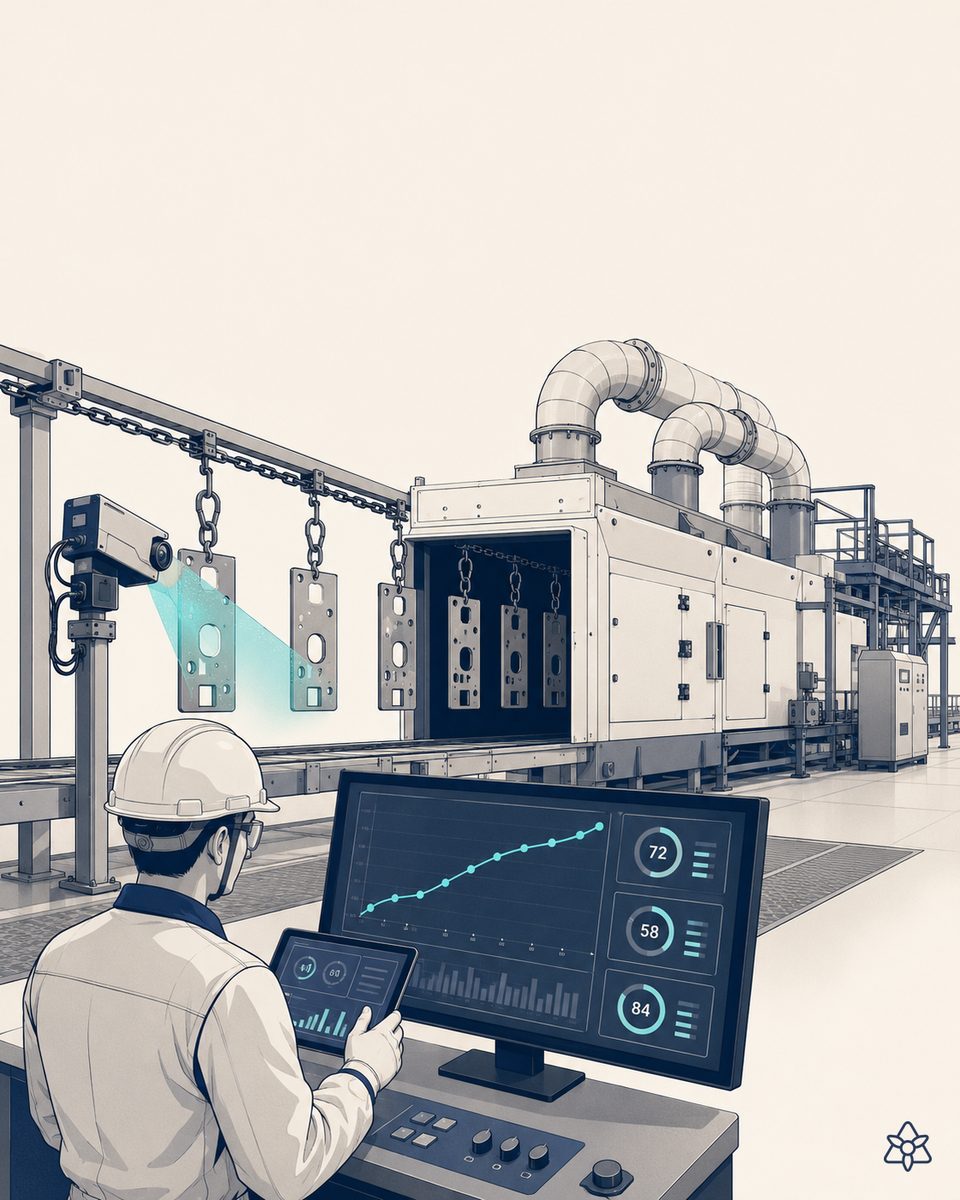
The gauge tells the truth about the filter. The change schedule never listens to it.
Between the reactor or dispersion tank and packaging, the varnish passes through filters — bag, cartridge, plate — whose job is to hold back gels, skins, particles and grinding residue. The life of each element depends on the product, the lot and the upstream process. On the floor, however, the change is decided like this:
- Fixed interval by hours or batches — inherited, conservative and blind: the same for the pigmented varnish that loads the filter fast and for the clear one that barely touches it.
- Changing too early costs hard cash — elements discarded at half life, line stops for the change, and the product held up in every discarded bag or cartridge.
- Changing too late costs complaints — at the end of the filter's life differential pressure spikes, retention efficiency drops, and haze, gels or particles reach the packaged lot.
- A burst warns nobody — a burst or unseated element lets varnish through unfiltered; differential pressure drops at once, but if nobody is watching the gauge, it is discovered at QC or at the customer.
The striking part is that the data already exists: almost every plant has gauges at the inlet and outlet of each filter. What does not exist is continuous monitoring, a memory of how each reference fouls, or the link between the curve and the lot that was passing through.
iLEAN does not change your filtration equipment — it listens to its gauges and learns how each product fouls.
The change decision does not fail for lack of technical judgment; it fails because nobody watches the pressure curve continuously and because every product fouls its own way. iLEAN acts as the putty between the filter gauges, the production schedule and the line operator, without forcing you to change anything.
Connect captures the differential pressure. The agent learns each product's fouling signature and flags the change window — or the sudden drop that betrays a burst. Edge logs the change and ties the curve to the lot. The person decides — never the other way round.
The iLEAN pieces applied to the filtration endpoint:
- Connect — reads existing pressure transmitters from the PLC (OPC UA, Modbus, 4-20 mA); if there are only analog gauges, it digitizes the photo the operator takes on his rounds with Edge. Flow and temperature, where available, enrich the curve.
- Filtration agent — ties each curve to the product and lot in process, learns the fouling signature of every reference and computes the real change window. It catches the sudden drop (burst or unseated element) and the sudden rise (anomalous batch or upstream problem) the moment they happen.
- Edge — a terminal in the filtration room: shows the state of every filter, guides the change, logs the element installed (consumable reference and lot via QR) and ties all the evidence to the product lot. It works without a network.
Filter changes by the clock vs. a pressure endpoint with iLEAN
| Aspect | Fixed interval + unwatched gauge | With iLEAN (pressure endpoint) |
|---|---|---|
| Change criterion | Hours or batches, same for every product | Real differential-pressure curve, per product |
| Filters discarded half-used | Frequent — the interval is conservative | Every element used up to its real window |
| End of life stretched too far | Haze and gels slip into packaging | Warning ahead of collapse, with lead time |
| Burst or channeled filter | Discovered at QC or in the complaint | Anomalous drop caught at once, lot flagged |
| Curve-to-lot link | Does not exist | Every lot tied to the curve of its filter |
| Change record | A sheet, if anyone fills it in | Element, date, operator and pressures, automatic |
Impact estimate for your plant — to be validated with your numbers.
The block below is an estimate to be validated with the specific data of your plant. We put it forward so the committee has an order of magnitude; we refine it during the diagnostic.
- Varnish, resin, ink or coatings plant with finishing filtration through bag, cartridge or plate filters before packaging.
- Pilot on one filtration line (pressure readings + per-product curves + Edge in the room). First value expected within a few weeks.
- Indicative payback between 5 and 10 months, depending on annual filter element consumption, the cost of change downtime and the history of haze or particle complaints.
- Hard levers: ≥ 20% reduction in filter consumption by using real element life; bursts and channeling caught the moment they happen; the filtration curve archived per lot as evidence against claims.
And the production manager's reasonable doubt
“What if the system stretches a filter and a hazy lot slips through?” — a healthy doubt, and the answer is the architecture: iLEAN does not stretch filters to save money, it warns based on the curve, and the threshold for each product is set by your quality team, not by the model. Hallucination is a problem of free generation, not of anchored tasks. In tasks where the AI merely follows a measured pressure against a product's fouling signature, the best models brought error below 1.5% [1]. And even so, what is critical is never decided alone: iLEAN warns and the operator or the quality manager decide. The three safety rings exist precisely for this.
[1] OpenAI paper “Why Language Models Hallucinate”, 2025 — on the reliability of AI in anchored tasks.
What people ask about the varnish filtration endpoint
Why is changing varnish filters on a fixed schedule a bad idea?
Because fouling does not run on a clock: it depends on the product (a pigmented varnish loads the filter several times faster than a clear one), on the raw material lot, on filtration temperature and on the state of the grinding or dispersion upstream. With a fixed interval there are only two possible outcomes: changing too early — filters and downtime paid for nothing, plus the product held up in every discarded element — or changing too late — differential pressure spikes at the end of the filter's life and haze, gels or particles show up in the packaged product. The only honest criterion is the real differential-pressure curve of that filter with that product.
What does the differential-pressure curve of a varnish or resin filter tell you?
Practically everything. Normal fouling draws a progressive, recognizable climb: slow at first, accelerating toward the end. Against that signature, anomalies stand out: a sudden drop in differential pressure betrays a burst or unseated element — varnish is passing unfiltered, straight toward packaging; a sudden rise betrays a batch with more load than expected, gels, or an upstream problem; a flat curve at low flow betrays channeling. The gauges already exist in almost every plant; what does not exist is anyone watching them continuously, or a memory of how each product fouls.
How does iLEAN capture differential pressure without changing the filtration equipment?
Three routes, from least to most instrumented: if pressure transmitters already exist at the filter inlet and outlet, iLEAN Connect reads them from the PLC or directly over 4-20 mA / Modbus; if there are only analog gauges, the operator photographs the reading with the Edge terminal on his rounds and Connect digitizes it; and if you want continuous readings without touching the PLC, two transmitters go on the existing taps. The agent ties each curve to the product and lot in process, learns the fouling signature of every reference and flags the change window in advance — not with the filter already at its limit.
What happens if the filter bursts or channels in the middle of a batch?
That is the case that hurts most, because without continuous monitoring it is discovered at finished-product QC — or in the customer complaint. With iLEAN, the anomalous pressure drop triggers the alert on the spot: the agent warns the operator, marks the running lot as suspect and can hold its packaging until quality verifies haze. The decision to release or rework always belongs to a person; what changes is that they now know exactly from which minute and over what volume the doubt applies, instead of quarantining the whole day's production.
What do you gain in a varnish, resin or ink plant with a real filtration endpoint?
Three concrete levers: (1) lower filter consumption — every element is used up to its real window, not up to the planning date, with direct savings in elements, downtime and held-up product; (2) less haze slipping through — end of life and bursts are caught on the curve, before packaging, not in the complaint; (3) a record per lot — every lot is tied to the curve of the filter it went through, its start and end pressures and the element installed, useful evidence against a quality claim. The order of magnitude of the savings is validated during the diagnostic against your annual filter consumption and incident history.
More cases in other sectors
- Specialty batch reactor — every batch compared live against the golden batch curve, not caught at final QC.How iLEAN overlays every specialty chemicals batch on the curve of your golden reference batch, live and…
- Surface treatment baths — pH and conductivity tracked continuously, tied to the batch that went through each bath.How iLEAN tracks the pH and conductivity of every surface treatment bath continuously and ties bath…
- UV coating cure with measured dose — real mJ/cm² tied to the batch, not faith in the lamp.How iLEAN ties radiometer-measured dose (mJ/cm²) and irradiance to every batch and every UV lamp, and…
- Wet film thickness control in coating — measured while you apply, not discovered at dry film.How iLEAN Edge captures wet film thickness in line during coating application, checks it against volume…
- Submarine manufacturing with AI — a bead out of window is not an incident, it is a life.How iLEAN assists pressure-hull welding, hydrostatic testing and hull-number traceability in submarine…
- Technical textiles — when the garment is PPE, the seam is a legal requirement.Documented iLEAN cases in technical textiles: EN 361 and EN 388 seam control, GOTS and OEKO-TEX…
Tell us your case and in 48h we'll send you the estimated ROI for your varnish filtration line.
We work on your plant's real data, not ours. Diagnostic with no commitment.
Request estimated ROI in 48h See specialty chemicals