Surface treatment baths — pH and conductivity tracked continuously, tied to the batch that went through each bath.
A treatment bath — degreasing, pickling, phosphating, passivation — drifts continuously: drag-in, depletion, contamination. Classic control photographs it in jumps: a round with the pH meter once or twice per shift, written on a log sheet. Batches pass between rounds, and when the customer claims poor adhesion weeks later, nobody can reconstruct how the bath was when that part went through. iLEAN captures pH, conductivity and temperature continuously, warns of drift before the bath leaves its window, and leaves every batch tied to the real state of the bath that treated it. The person doses and releases — the batch never moves on by itself.
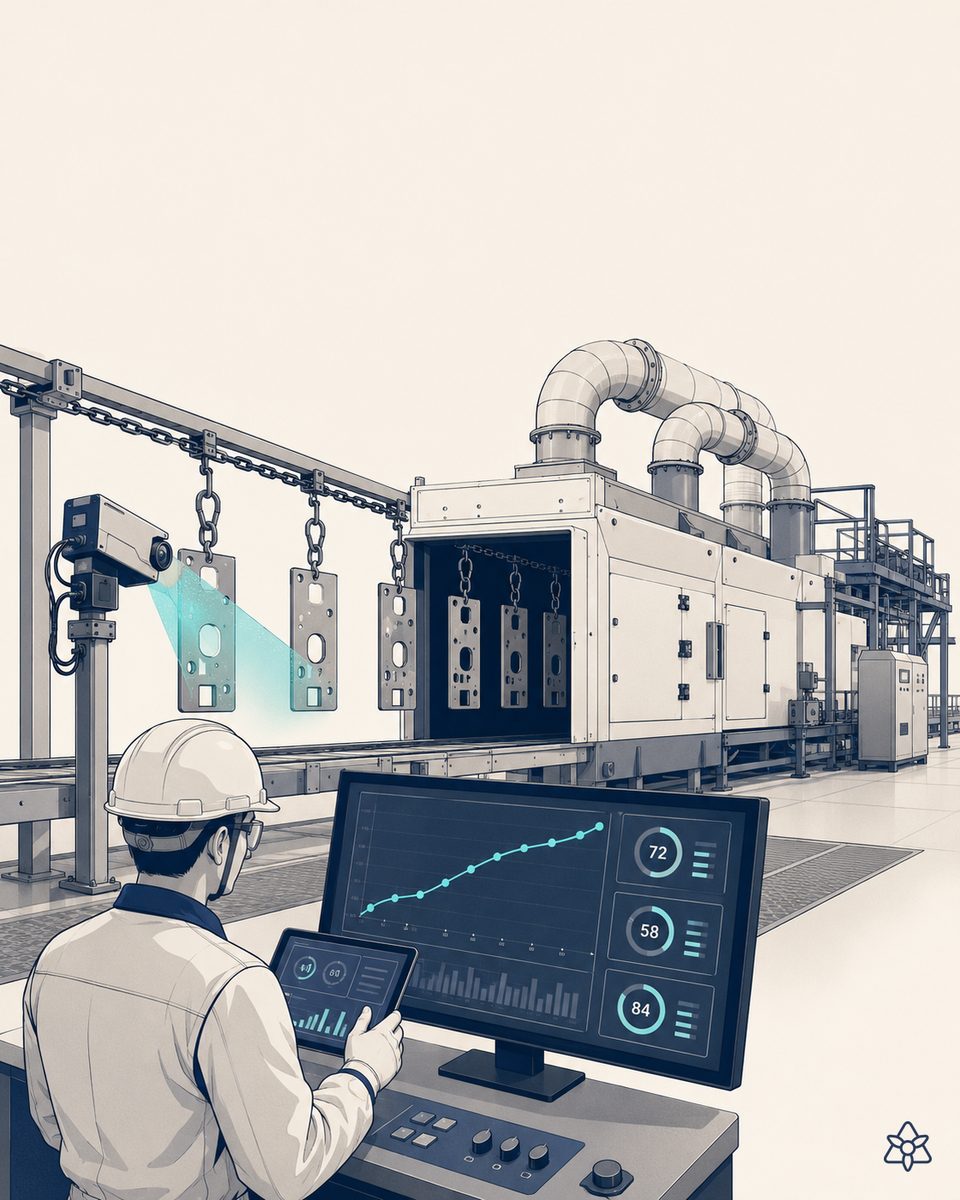
The bath drifts every minute. The log sheet measures it twice per shift.
On a pretreatment or finishing line — degreasing, pickling, phosphating, anodizing, passivation — the final quality of the part is decided in tanks whose chemistry changes with every rack that enters. The drift is physical and never rests:
- Drag-in and depletion — every load drags in solution from the previous stage and consumes active components; the degreaser loses alkalinity, the pickling bath loses acid, the phosphating bath unbalances its free-to-total acid ratio.
- Control in jumps — strips, a handheld pH meter or a lab titration once or twice per shift. If the bath left its window mid-morning, everything treated until the next round ran out of spec without anyone knowing.
- The data dies on the sheet — the reading lands on paper or in a line-side Excel: no time series, no trend alarm, no link to the batches that were passing through.
- The claim arrives with no defense — poor adhesion, premature corrosion, staining: the problem surfaces weeks later at the customer, and reconstructing the bath state of that day is impossible.
The paradox is that many lines already have probes installed — the phosphating pH is usually right on the panel — but the data stays on the local indicator: nobody historizes it per batch, nobody watches the trend, and dosing still goes by eye after the round.
iLEAN does not change your chemistry — it historizes your probes and ties every batch to the real state of its bath.
Bath control does not fail for lack of probes or judgment; it fails because the measurement is not historized, the trend warns nobody and the batch is never linked to the bath state. iLEAN acts as the putty between the line's probes, the operator's round and the quality record, without forcing you to change anything.
Connect captures pH, conductivity and temperature continuously. Tracer ties each batch to the bath state during its treatment window. The agent warns of drift before the window is breached. The person doses and signs — never the other way round.
The iLEAN pieces applied to bath control:
- Connect — reads the existing probes (from the PLC over OPC UA/Modbus or straight from the transmitter over 4-20 mA) and digitizes the round's manual measurements — lab titrations included — from the Edge terminal. A complete time series per bath, without touching the line.
- Tracer — the piece no probe provides: it crosses the time window of each batch or rack with the series of every bath, leaving each part linked to the real pH, conductivity and temperature of every stage it went through.
- Bath agent — watches each tank's trend against its operating window, warns of drift with margin to dose, flags batches that passed through an out-of-window bath and can hold their progress until quality signs off. The person releases — the batch never moves on by itself.
Rounds with a log sheet vs. baths traced per batch with iLEAN
| Aspect | Strips + pH meter + log sheet | With iLEAN (continuous bath tied to the batch) |
|---|---|---|
| Measurement frequency | One or two rounds per shift | Continuous, with the round as a cross-check |
| Drift between rounds | Invisible until the next reading | Trend watched, warning before the window is breached |
| Batch-to-bath-state link | Does not exist | Every batch tied to the real state of every stage |
| Dosing | By eye, after the round | Trend-triggered warning, executed by the person |
| Batch treated out of window | Passes without anyone knowing | Flagged and held until quality signs off |
| Answer to a claim | Memory and argument | That part's bath state, in seconds |
Impact estimate for your plant — to be validated with your numbers.
The block below is an estimate to be validated with the specific data of your plant. We put it forward so the committee has an order of magnitude; we refine it during the diagnostic.
- Surface treatment line — paint pretreatment, phosphating, anodizing, galvanizing, passivation — with 3 to 10 tanks and control currently done by rounds and log sheets.
- Pilot on the 2–3 most critical baths of one line (probe readings + Tracer + operating window validated with quality). First value expected within a few weeks.
- Indicative payback between 5 and 12 months, depending on the reject rate from treatment defects, the cost of bath chemistry and the weight of field claims.
- Hard levers: ≥ 25% reduction in batches treated out of window; a documented answer to claims; dosing and renewal by real state, saving chemicals, water and effluent.
And the quality manager's reasonable doubt
“What if a miscalibrated probe flags good batches as suspect?” — it can happen, and that is why the system never decides alone. The agent cross-checks the probe against the round's measurements and also warns when the two diverge — which is exactly the signature of a probe out of calibration. Hallucination is a problem of free generation, not of anchored tasks. In tasks where the AI merely compares probe readings against a window defined by quality, the best models brought error below 1.5% [1]. And even so, what is critical is never decided alone: iLEAN warns and the operator or the quality manager sign. The three safety rings exist precisely for this.
[1] OpenAI paper “Why Language Models Hallucinate”, 2025 — on the reliability of AI in anchored tasks.
What people ask about per-batch treatment bath control
Why do the pH and conductivity of a surface treatment bath drift?
Because the bath works and wears out: every rack that enters drags in solution from the previous bath and carries part of the current one away, active components are consumed by the surface being treated, makeup water adds salts, temperature shifts the equilibrium and contamination builds up with the hours. A degreaser loses alkalinity, a pickling bath loses free acid, a phosphating bath unbalances its free-to-total acid ratio, a passivation bath picks up metals. The drift is continuous and silent; a round with the pH meter twice per shift only photographs it in jumps.
What is wrong with the classic control routine of strips, a handheld pH meter and a log sheet?
Three things, and they are structural: (1) batches pass between rounds — if the bath left its window mid-morning and the last reading was at the start of the shift, everything treated in between ran through an out-of-spec bath without anyone knowing; (2) the data dies on the sheet — the reading is written on paper or in a line-side Excel, with no time series and no link to what was being treated; (3) dosing goes by eye — chemistry is replenished when a reading comes back bad, instead of when the trend announces it. The typical outcome: adhesion or corrosion claims weeks later, with no way to reconstruct how the bath was when that part went through.
How does iLEAN put the bath under continuous control without changing the line?
iLEAN Connect reads the pH, conductivity and temperature probes the line already has — from the PLC over OPC UA/Modbus or straight from the transmitters over 4-20 mA — and, where only manual measurement exists, digitizes it from the round via the Edge terminal. iLEAN Tracer does the part no probe can: it ties the time window of each batch or rack to the series of the bath it was treated in, so every part ends up linked to the real state — pH, conductivity, temperature — of every stage it went through. Neither the chemistry nor the process changes: what already happens gets captured.
What happens when a bath approaches the edge of its operating window?
The agent catches the trend before it crosses the limit and warns the operator or the line lead with context: which bath, which parameter, how fast it is drifting and how much margin is left. Dosing or renewal is decided and executed by the person following their procedure; iLEAN never doses on its own. If despite the warning a batch does get treated with the bath out of its window, it is flagged automatically and the agent can hold its progress until quality reviews and signs off. The person releases — the batch never moves on by itself.
What do you gain on a phosphating, anodizing or paint line with the bath traced per batch?
Three concrete levers: (1) fewer adhesion and corrosion defects, because batches stop passing through out-of-window baths between rounds; (2) a data-backed answer to claims — when a field problem appears, the state of every bath at the exact moment that part was treated is retrieved in seconds, instead of arguing from memory; (3) better use of the chemistry — trend-based dosing and state-based renewal replace the calendar, saving chemicals, water and effluent. The order of magnitude is validated during the diagnostic against your reject rate and annual bath chemistry spend.
More cases in other sectors
- Powder coating booth control — thickness and powder recovery in check, without giving powder away or living with rejects.How iLEAN cross-references film thickness, gun parameters and powder consumption per part number in the…
- Safety data sheet traceability — which SDS version went to which customer, with which batch.How iLEAN Tracer ties every chemical shipment to the safety data sheet version in force at that moment:…
- Specialty batch reactor — every batch compared live against the golden batch curve, not caught at final QC.How iLEAN overlays every specialty chemicals batch on the curve of your golden reference batch, live and…
- UV coating cure with measured dose — real mJ/cm² tied to the batch, not faith in the lamp.How iLEAN ties radiometer-measured dose (mJ/cm²) and irradiance to every batch and every UV lamp, and…
- Varnish and resin filtration — the filter change is called by the real pressure curve, not the clock.How iLEAN tracks the real differential pressure of every varnish or resin filter and flags the true…
- Wet film thickness control in coating — measured while you apply, not discovered at dry film.How iLEAN Edge captures wet film thickness in line during coating application, checks it against volume…
Tell us your case and in 48h we'll send you the estimated ROI for your surface treatment line.
We work on your plant's real data, not ours. Diagnostic with no commitment.
Request estimated ROI in 48h See specialty chemicals