UV coating cure with measured dose — real mJ/cm² tied to the batch, not faith in the lamp.
A UV lamp doesn't fail overnight: it ages. Irradiance drops month after month, the real dose slips below the formulator's window, and the coating leaves the tunnel looking exactly as it always has — until the customer runs a solvent rub or adhesion fails weeks later. iLEAN captures the radiometer runs, ties dose (mJ/cm²) and irradiance to the lamp and the batch, and warns when the trend points below minimum — before a single undercured batch ships. The person signs — the batch is never released on its own.
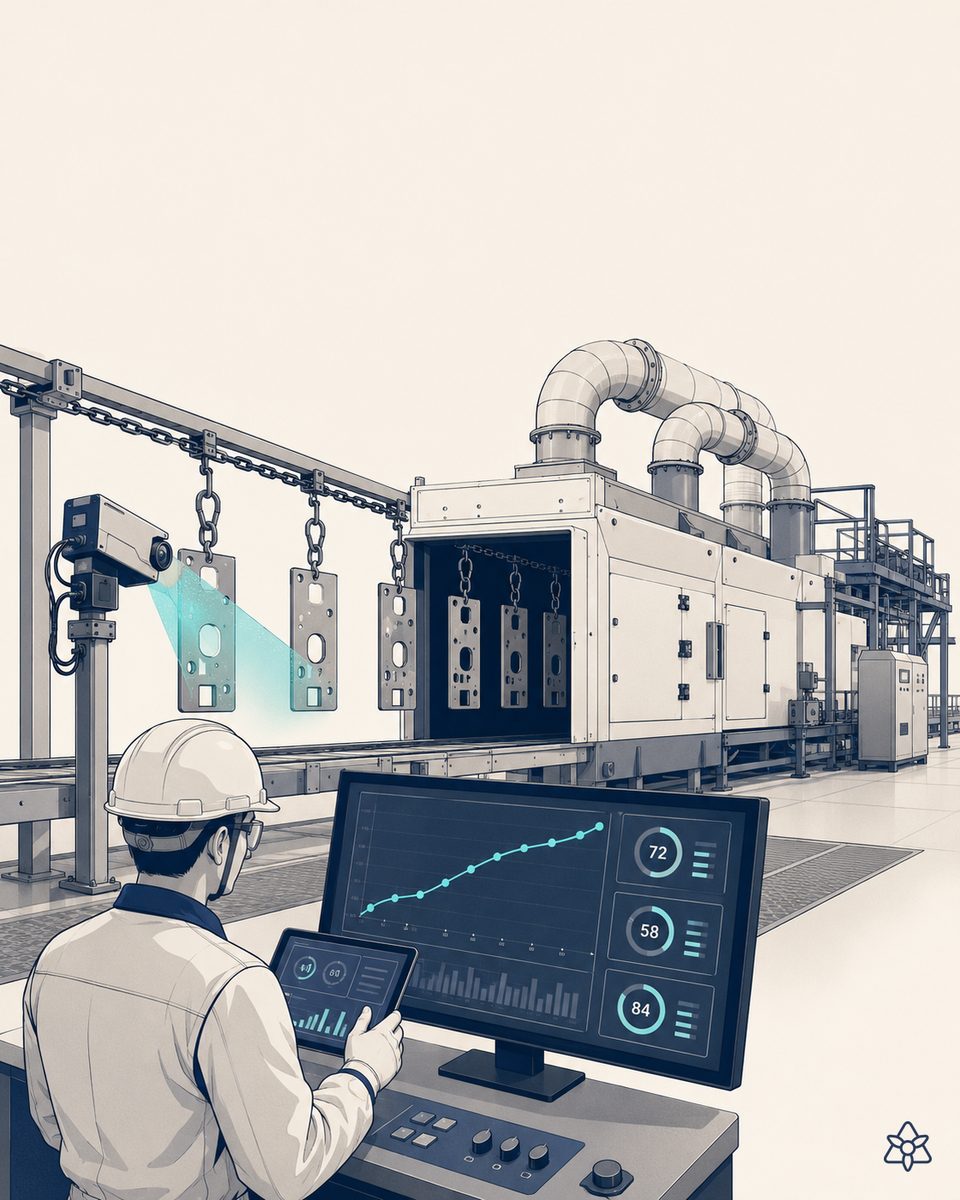
A UV lamp doesn't fail — it ages. And the dose drops with no visible change in the coating.
The dose a coating actually receives depends on the lamp, the reflector and the line speed — and all three drift. A mercury lamp loses irradiance over its life, a dirty reflector eats a surprising share of the output, and a line sped up to hit the schedule cuts the exposure time. On paper, the radiometer exists to catch all of that. On the floor:
- The radiometer run happens “when someone remembers” — no fixed cadence per lamp, and the reading ends up on a sheet, in a drawer, or nowhere.
- Undercure is invisible — at 70% of the dose, gloss and touch are nearly identical. It surfaces in an MEK rub test, an adhesion failure or a customer complaint weeks later.
- Speed changes are never recalculated — the line runs faster to make volume and the dose drops below the formulator's window with nobody doing the math.
- Lamp replacement is guesswork — by hour meter or by outright failure, because there is no irradiance history per lamp to plan against.
The line lead knows it; the quality manager knows it. The classic system works almost every time. The batch it misses is the one that leaves “cured” to the eye and fails the solvent rub at the customer — and by then, several more batches have shipped under the same aging lamp.
iLEAN doesn't change your radiometer — it ties every run to the lamp and the batch, and watches the trend.
Cure control does not fail for lack of a radiometer; it fails because the reading is never tied to the lamp or the batch. iLEAN acts as the putty between the radiometer, the cure tunnel and the batch record, changing none of the three.
Connect captures the radiometer. Edge ties dose and irradiance to lamp and batch. The agent watches the trend and warns before the window is breached. The person signs — never the other way round.
The iLEAN pieces applied to UV cure control:
- Connect — captures the radiometer you already use (a puck that rides the line or a probe) via USB, via its download software or, if it only has a display, from a photo of the screen that Connect reads. It also takes line speed and lamp power setting wherever the tunnel exposes them.
- Edge — identifies the line, the lamp and the running batch (QR/label or voice), so every radiometer run lands tied to all three, with date and product. It works without a network.
- Cure agent — checks dose and irradiance against the formulator's window for that product and watches the trend per lamp. A downward drift triggers the lamp-change or reflector-cleaning warning before the window is breached; a run below minimum holds the batches run since the last valid reading. The person signs — the batch is never released on its own.
Radiometer readings on paper vs. dose tied to the batch with iLEAN
| Aspect | Radiometer + sheet of paper | With iLEAN (dose tied to the batch) |
|---|---|---|
| Radiometer run | “When someone remembers” | Scheduled per lamp, captured at the source |
| Reading | Sheet of paper or memory | Dose + irradiance tied to lamp and batch |
| Line speed change | Dose recalculated by hand, or not at all | Recalculated and verified against the window |
| Lamp aging | Discovered through the failure | Trend per lamp with early warning |
| Undercured batch | Found by the customer | Held in-house before shipping |
| Lamp replacement | By hour meter or by breakdown | By measured irradiance data |
Impact estimate for your plant — to be validated with your numbers.
The block below is an estimate to be validated with the specific data of your plant. We put it forward so the committee has an order of magnitude; we refine it during the diagnostic.
- UV cure line for coatings, varnishes or industrial inks (wood, plastics, metal, industrial graphics) with a radiometer already in use.
- Pilot on one line (radiometer capture + lamp and batch identification + trend agent). First value expected within a few weeks.
- Indicative payback between 4 and 9 months, depending on the average cost of an undercured batch reaching the customer (replacement, freight, claim handling, brand damage).
- Hard levers: undercured batches at the customer trending to zero (estimate to be validated); lamp replacement driven by irradiance data, not by the calendar; a cure dossier per batch ready for audit.
And the quality manager's reasonable doubt
“What if the system misreads a value?” — false positives exist, and that is why the system never decides alone. Hallucination is a problem of free generation, not of anchored tasks. In tasks where the AI merely receives dose and irradiance from the radiometer and compares them against the formulator's window, the best models brought error below 1.5% [1]. And even so, what is critical is never decided alone: iLEAN warns and the operator or the quality manager sign. The three safety rings exist precisely for this.
[1] OpenAI paper “Why Language Models Hallucinate”, 2025 — on the reliability of AI in anchored tasks.
What people ask about UV cure dose control
Why can a UV coating ship undercured without anyone noticing?
Because undercure cannot be seen. A UV coating that received 70% of the dose leaves the tunnel with gloss and feel nearly identical to a fully cured one. The difference shows up later: an MEK solvent rub that lifts the film, adhesion that fails, yellowing, residual odor or photoinitiator migration. Very often the one who finds it is the customer, weeks later — and by then several batches have shipped under the same aging lamp.
What is the difference between irradiance and dose, and which one matters?
Both. Irradiance (mW/cm²) is the instantaneous power reaching the surface: you need a sufficient peak to initiate cure at depth. Dose (mJ/cm²) is the total energy accumulated during the pass under the lamp: irradiance integrated over time. You can meet the dose with a weak lamp and a slow line and still cure poorly at depth for lack of peak. The formulator specifies a window for both — and both have to be measured and recorded.
How does iLEAN tie the radiometer reading to the batch without changing the radiometer?
iLEAN Connect captures the radiometer you already use (a puck that rides the line or a probe) via USB, via its download software or, if it only has a display, from a photo of the screen that Connect reads. iLEAN Edge identifies the line, the lamp and the running batch, and the run lands tied to all three with date, line speed and product. No copying readings onto a sheet: the measurement exists in the system the moment it exists in the radiometer.
What happens if the measured dose falls below the formulator's window?
Two levels of reaction. If a radiometer run comes in below minimum, the agent warns at second zero and holds the batches run since the last valid reading until the quality manager decides: reprocess, test (MEK rub, adhesion) or release with a signature. And before it gets there, the per-lamp trend — irradiance dropping run after run — triggers the lamp-change or reflector-cleaning warning before the window is breached. The person signs — the batch is never released on its own.
What do you gain on a UV cure line with the dose tied to the batch?
Three levers: (1) undercured product stops reaching the customer — lamp drift is seen coming and the doubtful batch is held in-house; (2) lamp replacement driven by data, not the calendar — no discarding lamps with life left in them, no stretching them to failure; (3) a cure dossier per batch with dose, irradiance, speed and lamp — exactly what a demanding customer or an auditor asks for when there is a cure-related claim. The line lead's feel for when “the lamp is done” is captured as a measurable pattern.
More cases in other sectors
- Safety data sheet traceability — which SDS version went to which customer, with which batch.How iLEAN Tracer ties every chemical shipment to the safety data sheet version in force at that moment:…
- Specialty batch reactor — every batch compared live against the golden batch curve, not caught at final QC.How iLEAN overlays every specialty chemicals batch on the curve of your golden reference batch, live and…
- Surface treatment baths — pH and conductivity tracked continuously, tied to the batch that went through each bath.How iLEAN tracks the pH and conductivity of every surface treatment bath continuously and ties bath…
- Varnish and resin filtration — the filter change is called by the real pressure curve, not the clock.How iLEAN tracks the real differential pressure of every varnish or resin filter and flags the true…
- Wet film thickness control in coating — measured while you apply, not discovered at dry film.How iLEAN Edge captures wet film thickness in line during coating application, checks it against volume…
- Submarine manufacturing with AI — a bead out of window is not an incident, it is a life.How iLEAN assists pressure-hull welding, hydrostatic testing and hull-number traceability in submarine…
Tell us your case and in 48h we'll send you the estimated ROI for your UV cure line.
We work on your plant's real data, not ours. Diagnostic with no commitment.
Request estimated ROI in 48h See specialty chemicals