Specialty batch reactor — every batch compared live against the golden batch curve, not caught at final QC.
In specialty chemicals the same reactor runs dozens of recipes, and for each one there is a batch that came out perfect: its curve sits in the SCADA historian. But nobody watches it live, and the deviation — a slow ramp, a feed that started early, a short reflux — is discovered in the lab once the synthesis is over. iLEAN overlays the running batch on the curve of the golden reference batch, phase by phase, and flags the first divergence while correcting is still possible. The person decides — the batch is never adjusted on its own.
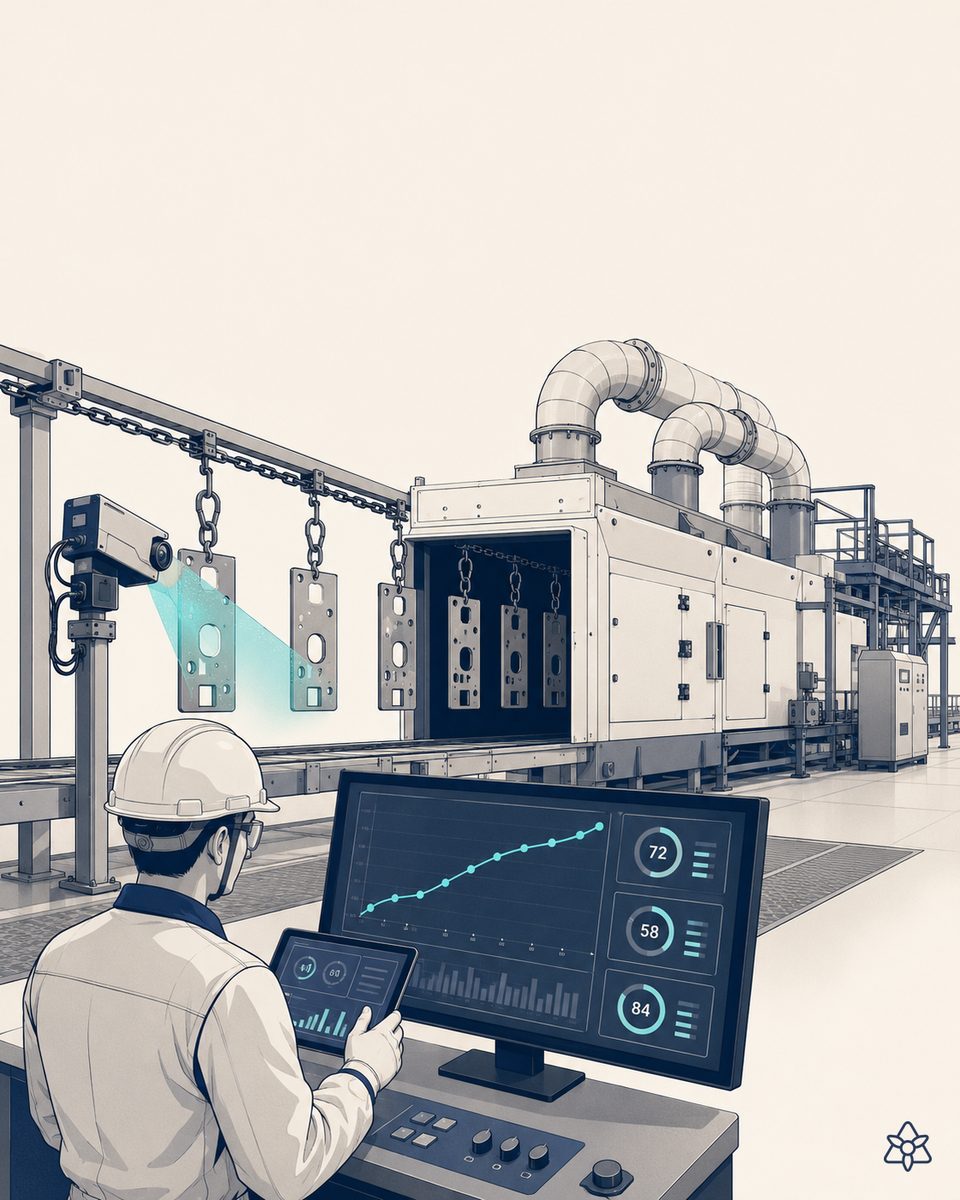
The perfect batch curve is in the historian. Today's batch gets compared to it when it is already too late.
A multiproduct specialty reactor — resins, adhesives, additives, surfactants, fine intermediates — chains campaigns of different recipes. Each recipe has its profile: temperature ramps, feeds, reflux times, vacuum, agitation. And for each recipe there is a golden reference batch whose curve was logged. On the shop floor, however:
- The SCADA historian is only opened after the fact — when a batch goes wrong, someone pulls up the trend and compares. Never during the batch, which is when it would help.
- The operator sees instantaneous values, not the shape of the curve — 82 °C can be perfect or the symptom of a lagging ramp, depending on which minute of the phase you are in.
- Final lab QC certifies, it does not correct — viscosity, acid value or color are measured once the synthesis is done. If the deviation happened in hour two, everything after was done on a batch already gone wrong.
- The only one who reads the curve by heart is the veteran — the shift lead with twenty years spots a bad batch at a glance on the trend. That judgment is not on the night shift, and not in the operator who joined three months ago.
Every specialty plant knows the outcome: the correction with extra reactor hours, the rework, the batch downgraded to second quality. And on a multiproduct reactor, every hour of adjustment is sellable capacity that never comes back.
iLEAN does not replace your SCADA — it puts its historian to work live, batch by batch.
The data already exists: the PLC and the SCADA log everything. What is missing is the real-time comparison against the right reference. iLEAN acts as the putty between the historian, the recipe and the control-room operator, without touching the control loop or forcing you to change anything.
Connect captures the reactor signals. The agent overlays the running batch on the golden batch curve, phase by phase. Edge alerts the operator with context. The person decides — never the other way round.
The iLEAN pieces applied to batch-versus-golden-curve control:
- Connect — connects read-only to the PLC/SCADA (OPC UA, Modbus, or the existing historian) and captures batch and jacket temperature, pressure, agitation and feed rates in real time. It writes no setpoints and never enters the control loop.
- Golden Batch agent — identifies the recipe and the current phase, overlays the batch curve on the reference curve and computes the divergence using the tolerance the process engineer defined per phase. It tells the extra degree that does not matter from the one that announces a problem.
- Edge — a terminal at the reactor. It ties manual charges to the batch (the bag added by hand, via voice or QR) and shows the alert with context: phase, signal, size of the deviation and what the reference batch did at that point. It works without a network.
Trends reviewed after the fact vs. batches compared live with iLEAN
| Aspect | SCADA + final lab QC | With iLEAN (batch vs golden curve) |
|---|---|---|
| Golden batch reference | In the historian, and in the veteran's head | Explicit curve per recipe and phase |
| Deviation detection | At final QC, synthesis already over | At the first sustained divergence, live |
| Room to correct | None — the batch is what it is | Inside the batch, while still correctable |
| Manual charges | Note on the recipe sheet | Tied to the batch via voice or QR on Edge |
| Reactor hours on adjustments | Whatever each crooked batch demands | Fewer adjustments, more sellable capacity |
| Veteran's judgment | Goes home with him every evening | Captured as a pattern per recipe and phase |
Impact estimate for your plant — to be validated with your numbers.
The block below is an estimate to be validated with the specific data of your plant. We put it forward so the committee has an order of magnitude; we refine it during the diagnostic.
- Specialty chemicals plant (resins, adhesives, additives, intermediates) with 4–10 multiproduct batch reactors and a SCADA historian already running.
- Pilot on one reactor and 2–3 high-rotation recipes (read-only Connect + reference curves validated by the process engineer). First value expected within a few weeks.
- Indicative payback between 6 and 12 months, depending on the cost of a reworked or downgraded batch and the reactor hours currently lost to adjustments.
- Hard levers: ≥ 20% reduction in batches out of spec at first analysis; multiproduct reactor hours recovered; every batch archived with its full curve next to its reference as a technical dossier.
And the process manager's reasonable doubt
“What if the system flags deviations that are not real?” — false positives exist, and that is why the system never decides alone. Hallucination is a problem of free generation, not of anchored tasks. In tasks where the AI merely compares measured signals against a reference curve with defined tolerances, the best models brought error below 1.5% [1]. And even so, what is critical is never decided alone: iLEAN warns and the operator or the process engineer decide. The three safety rings exist precisely for this.
[1] OpenAI paper “Why Language Models Hallucinate”, 2025 — on the reliability of AI in anchored tasks.
What people ask about golden batch control in specialty reactors
What is the golden batch curve in a specialty chemicals batch reactor?
It is the complete profile of the golden reference batch for each recipe: batch and jacket temperature, pressure, agitation, feed rate and the timing of every phase, exactly as they were logged in the SCADA historian the day the batch came out perfect on the first try. Almost every plant has that curve stored; almost none uses it live. iLEAN turns it into the reference that every new batch of the same recipe is overlaid on, phase by phase.
Why does final lab QC come too late to save the batch?
Because by the time the lab measures viscosity, acid value or color, the synthesis is over: the energy has been applied, the reagent has been consumed and the product is what it is. If the deviation happened in hour two of a twelve-hour polymerization, everything after that was done on a batch already gone wrong. In the best case the outcome is a correction with extra reactor hours; in the worst, a full rework or a batch downgraded to second quality. Final QC certifies — it does not correct.
How does iLEAN compare each batch against its reference without changing the SCADA?
iLEAN Connect connects read-only to the existing PLC or SCADA (OPC UA, Modbus, or whatever historian is already there) and captures the reactor signals in real time. The agent identifies the recipe and the current phase, overlays the running batch on the reference batch curve and computes the divergence using the tolerance the process engineer defined for each phase — because one extra degree during heat-up is not the same as one extra degree during hold. Nothing is installed in the control loop: iLEAN observes, compares and warns.
What happens when a batch drifts away from the reference curve?
The agent alerts the operator and the process engineer at the first sustained divergence, with context: which phase the batch is in, which signal is drifting, by how much and since when, and what the reference batch did at that same point. The decision to act — stretch a ramp, correct a feed, call the process owner — is always made by a person. iLEAN never writes to the reactor or changes setpoints: it delivers the diagnosis early enough for the correction to happen inside the batch, not after it.
What do you gain in a specialty chemicals plant running multiproduct reactors?
Three concrete levers: (1) fewer batches out of spec at first analysis, because deviations get corrected while they are still correctable; (2) fewer reactor hours lost to adjustments and rework — on a multiproduct reactor those hours are sellable capacity; (3) the veteran's judgment captured as a pattern — the curve a shift lead with twenty years recognizes at a glance becomes explicit per recipe and phase, available to the night shift and to the operator who joined three months ago. On top of that, every batch is archived with its full curve next to the reference: a technical dossier almost nobody can show today.
More cases in other sectors
- Particle size of the milled batch — a distribution correlated with application, not a loose sample.How iLEAN ties the particle size distribution of every milled batch to its application results — tint…
- Powder coating booth control — thickness and powder recovery in check, without giving powder away or living with rejects.How iLEAN cross-references film thickness, gun parameters and powder consumption per part number in the…
- Safety data sheet traceability — which SDS version went to which customer, with which batch.How iLEAN Tracer ties every chemical shipment to the safety data sheet version in force at that moment:…
- Surface treatment baths — pH and conductivity tracked continuously, tied to the batch that went through each bath.How iLEAN tracks the pH and conductivity of every surface treatment bath continuously and ties bath…
- UV coating cure with measured dose — real mJ/cm² tied to the batch, not faith in the lamp.How iLEAN ties radiometer-measured dose (mJ/cm²) and irradiance to every batch and every UV lamp, and…
- Varnish and resin filtration — the filter change is called by the real pressure curve, not the clock.How iLEAN tracks the real differential pressure of every varnish or resin filter and flags the true…
Tell us your case and in 48h we'll send you the estimated ROI for your specialty batch reactors.
We work on your plant's real data, not ours. Diagnostic with no commitment.
Request estimated ROI in 48h See specialty chemicals