Powder coating booth control — thickness and powder recovery in check, without giving powder away or living with rejects.
In a powder coating booth the balance is measured in microns: every micron over spec is powder given away across thousands of parts; every part under spec is a reject, a rework and another oven cycle. And how much oversprayed powder actually comes back from recovery decides a good share of the real cost. iLEAN captures measured thickness, application parameters and consumption per part number, and warns as drift begins — before a whole shift comes out heavy or thin. The person signs — the rack never ships on its own.
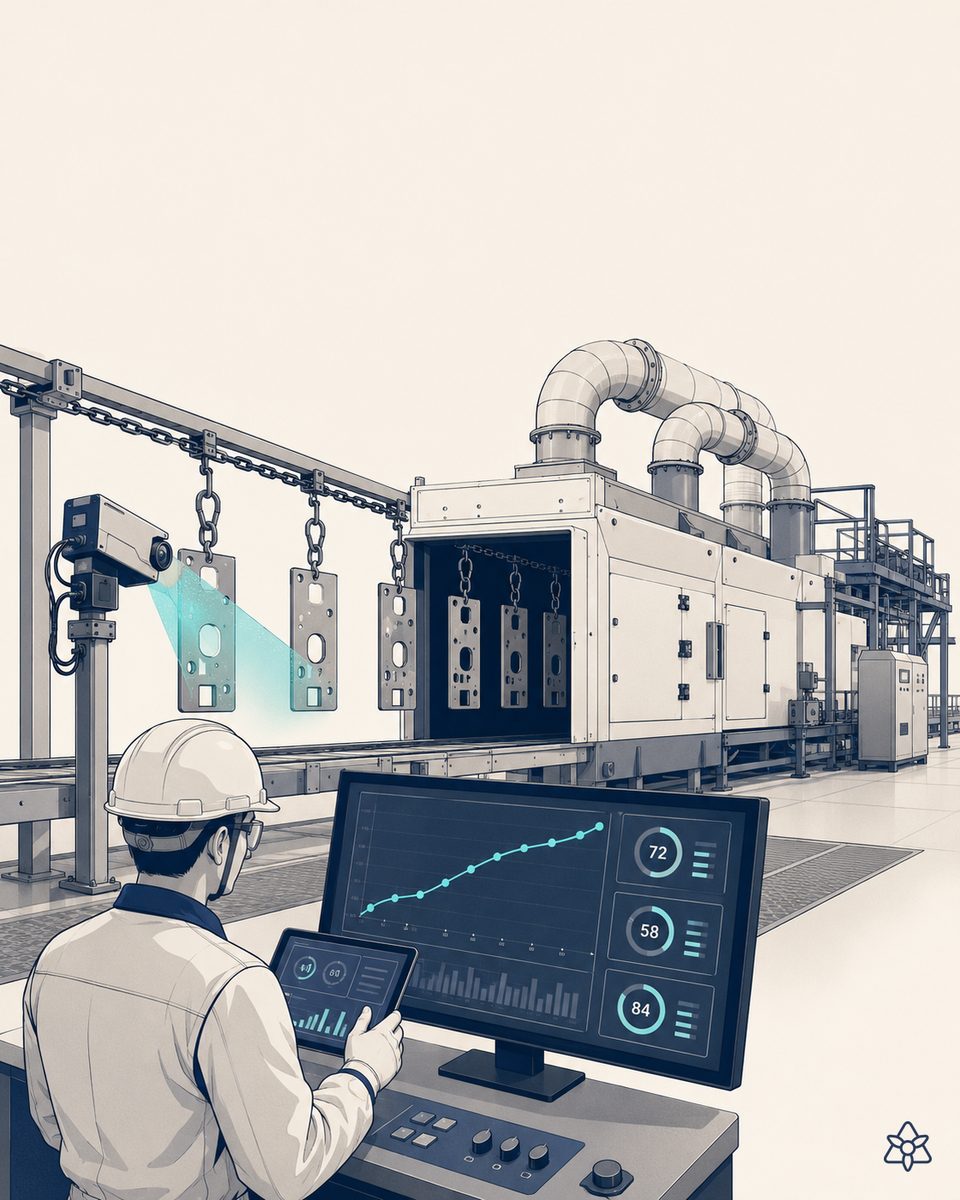
Between giving powder away and living with rejects there is a window a few microns wide — and today it is flown by eye.
The specification says 60–80 microns. Every micron above it is powder given away on every part; every part below it is a reject, a rework and another oven cycle. And the share of oversprayed powder actually recovered decides a good part of the real cost. On paper, that balance is under control; on the floor:
- Thickness is measured on samples, after the oven — a magnetic or eddy-current gauge on the odd part. Whatever drifted between samples is only discovered at the next one.
- Gun setup lives in the sprayer's judgment — kV, powder flow, distance. A superb veteran setting at every color change, written down nowhere.
- Consumption is never reconciled per part number — powder bought against parts coated is squared once a month, globally, so overthickness and overspray stay invisible.
- Recovery is the brochure figure — cyclone or filter efficiency is assumed from the booth's datasheet, never checked against what the line actually consumes.
The finishing lead knows it; the purchasing manager suspects it. The classic control answers a single question — does it cover? — and the answer is always yes. The cost of answering only that question is paid in powder, silently, every shift.
iLEAN doesn't touch the booth — it cross-references thickness, parameters and consumption that already exist, part number by part number.
Booth control does not fail for lack of a gauge; it fails because thickness, parameters and consumption are never cross-referenced per part number. iLEAN acts as the putty between the gauge, the booth controller and each part number's standard, without touching the installation.
Edge identifies part number and rack. Connect captures thickness, parameters and consumption. The agent checks against the standard and warns as drift begins. The person signs — never the other way round.
The iLEAN pieces applied to the powder booth:
- Connect — integrates with whatever is there: the digital thickness gauge (Bluetooth or USB), the gun parameters wherever the booth controller exposes them (kV, μA, powder flow), and powder consumption by scale or counter.
- Edge — identifies part number and rack by QR or vision; if the gauge is handheld, the operator calls readings through the earpiece and Edge ties each one to part number, rack and time. It works without a network.
- Drift agent — compares every reading against that part number's standard and watches the trend, not just the value. Sustained drift triggers the warning before the first part comes out low; parts hung since the last good reading are flagged for recheck, and the order does not close until the manager validates. The person signs — the rack never ships on its own.
Booth flown by eye vs. drift watched by iLEAN
| Aspect | Booth by eye + samples | With iLEAN (drift watched) |
|---|---|---|
| Thickness measurement | Loose samples, no record per part | Captured, tied to part number and rack |
| Application drift | Seen at the end of the shift | Warned as the drift begins |
| Powder consumption per part number | Monthly global figure | Per order, against the standard |
| Recovery | The booth brochure figure | Reconciled against real consumption |
| Setup on color change | The sprayer's judgment, unwritten | Recipe captured per part number |
| Reject for low thickness | Found at unloading, oven already spent | Warned in line |
Impact estimate for your plant — to be validated with your numbers.
The block below is an estimate to be validated with the specific data of your plant. We put it forward so the committee has an order of magnitude; we refine it during the diagnostic.
- Powder coating plant (architectural aluminum, profile, sheet metal, metal subassemblies) with a digital thickness gauge and frequent color changes.
- Pilot on one booth (gauge capture + part number and rack identification + drift agent). First value expected within a few weeks.
- Indicative payback between 5 and 10 months, depending on powder price, parts volume and the current rework rate for thickness.
- Hard levers: powder consumption from overthickness down 5–15% (estimate to be validated); fewer rejects for low film build; a recipe per part number captured at every color change.
And the quality manager's reasonable doubt
“What if the system misreads a value?” — false positives exist, and that is why the system never decides alone. Hallucination is a problem of free generation, not of anchored tasks. In tasks where the AI merely receives a reading from the thickness gauge and compares it against that part number's standard, the best models brought error below 1.5% [1]. And even so, what is critical is never decided alone: iLEAN warns and the operator or the quality manager sign. The three safety rings exist precisely for this.
[1] OpenAI paper “Why Language Models Hallucinate”, 2025 — on the reliability of AI in anchored tasks.
What people ask about powder coating booth control
Why is overthickness in powder coating an invisible cost?
Because nobody complains about a part with plenty of coverage. If the specification calls for 60–80 microns and the line applies 110, the part passes every check — but you are spending 30–40% more powder on every part, shift after shift. On a line running thousands of parts a day, that excess is an entire purchasing line item that shows up in no KPI, because the only check in place — does it cover? — always comes back fine.
Why isn't measuring thickness after the oven enough?
Because it is a sampled measurement, after the fact. The magnetic or eddy-current gauge measures the odd part every so often; drift between samples — a fouling electrode, a powder flow dropping, a bad ground on the rack — is invisible until the next sample. And when a sample comes out low, everything hung in between is suspect: recheck or recoat, with the oven cycle already spent. Measuring is fine; what is missing is tying every reading to part number, rack and parameters so the drift is seen as it starts.
How does iLEAN capture the data without changing the booth or the guns?
iLEAN Connect integrates with what is already there: the digital thickness gauge (Bluetooth or USB), the gun parameters where the booth controller exposes them (kV, μA, powder flow), and powder consumption by scale or counter. iLEAN Edge identifies the part number and the rack by QR or vision, and the operator calls readings through an earpiece when the gauge is handheld. Everything lands tied to part number, order, rack and time — without touching the booth.
What happens when drift pushes parts out of the thickness window?
The agent compares every reading against that part number's standard and watches the trend, not just the value: if the last readings fall steadily even while still inside the window, it warns before the first part comes out low — which is when correcting costs nothing. If parts still land outside, everything hung since the last good reading is flagged for recheck and the order does not close until the manager validates. The person signs — the rack never ships on its own.
What do you gain in a powder coating plant?
Three levers: (1) powder consumption per part number against a standard — overthickness is quantified and comes down, and cyclone recovery is reconciled against real consumption instead of the brochure figure; (2) fewer rejects for low film build, because drift warns as it starts, not at unloading; (3) recipes captured per part number — the veteran sprayer's setup at every color change stops being unrepeatable craft and becomes the next shift's starting point.
More cases in other sectors
- Inline offset ink viscosity control during the press run — solvent corrected before density drifts off.How iLEAN captures Ford cup checks and inline viscometer readings during the press run and flags…
- Pigment dispersion in a bead mill — stop at the right fineness, without over-milling.How iLEAN captures Hegman fineness and bead mill parameters pass by pass, so you stop at spec without…
- Particle size of the milled batch — a distribution correlated with application, not a loose sample.How iLEAN ties the particle size distribution of every milled batch to its application results — tint…
- Safety data sheet traceability — which SDS version went to which customer, with which batch.How iLEAN Tracer ties every chemical shipment to the safety data sheet version in force at that moment:…
- Specialty batch reactor — every batch compared live against the golden batch curve, not caught at final QC.How iLEAN overlays every specialty chemicals batch on the curve of your golden reference batch, live and…
- Surface treatment baths — pH and conductivity tracked continuously, tied to the batch that went through each bath.How iLEAN tracks the pH and conductivity of every surface treatment bath continuously and ties bath…
Tell us your case and in 48h we'll send you the estimated ROI for your powder coating plant.
We work on your plant's real data, not ours. Diagnostic with no commitment.
Request estimated ROI in 48h See specialty chemicals