Wet film thickness control in coating — measured while you apply, not discovered at dry film.
Wet film thickness takes seconds to measure with a comb gauge while the coating is being applied — yet many lines only check dry film thickness hours later, once the mistake is already cured onto the part. Thin means repainting; heavy means product given away across the whole run. iLEAN Edge captures the wet reading in line, checks it against the datasheet's volume solids, and warns at second zero when the window drifts. The person signs — the order never closes on its own.
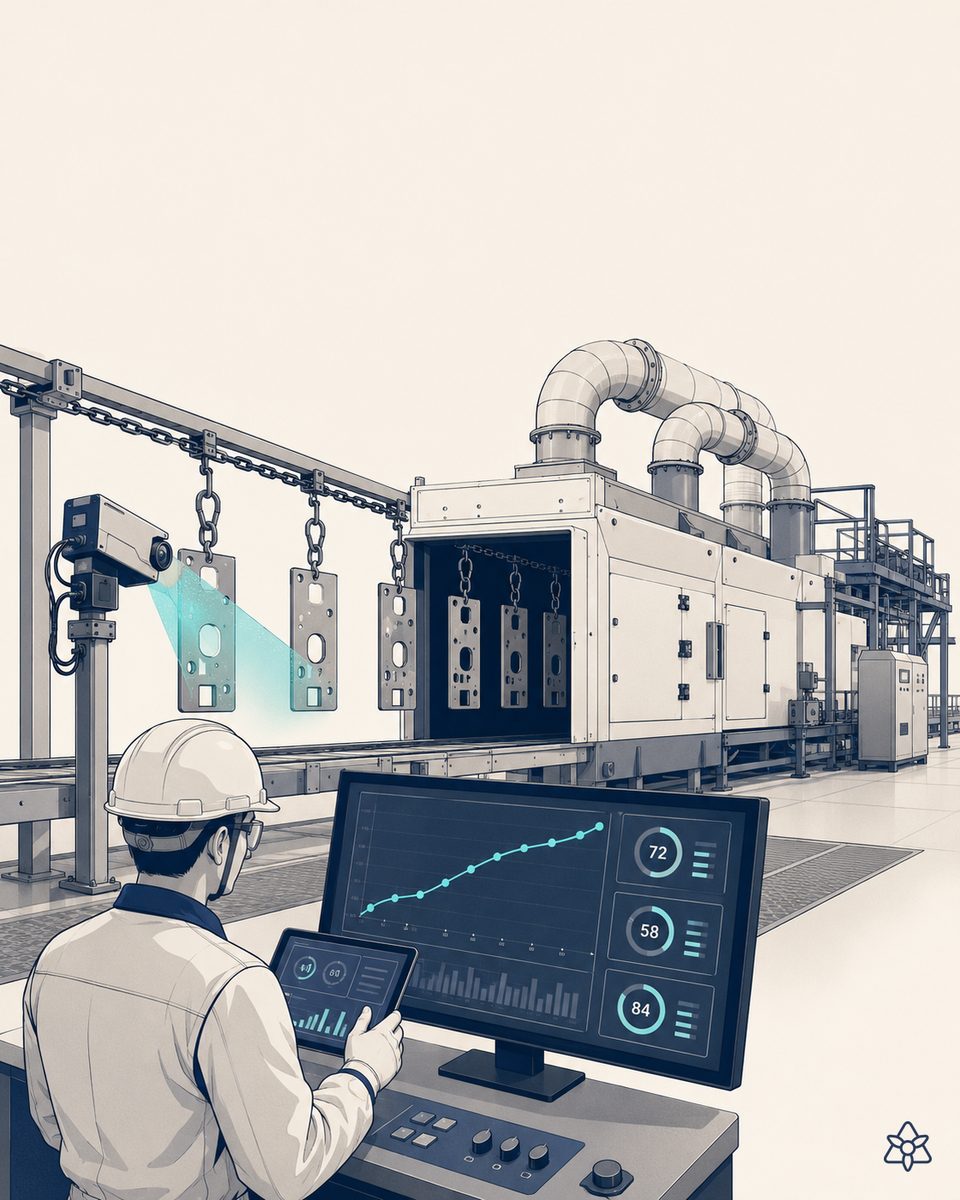
Dry film is measured when nothing can be fixed — and wet film is measured but never recorded.
Wet film thickness × volume solids = predicted dry film thickness. In other words: the wet reading is the only one that arrives while the coating can still be corrected. And yet, on most lines, the control story looks like this:
- The comb gauge is used, but the reading is never recorded — the applicator checks, adjusts and moves on; the number lives and dies in his head.
- Dry film is measured hours later — after flash-off and the drying or oven cycle. If it comes in low, repainting means another full cycle; the mistake is already cured onto the part.
- Overthickness triggers no alarm at all — “plenty of coverage” passes every check, while product is given away run after run.
- Viscosity and thinning drift between batches and shifts — and the compensation lives in the veteran applicator's judgment, written down nowhere.
The line lead knows it; the quality manager knows it. The classic control works most of the time. What it can never do is arrive early — by the time dry film is measured, the choice is repaint or absorb the cost.
iLEAN doesn't replace your gauge or your paint — it captures the reading you already take and ties it to the order.
Thickness control does not fail for lack of a gauge; it fails because the wet reading is never recorded or tied to the order. iLEAN acts as the putty between the comb gauge, the product datasheet and the production order, changing none of the three.
Edge identifies the order and the zone. Connect captures the wet reading. The agent computes the window from volume solids and warns before the film dries. The person signs — never the other way round.
The iLEAN pieces applied to wet film control:
- Edge — a terminal on the line. It identifies the order and the product by QR and, by voice or camera, the zone of the part being measured. An applicator with an earpiece says “wet ninety” and the reading lands tied. It works without a network.
- Connect — if the applicator prefers a photo, it reads the last wetted tooth of the gauge from the image; if the line has non-contact measurement (ultrasonic, laser), it captures the value straight from the instrument. It also takes volume solids and declared thinning from the product datasheet.
- Window agent — computes the wet film window from the specified dry film thickness and the volume solids, checks every reading and warns the applicator at second zero if it drifts out — while the film is still wet. An order with out-of-window readings, or none at all, is held until quality signs. The person signs — the order never closes on its own.
Unrecorded comb gauge vs. wet film tied to the order with iLEAN
| Aspect | Comb gauge + dry film checks | With iLEAN Edge + Connect (wet) |
|---|---|---|
| Wet reading | Taken and forgotten | Captured, tied to order and zone |
| Low film build | Discovered at dry film, hours later | Warned during application, still wet |
| Overthickness | Invisible: “plenty of coverage” | Quantified per order and part number |
| Thinning and viscosity adjustment | Veteran judgment, unwritten | Pattern captured per part number |
| Dossier per order | Final dry film thickness only | Wet + dry + application conditions |
| Repaints | Another full cycle per low part | Falling: corrected while wet |
Impact estimate for your plant — to be validated with your numbers.
The block below is an estimate to be validated with the specific data of your plant. We put it forward so the committee has an order of magnitude; we refine it during the diagnostic.
- Liquid coating line (industrial metal, plastics, wood, coil) with a dry film specification per product and a comb or wheel gauge available.
- Edge pilot on one line (terminal + voice or photo capture + wet-window agent). First value expected within a few weeks.
- Indicative payback between 5 and 10 months, depending on the cost of the applied product, line volume and the current repaint rate.
- Hard levers: ≥ 25% reduction in repaints for low film build (estimate to be validated); overconsumption from overthickness quantified and falling; a dossier per order with wet + dry + conditions.
And the quality manager's reasonable doubt
“What if the system misreads a value?” — false positives exist, and that is why the system never decides alone. Hallucination is a problem of free generation, not of anchored tasks. In tasks where the AI merely receives a thickness reading and compares it against the window computed from the datasheet volume solids, the best models brought error below 1.5% [1]. And even so, what is critical is never decided alone: iLEAN warns and the operator or the quality manager sign. The three safety rings exist precisely for this.
[1] OpenAI paper “Why Language Models Hallucinate”, 2025 — on the reliability of AI in anchored tasks.
What people ask about wet film thickness control
What is wet film thickness and why measure it?
It is the thickness of the coating right after application, before the solvent or water flashes off. It takes seconds to measure with a comb gauge or a rolling wheel gauge, and it lets you predict dry film thickness: DFT ≈ WFT × volume solids. It is the only measurement that arrives in time — once the film has dried or cured, whatever thickness you have is what you keep, and fixing it means repainting or absorbing the overconsumption.
Why isn't measuring dry film thickness enough?
Because by definition it arrives late. If dry film comes in low, the part goes back through the line: another application and another drying or oven cycle. If it comes in high, no alarm goes off — “plenty of coverage” — but that is product given away across the entire run, and with high-solids or polyurethane systems the excess is straight cost. Dry film also explains nothing about the cause: it cannot tell you whether the deviation came from viscosity, thinning or the gun setup.
How does iLEAN capture the comb gauge reading without slowing the applicator down?
Three ways, depending on the line. By voice: the applicator wears an earpiece and says “wet ninety” — iLEAN Edge ties it to the order and the zone of the part with nothing to write. By photo: they photograph the gauge and Connect reads the last wetted tooth. By sensor: if the line has non-contact measurement (ultrasonic or laser), Connect captures the value straight from the instrument. In all three cases the reading is tied to order, product, operator and time.
What happens when a reading falls outside the window?
The agent catches it at second zero. It computes the wet film window from the specified dry film thickness and the volume solids on the datasheet — declared thinning included — and if the reading falls outside, it warns the applicator through the earpiece or on the panel so the correction happens while the film is still wet. If an order reaches closing with out-of-window readings or no readings at all, it is held until the quality manager validates. The person signs — the order never closes on its own.
What do you gain on a coating line with this control?
Three levers: (1) fewer repaints, because low film build gets corrected wet instead of discovered dry; (2) overconsumption quantified per order and per part number — the extra microns stop being invisible and come down; (3) a dossier per order with wet readings, final dry film thickness and application conditions, ready for the customer who audits. And the veteran applicator's fine-tuning is captured as a pattern instead of living in his head.
More cases in other sectors
- Surface treatment baths — pH and conductivity tracked continuously, tied to the batch that went through each bath.How iLEAN tracks the pH and conductivity of every surface treatment bath continuously and ties bath…
- UV coating cure with measured dose — real mJ/cm² tied to the batch, not faith in the lamp.How iLEAN ties radiometer-measured dose (mJ/cm²) and irradiance to every batch and every UV lamp, and…
- Varnish and resin filtration — the filter change is called by the real pressure curve, not the clock.How iLEAN tracks the real differential pressure of every varnish or resin filter and flags the true…
- Submarine manufacturing with AI — a bead out of window is not an incident, it is a life.How iLEAN assists pressure-hull welding, hydrostatic testing and hull-number traceability in submarine…
- Technical textiles — when the garment is PPE, the seam is a legal requirement.Documented iLEAN cases in technical textiles: EN 361 and EN 388 seam control, GOTS and OEKO-TEX…
- A pore in airbag fabric is not a defect — it is a recall on the finished vehicle.How iLEAN Vision inspects airbag fabric in line, detecting pores, irregular seams and weft defects…
Tell us your case and in 48h we'll send you the estimated ROI for your coating line.
We work on your plant's real data, not ours. Diagnostic with no commitment.
Request estimated ROI in 48h See specialty chemicals