A pore in airbag fabric is not a defect — it is a recall on the finished vehicle.
In airbag weaving (OPW or conventional fabric), the defect that gets through to cutting and sewing ends up stitched into the cushion and reaches the tier-1 as a nonconformity. iLEAN Vision puts a CNN over the loom output that recognizes pores, irregular seams and weft defects in milliseconds, marks the affected meter and stops or alerts before weaving continues. The person signs — the roll is not released on its own.
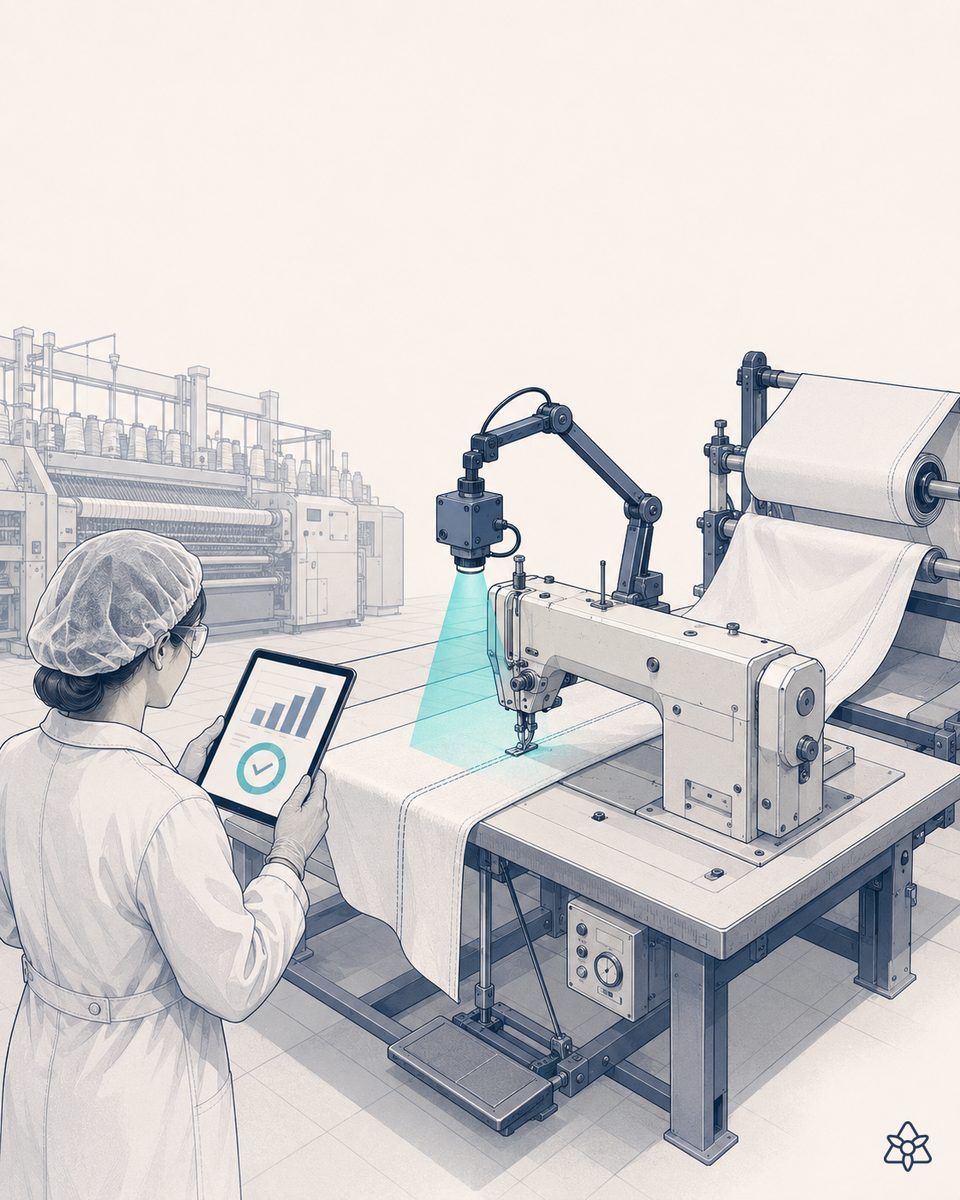
What slips through at the loom ends up stitched into the cushion — and by then it is a recall.
Airbag fabric carries a quality constraint the rest of the textile world does not have: once it has been cut and sewn, visually inspecting for the defect becomes practically impossible and extremely expensive. A pore in the OPW that changes the permeability of the cushion as it inflates cannot be seen from the outside. An irregular seam in the critical zone of the OPW alters the deployment pattern. The tier-1 audits PPM and asks for a dossier — and a defect that reached a vehicle means a recall or, in the worst case, an accident.
The three realities almost nobody cross-references in the plant in time:
- What defect the fabric has at this meter — the operator sees it if they happen to be looking. If not, the fabric keeps moving.
- Exactly where the defect is on the roll — so that cutting downstream can avoid it. A piece of data that lives in the shift notebook.
- Which tier-1 and which OEM are expecting that roll — and therefore which tolerance applies. ERP data that comes into play too late.
The quality standard in automotive is on the order of 25 PPM according to industry references (Symestic). The classic system (operator + final inspection on a light table) works 99% of the time. The remaining 1% is what triggers the tier-1 audit and the penalty.
iLEAN Vision does not replace the inspector — it puts their eyes on the meter coming out right now.
The problem with airbag defects is not ignorance of what to look for: the inspector knows perfectly well. The problem is weaving speed + human visual fatigue. iLEAN Vision acts as the putty between the loom output and the light table downstream, without asking you to change the loom, the traceability system or the cutting flow.
Edge watches the fabric at the loom output. The CNN detects pores, irregular seams and weft defects. It marks the meter, holds the roll or alerts the operator. The person validates — the batch does not move on to cutting by itself.
The iLEAN pieces applied to defect control in airbag fabric:
- iLEAN Vision (Edge) — a terminal with a high-resolution camera over the output of the OPW or conventional loom. The CNN is trained on your own defects during the first weeks (transfer learning on top of the quality baseline). It fires an actuator (stack light, mark on the roll, alert to the operator's earpiece). It works with no network.
- Connect — captures the incoming yarn batch, the silicone batch used for the coating, the warp changeover, the tier-1's notices about special tolerances for a specific OEM, everything that arrives by email, WhatsApp or delivery note. At second zero.
- Agent — links the detected defect to meter, position, loom, batch, shift and yarn lot. It assembles the PPM dossier for the tier-1 and proposes to cutting downstream which meters to scrap. A defect repeating at the same position on the same roll triggers a loom maintenance review — before the major breakdown.
Human inspection on the light table vs. iLEAN Vision at the loom output
| Aspect | Classic human inspection | With iLEAN Vision at the loom |
|---|---|---|
| Inspection point | Light table downstream — the fabric is already finished | Loom output — the fabric is still being formed |
| Defect types | Whatever the inspector can see at table speed | Pores, weft, OPW seams and stains, in milliseconds |
| Defect location | Estimated in meters from the end | Exact meter + coordinate across the width |
| PPM traceability to the tier-1 | Rebuilt by hand for the audit | Automatic per-roll dossier with image |
| Operation without a network | n/a | Edge keeps inspecting and marking |
| Pattern by loom/batch/yarn | The veteran remembers it, if they remember it | The agent cross-references history and proposes an inspection |
Impact estimate for your plant — to be validated with your numbers.
The block below is an estimate to be validated with the specific data of your plant. We put it forward so the committee has an order of magnitude; we refine it during the diagnostic.
- Tier-2 airbag weaving mill with 4-12 Dornier/Picanol/Itema OPW looms or conventional looms for sewn fabric, supplying European or American tier-1s.
- Vision pilot on 1-2 looms (high-resolution camera + CNN trained on your own defects + integration with the traceability system). First value expected within a few weeks.
- Indicative payback between 4 and 9 months depending on monthly volume, roll value, current PPM reported to the tier-1 and the average cost of a nonconformity/return.
- Reduction in PPM caused by fabric defects on the order of ≥30% already during the pilot.
- The hard lever is threefold: PPM to the tier-1 (with dossier and traceability), scrap avoided at the light table, and a lower cost for any nonconformity or recall downstream.
And the quality manager's reasonable doubt
“What if the vision system fails and lets a pore through?” — reliability when the task is anchored (the CNN compares the loom output against the calibrated pattern of that same loom) brings error below 1.5% [1]. Hallucinations are a problem of free AI, not of anchored AI. And even so, the system holds; the person signs. iLEAN does not relieve the quality manager of responsibility: it gives them the eyes the human eye cannot sustain for 8 hours. The traceability of the decision (what Edge saw, what the person validated) stays in the dossier for the tier-1.
[1] OpenAI paper “Why Language Models Hallucinate”, 2025 — on the reliability of AI in tasks anchored to the source. 25 PPM standard in automotive: Symestic reference.
What people ask about defect control in airbag fabric
Which airbag fabric defects can AI vision detect?
The critical defects for an OPW (one-piece woven) airbag or a conventional sewn fabric are: pores that compromise permeability, weft or warp yarns that are broken or replaced by a different count, irregular seams in the OPW that change the geometry of the cushion as it inflates, stains and contamination of the silicone coating, and tension defects caused by abrupt speed changes. iLEAN Vision trains a CNN to recognize each of those patterns at the loom output.
Why is human visual inspection not enough for airbags?
Because the quality standard in automotive is on the order of 25 PPM (parts per million) according to industry references — and the human eye sustained over 8 hours falls well below that reliability. Add to that the fact that a defect passing through to cutting and sewing becomes a stitched cushion with a defect built into it, far more expensive to detect and far more expensive to scrap. The tier-1 customer audits PPM and asks for a dossier — and a defect that reached a vehicle means a recall.
How does iLEAN Vision fit with OPW airbag looms (Picanol, Dornier, Stäubli)?
The Edge is mounted over the fabric output of the loom itself — regardless of the manufacturer. A camera pointed at the fabric, a CNN running local inference in milliseconds, an actuator to alert the operator and a mark on the roll (label, stack light, or a washable ink mark depending on the plant). Nothing is asked of the loom's PLC. It works with no network: if the plant loses WiFi, Edge keeps inspecting and marking.
How is the detected defect linked to tier-1 traceability?
Every detection is associated with a meter and a position on the roll, and is cross-referenced with the yarn batch, the loom and the shift. When that roll goes to cutting, the cut is planned to avoid the marked zone or the zone is scrapped — before sewing and assembling the cushion. And the dossier is already assembled for the tier-1 auditor: image of the defect, time, batch, operator who validated it. It is the hot-bunk pattern applied to airbags: the next shift comes in and the batches have already been cleaned up.
How much does it cost to deploy AI vision for airbag fabric?
The pilot covers 1-2 OPW airbag looms with Edge + a high-resolution camera + training the CNN on your own defects + integration with the production reporting and traceability system. First value expected within a few weeks: the first defective cushion identified before cutting. Indicative payback between 4 and 9 months depending on monthly volume, current PPM reported to the tier-1 and the average cost of a nonconformity. This is an estimate to be validated with your plant's data — we ask for your PPM history and return the ROI in 48h.
More cases in other sectors
- Wet film thickness control in coating — measured while you apply, not discovered at dry film.How iLEAN Edge captures wet film thickness in line during coating application, checks it against volume…
- Submarine manufacturing with AI — a bead out of window is not an incident, it is a life.How iLEAN assists pressure-hull welding, hydrostatic testing and hull-number traceability in submarine…
- Technical textiles — when the garment is PPE, the seam is a legal requirement.Documented iLEAN cases in technical textiles: EN 361 and EN 388 seam control, GOTS and OEKO-TEX…
- Roll-to-VIN traceability is earned day by day — not at 10 pm when the call-back lands.How iLEAN Tracer builds the traceability of every airbag and seat-belt roll up to the vehicle VIN with…
- Aramid (Kevlar) spinning control with AI — the micro-break is invisible, the ballistic test is not.How iLEAN Edge watches tension, speed and micro-breaks in aramid (Kevlar) spinning and alerts before the…
- Pore detection in filter bags — a single one sends the whole batch back.How iLEAN Vision inspects filter bags to detect pores and loose seams before shipment to cement or…
Tell us your case and in 48h we'll send you the estimated ROI of this AI project for your airbag weaving mill.
We work on your plant's real data, not ours. Diagnostic with no commitment.
Request estimated ROI in 48h See other sectors