Pore detection in filter bags — a single one sends the whole batch back.
A 2 mm pore in a bag installed in a cement or ceramic baghouse is an emission outside the limit, a line shutdown at the customer and a returned order — because the customer has no way of knowing how many more are faulty. iLEAN Vision inspects 100% of the bags with a CNN and back-lighting, separates the borderline from the clear-cut, and lets the operator decide where it matters. The person signs.
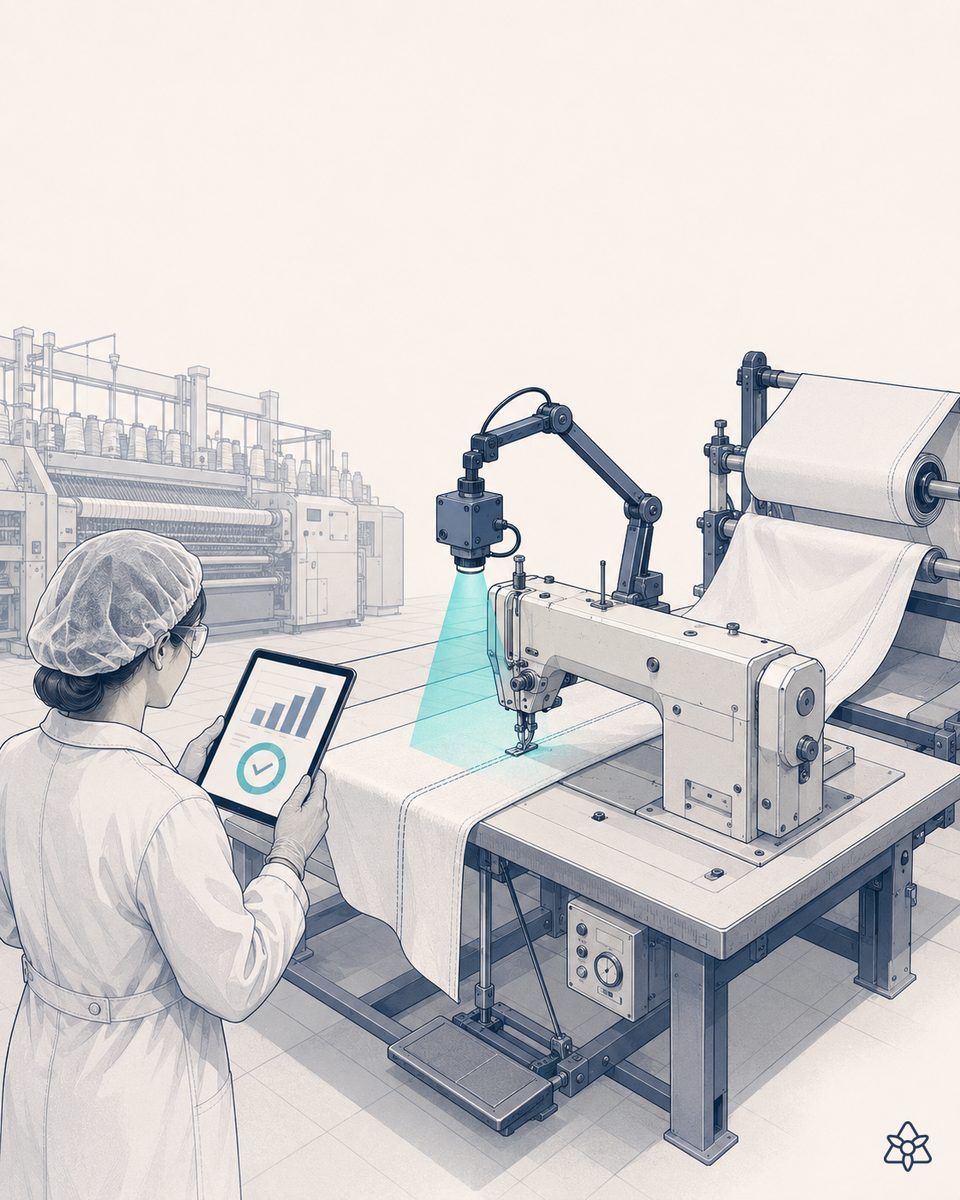
The operator's eye is good — but not at line speed, and not 100% of the shift.
Inspecting filter bags by eye is the classic example of a task a human does well in the morning and badly in the afternoon. There are three relevant defects:
- Pores in the fabric or the felt — areas where density is insufficient. Sizes of 1-3 mm that show up under back-lighting, but not under the overhead light of the workshop.
- Needle defects — perforations from the manufacturing process itself that should not have been left open. Especially frequent at roll changes and at the end of the shift.
- Loose or skipped seams — in the longitudinal closure or in the cuff that attaches to the cage. The bag survives the first pulse cleaning, but tears a few months later.
Sampling inspection cannot detect what it never touches; 100% inspection by an operator saturates the line and the detection rate falls with fatigue. A single bag with a pore installed in the customer's baghouse triggers the environmental fine, shuts down the customer's unit and sends the batch back — because from the outside there is no way to tell the faulty ones from the good ones.
iLEAN Vision does not replace the inspector — it strips out the noise and leaves his eye where it matters.
The problem with bag inspection is not a lack of human talent: it is line speed + fatigue + defects below the threshold of the naked eye. iLEAN Vision acts as a pair of tireless eyes that see with the right light and at tunnel speed — but the decision on a borderline piece is signed by the inspector.
Edge sees the bag with back-lighting and a CNN. Clear defects go to automatic rejection. Borderline ones go to the human review lane. Inspecting 100% stops saturating the person.
The iLEAN pieces applied to filter bag inspection:
- Edge (iLEAN Vision) — a terminal with a camera and a convolutional neural network trained on your fabrics and references. It is installed in an inspection tunnel with back-lighting (the light that makes the pore visible). It processes each bag in milliseconds, fires the actuator (stack light, ejector to the reject lane) and stores the image of the defect. It works with no network: if the plant loses WiFi, Edge keeps inspecting, because what is critical cannot depend on connectivity.
- Connect — captures the reference data sheet (felt type, target basis weight, dimensions, customer specification), the incoming fabric batch and the customer's inspection protocol (PDF, email, specification). It passes them to the Edge at the start of the batch so every bag is inspected against the right pattern.
- Agent — when rejections in a shift rise above the baseline, it cross-references the incoming fabric batch, the machine and the sewing operator, and alerts the production manager to investigate before the order is closed. It anticipates the root cause instead of discovering it in the internal audit.
Operator inspection vs. Vision in line
| Aspect | Visual inspection + sampling | With iLEAN Vision + Connect + Agent |
|---|---|---|
| Coverage | Sampling + 100% visual at the end of the shift | Real 100% with the camera, borderline lane for humans |
| Detection of pores < 3 mm | Limited (depends on light and angle) | High with back-lighting + CNN |
| Loose seam detection | Good, but drops at the end of the shift | Constant, shift after shift |
| Defect traceability | Inspector's sheet, fragmentary | Image and defect class stored per bag number |
| Operation with no network | n/a | Edge keeps running on cabinet power |
| Root cause of a rise in rejections | Investigation afterwards, weeks | Agent cross-references fabric batch + machine + operator |
Impact estimate for your plant — to be validated with your numbers.
The block below is an estimate to be validated with the specific data of your plant. We put it forward so the committee has an order of magnitude; we refine it during the diagnostic.
- Filter bag manufacturer with 1-3 sewing lines, customers running cement/ceramic/asphalt baghouses, return rate for defects between 0.5% and 3% of shipped value.
- iLEAN Vision pilot on one line (the Pareto one: the reference that concentrates the volume and the complaints). Back-light tunnel + CNN + actuator. First value expected in a few weeks.
- Indicative payback between 4 and 9 months, depending on how often returns happen and on the average cost of a returned batch (bag + reverse logistics + the customer's lost output + commercial damage).
- Reduction in returns for detectable defects ≥ 30% (a defensible floor; the hard lever is a single return avoided, which pays for the pilot).
And the quality manager's reasonable doubt
“What if the camera rejects bags that are fine?” — the model works with three classes (clean / clear defect / borderline), not with two. Borderline ones go to the human lane, and the inspector decides. Besides, hallucination is a problem of free generation, not of anchored tasks; here the CNN classifies an image, a task with known metrics and adjustable thresholds, where the best models reach very low error rates [1]. And the veteran inspector is still in charge: what changes is that he no longer inspects 100%, only what genuinely needs his eye.
[1] OpenAI paper “Why Language Models Hallucinate”, 2025 — on the reliability of AI in anchored tasks.
What people ask about pore detection in filter bags
What defects are you looking for in a filter bag before shipment?
Three families: fabric pores (areas where the weave or the felt has insufficient density and lets particles through), needle defects (perforations from the manufacturing process that should not have been left open) and loose or skipped seams in the longitudinal closure and in the cuff. A single defect in a bag installed in a cement or ceramic baghouse means a dust leak point, an emission above the limit and a returned batch — because the customer has no way of knowing how many more are faulty.
Why are pores in a filter bag so hard to see with the human eye?
Because the defect is usually below the size threshold an operator can distinguish at line speed. A 6-meter bag is inspected in thirty seconds with the naked eye: a 1-2 mm pore halfway down the body is invisible unless the light hits it at exactly the right angle. Back-lit inspection catches more, but it slows the line down. And by the end of the shift the operator's fatigue drives the detection rate down — always.
How does iLEAN Vision inspect a filter bag in line?
iLEAN Vision is an Edge terminal with a camera and a convolutional neural network (CNN) trained on the bags your plant makes. It works with back-lighting in the inspection tunnel: the bag passes through, the camera captures a 360° image (or successive rotations), and the CNN detects pores, perforations and loose seams in milliseconds. If it finds a defect, it fires the actuator — stack light, ejector to the reject lane — and the operator decides whether the bag is reworked or scrapped. Edge keeps inspecting even if the plant loses the network.
What happens to the bags flagged as borderline?
They go to a human review lane. The system sorts into three buckets: clean (moves on to packing), clear defect (reject or rework) and borderline (human review). The borderline lane is deliberately small — the value lies in the operator only looking at the ones that genuinely need an expert eye, not at the whole batch. Sampling inspection stops making sense: now 100% is inspected, and the person decides where it matters.
How much does a faulty bag reaching the customer cost?
Far more than the bag. In a cement or ceramic baghouse, an installed bag with a pore means: dust emission above the limit (risk of a fine), a unit shutdown for replacement (lost output on the customer's line), a batch return from the customer (because they do not know how many more are faulty) and damage to the commercial relationship. That is exactly Vision's lever: every returned batch avoided pays for the pilot before the quarter is over. We ask for your data and send you the estimated ROI in 48h.
More cases in other sectors
- A pore in airbag fabric is not a defect — it is a recall on the finished vehicle.How iLEAN Vision inspects airbag fabric in line, detecting pores, irregular seams and weft defects…
- Roll-to-VIN traceability is earned day by day — not at 10 pm when the call-back lands.How iLEAN Tracer builds the traceability of every airbag and seat-belt roll up to the vehicle VIN with…
- Aramid (Kevlar) spinning control with AI — the micro-break is invisible, the ballistic test is not.How iLEAN Edge watches tension, speed and micro-breaks in aramid (Kevlar) spinning and alerts before the…
- Carbon fiber prepreg traceability with AI — the clock starts the moment it leaves the freezer.How iLEAN Tracer logs out-of-freezer hours roll by roll for carbon fiber prepreg and builds the per-roll…
- Color batch matching in dyeing — an off-shade batch is water, energy and a broken delivery date.How iLEAN Edge controls dye bath color with an in-line spectrophotometer and adjusts the formula in real…
- EN 14683 surgical mask control with AI — basis weight, BFE and welding reconciled before packing.iLEAN Edge controls basis weight, BFE and ultrasonic welding on the EN 14683 surgical mask line with…
Tell us your case and in 48h we'll send you the estimated ROI of this AI project for your filter bags.
We work on your plant's real data, not ours. Diagnostic with no commitment.
Request estimated ROI in 48h See technical textiles