Carbon fiber prepreg traceability with AI — the clock starts the moment it leaves the freezer.
Structural prepreg has two clocks — shelf life in the freezer and out-of-freezer life at room temperature — and the aerospace auditor wants them roll by roll, not by theoretical batch. iLEAN Tracer reads the roll label, adds up the hours out of the cold and builds the audit-ready file. The person signs.
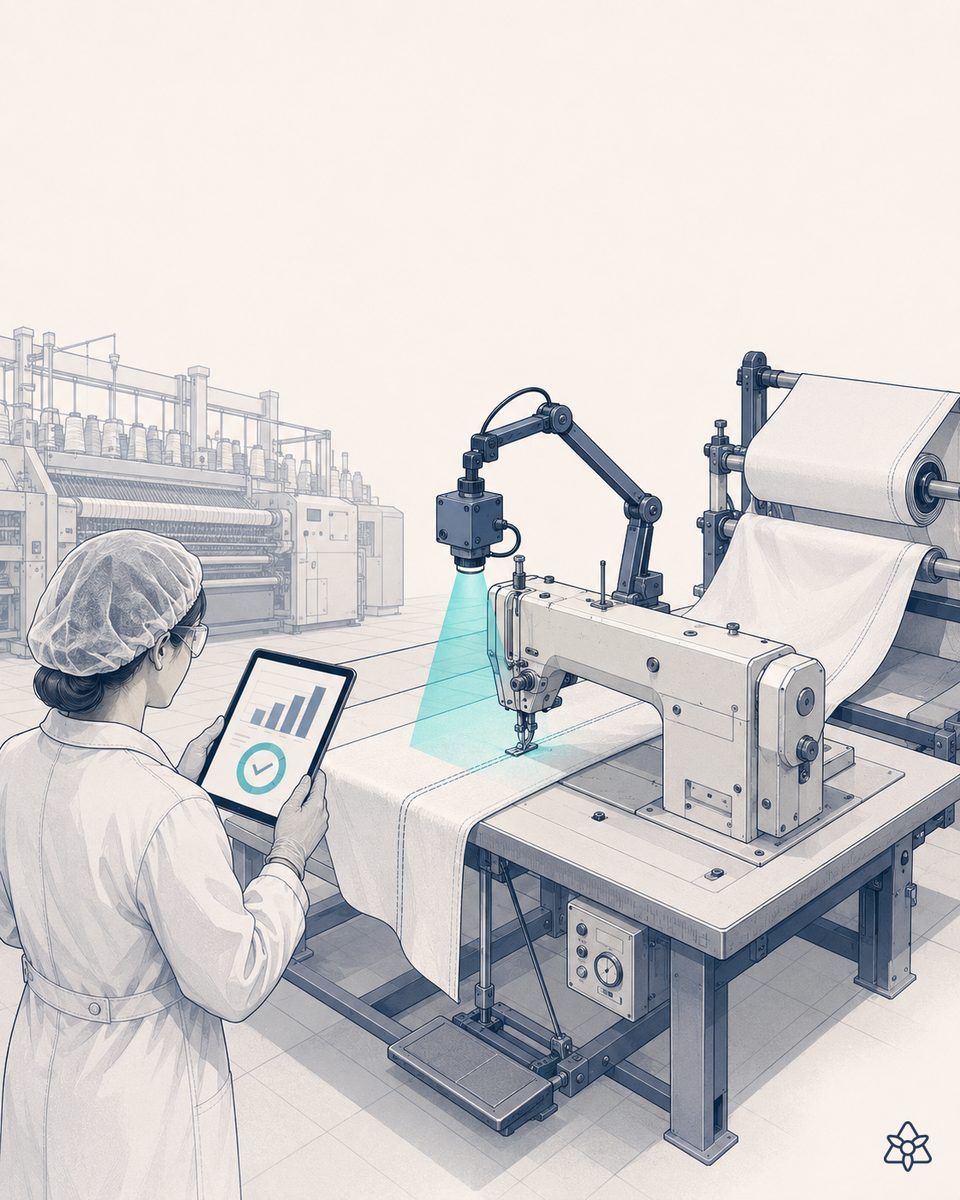
Two clocks that almost nobody adds up roll by roll.
Carbon fiber prepreg is not an inert material you store and then use: it is a living resin with two clocks that the aerospace auditor demands for each individual roll.
- Shelf life — the months the roll can survive at −18 °C in the freezer. It is usually on the supplier's certificate and in the ERP, if somebody entered it.
- Out-of-freezer life — the cumulative hours at room temperature, adding up every time the roll comes out of the cold to be cut, laid up, or simply left on the table. It usually lives in a spreadsheet kept by the materials manager, if somebody updates it.
- Actual room temperature — the declared out-life assumes 23 °C. If the room is at 26 °C because the air conditioning is down, the clock runs faster. It is usually nowhere anyone can act on.
The quality manager knows this, but cannot recalculate the balance of every roll each time a cabinet is opened. The laminator, gloves on and in a hurry, glances at a yellow label, thaws and cuts. The classic system works 99% of the time. That 1% is the expired roll that reaches the layup tool — and the AS9100 audit NCR does not forgive.
iLEAN does not add another spreadsheet — it seals the cracks between the freezer, the table and the ERP.
The prepreg problem is not a lack of information: it is information living on separate islands that, at the critical moment (the cabinet door opening, the second thaw, the shift change with a half-used roll), does not reach the decision-maker in time. iLEAN acts as the putty that fills those gaps, without asking you to change your ERP, your composites MES or your layup room.
The terminal reads the roll label as it leaves the cabinet. The agent adds up the clock against the actual room temperature. The per-roll file builds itself and is handed to the auditor signed.
The three iLEAN pieces applied to carbon fiber prepreg traceability:
- Edge — a computer-vision terminal (CNN) at the freezer cabinet door and at the cutting table. It reads the roll label (Hexcel, Toray, Solvay, Cytec), records the in/out event and, if you want, triggers a stack light when a roll has been out too long. It works with no network. If the plant loses WiFi, Edge keeps reading and recording.
- Connect — captures the layup recipe, the supplier's delivery note, the manufacturer's certificate and the reading from the ambient temperature sensor. And it also captures what comes in from outside (an email from the supplier with a change to the batch out-life, a WhatsApp message from the R&D manager with an authorized exception for a specific roll) at second zero.
- Agents — add up the clock roll by roll, cross-reference it with the actual temperature, maintain the balance and assemble the per-roll file in auditor format (certificate + temperature curve + out-of-freezer hours + signature of the person who released it). If a roll goes past the limit, the agent holds the material and alerts the quality manager through whatever channel they use. The person validates and signs; the roll is never released on its own.
Manual prepreg traceability vs. a live file with iLEAN Tracer
| Aspect | Spreadsheet + yellow label on the roll | With iLEAN Edge + Connect + Agents |
|---|---|---|
| Out-of-freezer clock per roll | Added up by hand; depends on the laminator writing it down | Added up automatically from the label reading on the way out |
| Actual room temperature | Assumed (a theoretical 23 °C) | Integrated sensor; the clock runs accordingly |
| Real-time balance | Calculated when somebody asks | Visible to operator and quality on screen and earpiece |
| Expired roll | Caught when unwrapping it or at the audit | Held before it leaves the cabinet |
| Operation without a network | n/a | Edge keeps reading with its own light |
| Per-roll file for AS9100 | Rebuilt by hand, weeks of work | Per-roll dossier, automatic, ready for the auditor |
Impact estimate for your plant — to be validated with your numbers.
The block below is an estimate to be validated with the specific data of your plant. We put it forward so the committee has an order of magnitude; we refine it during the diagnostic.
- Aerospace composites plant with a layup room, 2-4 prepreg freezer cabinets and ATL/manual cutting tables. Volume of rolls opened per month in the tens to the low hundreds.
- iLEAN Tracer pilot on one cabinet and one table: camera for label reading + ambient temperature sensor + integration with the composites ERP/MES. First value expected within a few weeks (out-life balance per roll visible on screen and traced into the file).
- Indicative payback between 4 and 9 months, depending on the number of rolls scrapped per year because the clock was uncertain, the average cost of a structural roll, and the weight of historical AS9100 audit NCRs.
- The hard levers: rescued rolls that the system certifies as still within out-life (instead of scrapping on "I don't know", scrapping on "it exceeds"), a reduction of ≥ 30% in the time spent preparing the audit file, and one NCR avoided in primary structure — which on its own pays for the pilot.
And the quality manager's reasonable doubt
“What if the AI makes up an exit time that never happened?” — hallucination is a problem of free generation, not of anchored tasks. Reading the label and computing the clock are tasks anchored to the source: read a code, add up minutes, compare against a threshold. In that family of tasks the best models brought error below 1.5% [1]. And even so, what is critical is never decided alone: iLEAN holds the roll and the person signs. The three safety rings are there for exactly this — ring 1 (the OT network, the machines) accepts nothing that has not been validated and signed by a person.
[1] OpenAI paper “Why Language Models Hallucinate”, 2025 — on the reliability of AI in anchored tasks.
What people ask about carbon fiber prepreg traceability
What is out-of-freezer life for carbon fiber prepreg?
Carbon prepreg is stored at −18 °C because the thermoset resin (epoxy, BMI) keeps reacting slowly at room temperature. The supplier declares two clocks on the data sheet: shelf life (months in the freezer) and out-life or out-of-freezer life (cumulative hours at room temperature before cure). For typical aerospace structural prepregs, out-life runs from 240 to 720 hours, depending on the system and on whether the laminate goes into a primary or a secondary structure. Once that clock runs out the roll is scrapped — and the auditor asks to see the calculation roll by roll, not by theoretical batch.
How do you log time out of the freezer for each individual roll?
By cross-referencing three pieces of data that today live on separate islands: the roll label (part number, manufacturing date, first thaw), the freezer in/out event (captured by reading the label or by a code on the cabinet door) and the ambient temperature of the layup room during those hours. iLEAN Tracer adds up the clock roll by roll, subtracts it from the declared out-life and keeps a real-time balance visible to the operator and to the quality manager. When the balance drops below the agreed threshold, the system holds the roll. The person signs — the roll is never released on its own.
What does an aerospace audit require regarding prepreg?
AS9100 and aerospace tier-1 quality plans (especially for primary structure) require the per-roll file: manufacturer's certificate, storage conditions since receipt, cumulative out-of-freezer hours with their traceability, DSC cure testing if out-life has been exceeded, and the signature of the person who released the material for cutting. Rebuilding that file by hand weeks later is what breaks many audits. iLEAN Tracer assembles it at second zero, with the event already documented.
Does it work if the plant uses rolls from several suppliers with different labels?
Yes. Label reading uses computer vision (CNN) and OCR on the supplier's label, whether it is Hexcel, Toray, Solvay, Cytec or any other. iLEAN Connect normalizes the formats and stores both the raw data and the normalized data. If a supplier changes the label layout, the system adapts without throwing away the history. And for rolls with no readable code, the operator can dictate the part number and the system validates it against the delivery note.
How much does AI prepreg traceability cost in an aerospace composites plant?
An iLEAN Tracer pilot in a layup room is of the same order of magnitude as any Edge + Connect pilot in an industrial plant: camera-equipped terminals at the freezer cabinets and cutting tables + integration with the ERP/MES and the quality system, plus an annual license. A reasonable payback is measured in months, and the hard lever is a single roll rescued from an unjustified scrap (a structural prepreg roll costs several thousand euros) or, the other way round, a single audit NCR avoided. We ask for your plant's data and send you the estimated ROI in 48h with your numbers.
More cases in other sectors
- Roll-to-VIN traceability is earned day by day — not at 10 pm when the call-back lands.How iLEAN Tracer builds the traceability of every airbag and seat-belt roll up to the vehicle VIN with…
- Aramid (Kevlar) spinning control with AI — the micro-break is invisible, the ballistic test is not.How iLEAN Edge watches tension, speed and micro-breaks in aramid (Kevlar) spinning and alerts before the…
- Pore detection in filter bags — a single one sends the whole batch back.How iLEAN Vision inspects filter bags to detect pores and loose seams before shipment to cement or…
- Color batch matching in dyeing — an off-shade batch is water, energy and a broken delivery date.How iLEAN Edge controls dye bath color with an in-line spectrophotometer and adjusts the formula in real…
- EN 14683 surgical mask control with AI — basis weight, BFE and welding reconciled before packing.iLEAN Edge controls basis weight, BFE and ultrasonic welding on the EN 14683 surgical mask line with…
- Seam control on EN ISO 20345 safety footwear with AI — the skipped stitch reaches the customer.How iLEAN Vision inspects critical seams on EN ISO 20345 safety footwear to prevent bond-test failures…
Tell us your case and in 48h we'll send you the estimated ROI of this AI project for your layup room.
We work on your plant's real data, not ours. Diagnostic with no commitment.
Request estimated ROI in 48h See technical textiles