Color batch matching in dyeing — an off-shade batch is water, energy and a broken delivery date.
When two batches dyed with the same formula come out different, it is not the formula: it is the dyestuff batch, the water, the thermal profile and the jet load that nobody cross-referenced in time. iLEAN Edge reads the in-line spectrophotometer, cross-references it with the recipe and the history, and proposes the adjustment to the operator before the cycle ends. The person signs — rework is avoided on the line, not discovered in the warehouse.
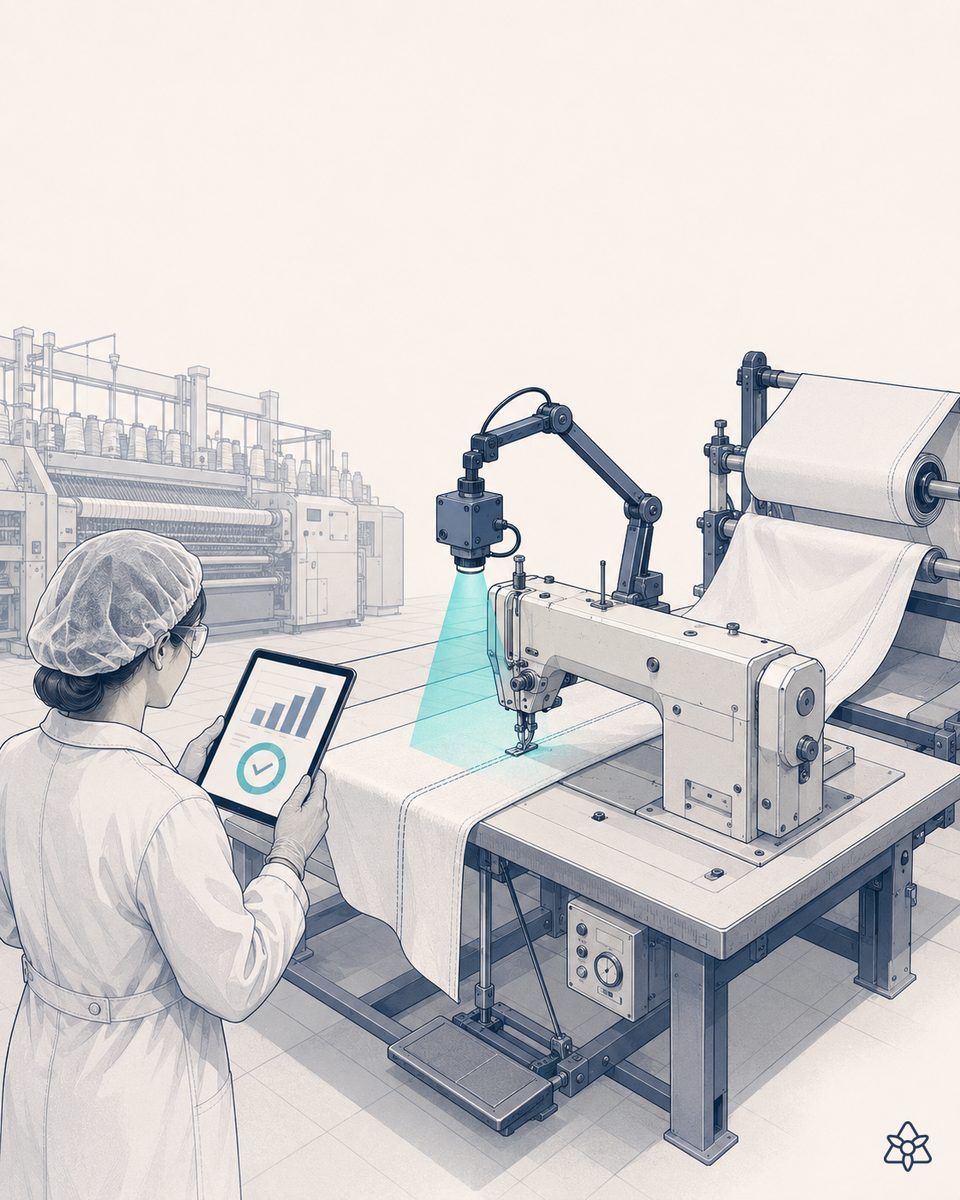
Color does not break in the recipe — it breaks between the recipe and everything else.
A batch that misses the target ΔE is always the intersection of a correct formula with one (or several) factors that were not cross-referenced in time:
- Dyestuff batch — two deliveries from the same supplier can have slightly different real concentrations. The control sheet rarely records it.
- The day's water — hardness, pH, residuals. It changes with the rain, with the filter, with the hour.
- Real thermal profile — the thermostat says one thing, the jet thermocouples say something slightly different. The ramp ran 3 minutes longer because the operator opened up to add the auxiliary.
- Jet load — the liquor-to-goods ratio is not exactly the one on the sheet; the veteran operator knows it, but he is on another jet.
The lab spectrophotometer measures at the end of the cycle — that is, when nothing can be corrected without rework. The batch comes out off-shade, quality rejects it or the customer rejects it, and the rework pays for water, energy and jet time. The veteran operator knows how to read the signal and correct mid-cycle — but that knowledge lives in his head and walks out with him the day he retires.
iLEAN Edge does not replace the dyer — it gives him the eye he needs at plant speed.
The batch matching problem is not a lack of measurement: it is measurement that arrives too late and data living in islands (dyestuff batch on one sheet, water on another, thermal profile in the jet SCADA, customer standard in an email). iLEAN acts as the putty that fills the gaps between the jet, the lab, the formula and the customer's standard — without asking you to change your current system.
Edge reads the spectrum while the batch is still in the jet. The agent cross-references it with recipe, water and thermal profile, and proposes the adjustment before the cycle ends. The person signs — Edge never touches the recipe without an operator.
The iLEAN pieces applied to dyeing by color batch matching:
- Edge — a terminal with a neural network connected to the in-line spectrophotometer (in situ on the jet or in a bypass). It cross-references spectrum, formula, real temperature and the characteristics of the dyestuff batch. When the curve points toward missing the target ΔE, it pushes an adjustment proposal to the jet panel and to the operator's phone before the cycle ends. It works with no network: the detection logic lives on the terminal; if the plant loses WiFi, Edge keeps reading and proposing.
- Connect — captures the day's water hardness (from the lab reading that arrives by email, from the chemical supplier's analysis, from the shift lead's sheet), the dyestuff batch data sheet (supplier PDF) and the customer's standard (PDF, photo of the reference color, ΔE specification). It deposits it in the system so Edge has it when the cycle starts.
- Agent — watches every jet in the dye house and, when several cycles share the same deviation pattern (for example, a change in the batch of one colorant), alerts production to review the formula for the whole group before scheduling the next batches. It anticipates instead of waiting for the damage.
Dyeing with no eye on the line vs. dyeing with iLEAN Edge
| Aspect | Classic dyeing (measured at end of cycle) | With iLEAN Edge + Connect + Agent |
|---|---|---|
| Color measurement | Lab spectrophotometer at the end, by sample | In-line spectrophotometer, continuous reading during the cycle |
| Deviation detection | End of cycle, outside the correction window | Mid-cycle, with margin to adjust the formula |
| Veteran's knowledge | Lives in his head, walks out with him | Stays in the plant as a permanent capability of the system |
| Rework from out-of-tolerance ΔE | Every time the batch misses the standard | Rework ≥ 30% lower (estimate to be validated) |
| Operation with no network | n/a (depends on the SCADA) | Edge keeps running on cabinet power |
| Traceability per batch | Operator's sheet, fragmented | Per-batch file with spectrum, adjustments and signature |
Impact estimate for your plant — to be validated with your numbers.
The block below is an estimate to be validated with the specific data of your plant. We put it forward so the committee has an order of magnitude; we refine it during the diagnostic.
- Knit fabric dye house with 4-8 jets, rework rate from ΔE deviation between 3% and 8% of batches, customer with a demanding tolerance (ΔE < 1 against the standard and between batches).
- Edge pilot on one or two jets (the Pareto ones: those that concentrate the volume and the customer complaints). In-line spectrophotometer + integration with the MES recipe + on-the-fly adjustment. First value expected in a few weeks.
- Indicative payback between 4 and 9 months, depending on the average cost of a rework (water, energy, dyestuff, jet hour) and on how often batches are thrown away.
- Rework reduction ≥ 30% (a defensible floor; the hard levers are water and energy avoided, jet cycles freed up, and damage to the customer's delivery date).
And the dyeing manager's reasonable doubt
“What if the AI proposes a strange adjustment and ruins the batch?” — Edge never touches the recipe without a signature. The proposal reaches the jet panel and the operator's phone; the operator decides. Besides, hallucination is a problem of free generation, not of anchored tasks; here the agent extracts a spectrum, compares it with a standard and proposes a physical-chemical adjustment from a known catalog. In that class of tasks, the best models brought error below 1.5% [1]. And the veteran operator is the one who validates — he is not replaced, his eye is multiplied across every jet at once.
[1] OpenAI paper “Why Language Models Hallucinate”, 2025 — on the reliability of AI in anchored tasks.
What people ask about color batch matching in textile dyeing
Why do two batches dyed with the same formula come out different?
Because the formula is only one of the variables. Final color also depends on the dyestuff batch (real concentration varies between deliveries from the same supplier), on the water hardness that day, on pH, on the temperature profile of the bath, on real versus scheduled time and on how heavily the jet was loaded. If all those variables are not cross-referenced at second zero with the in-line spectrophotometer, the color deviation (ΔE) is only measured at the end — and by then the rework is already paid for.
What is color batch matching and why is it hard?
Color batch matching means hitting the customer's color standard batch after batch, with a ΔE tolerance typically below 1.0 against the standard and between batches. It is hard because it mixes chemistry (the formula), physics (how the dyestuff behaves on the fiber) and operations (the jet, the water, the thermostat). The veteran dyeing operator learns to read the signal and correct it; the problem is that this knowledge lives in his head and walks out with him the day he retires.
How does iLEAN Edge adjust the formula in real time?
iLEAN Edge is a terminal with a trained neural network that, during the dyeing cycle, cross-references the spectrum read by the in-line spectrophotometer, the loaded formula, the real temperature profile and the jet parameters. When it detects that the curve is heading away from the target ΔE, it proposes a corrective adjustment to the operator (more or less salt, more time, a touch of a specific dyestuff) before the cycle ends. The person validates and executes — the agent never touches the recipe without a signature. Edge keeps working even if the plant loses the network.
What happens to the veteran operator's knowledge once Edge arrives?
It stays in the plant instead of walking out with him the day he retires. Edge's neural network is trained on your own operation — including how the veteran corrects things when they go wrong — and captures that pattern as a permanent capability of the system. The veteran does not lose his job: he gains a tool that strips out the noise and leaves him the hard calls. Young people join the dye house with a safety net instead of the fear of ruining a batch.
How much does it cost to avoid one dyeing rework?
More than it looks. A batch thrown away or reprocessed adds up water, energy, dyestuff and auxiliaries; it occupies the jet for another cycle and pushes back every batch behind it in the schedule. In high-end textiles a batch can be worth several thousand euros and the damage to the customer's delivery date is severe. That is exactly Edge's lever: every rework avoided pays for the pilot before the quarter is over. We ask for your plant's data and send you the estimated ROI in 48h.
More cases in other sectors
- Aramid (Kevlar) spinning control with AI — the micro-break is invisible, the ballistic test is not.How iLEAN Edge watches tension, speed and micro-breaks in aramid (Kevlar) spinning and alerts before the…
- Pore detection in filter bags — a single one sends the whole batch back.How iLEAN Vision inspects filter bags to detect pores and loose seams before shipment to cement or…
- Carbon fiber prepreg traceability with AI — the clock starts the moment it leaves the freezer.How iLEAN Tracer logs out-of-freezer hours roll by roll for carbon fiber prepreg and builds the per-roll…
- EN 14683 surgical mask control with AI — basis weight, BFE and welding reconciled before packing.iLEAN Edge controls basis weight, BFE and ultrasonic welding on the EN 14683 surgical mask line with…
- Seam control on EN ISO 20345 safety footwear with AI — the skipped stitch reaches the customer.How iLEAN Vision inspects critical seams on EN ISO 20345 safety footwear to prevent bond-test failures…
- EN ISO 20471 high-visibility garment control with AI — one centimeter of band decides whether the garment is Class 2 or not.How iLEAN Vision controls retroreflective tape, fluorescent color and band position on EN ISO 20471…
Tell us your case and in 48h we'll send you the estimated ROI of this AI project for your dye house.
We work on your plant's real data, not ours. Diagnostic with no commitment.
Request estimated ROI in 48h See technical textiles