Seam control on EN ISO 20345 safety footwear with AI — the skipped stitch reaches the customer.
On EN ISO 20345 safety footwear, a skipped stitch or a stitch line a few millimeters off is not visible on the shop floor — it shows up in the bond-strength test, in the distributor's audit or in the end user's claim. iLEAN Vision watches every critical seam in line with a CNN, flags the suspect unit and leaves it for the reviewer. The person signs.
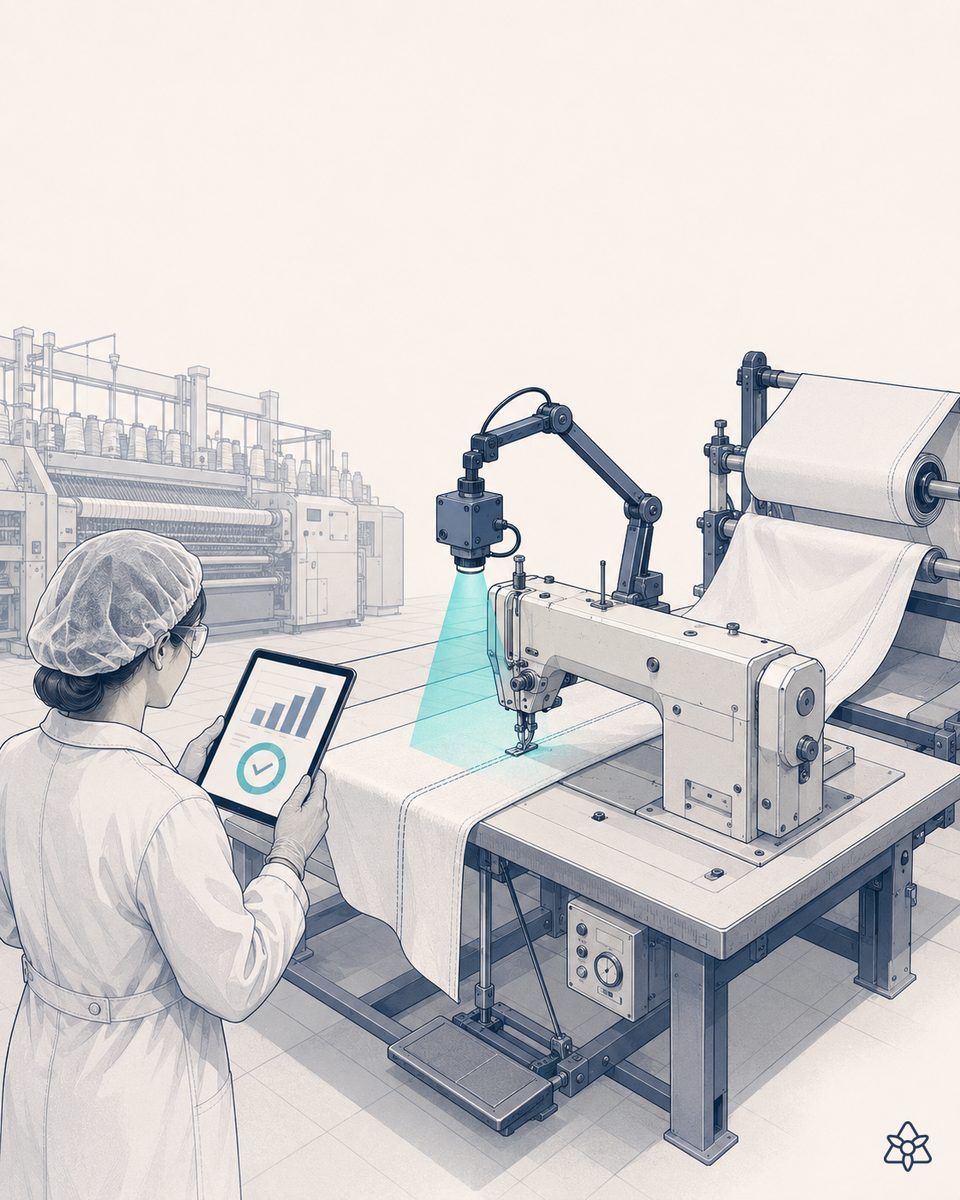
What decides the test is not the style — it is three millimeters of stitching.
An EN ISO 20345 safety boot is designed to withstand 200 J at the toecap and a sole bond strength that leaves no room for improvisation. But the test does not fail because of the rubber, nor because of the composite toecap — it fails because of the seam.
- Skipped stitches — the machine completes the cycle, the operator does not notice the gap, and the seam closes with two stitches missing. In the bond-strength test the stitch line is the first weak point.
- Stitch line drifting off the edge — the panel is not where the pattern expects it and the stitch runs off the reinforcement. Visually it looks fine; mechanically, it is not.
- Badly managed SKU changeover — the order changes, the thread color does not, the stitch program does not, and the first dozen pairs come out with the previous recipe.
The quality manager knows this, but cannot watch every stitch of every pair at 600 pairs per hour. The classic system (visual check at the end of the line + destructive lab sampling) works 99% of the time. That 1% is the distributor's NCR returning 800 pairs, or the batch held at customs because the notified body's type test came back abnormal — and the cost of a single return pays for the line.
iLEAN does not change your Pfaff or Adler machines — it puts eyes where nobody reaches today.
The problem with critical seams is not a lack of procedure: it is information living on islands (the production order in the ERP, the stitch recipe in the supervisor's head, the veteran's eye at the station) that at the critical moment (the first pair after a changeover, the last pair of the night shift) does not arrive in time. iLEAN acts as the putty that fills those gaps, without asking you to replace a single Pfaff.
The camera watches the seam in line. The agent cross-references it with the style recipe. The suspect unit is set aside before assembly. The person signs.
The three iLEAN pieces applied to seam control in safety footwear:
- Edge (Vision) — a terminal with a CNN camera over the output of the sewing machine. It recognizes the correct pattern trained on your own shop floor for each part number, and detects skipped stitches, drifting stitch lines, abnormal density and thread changes. It works with no network. If the plant loses WiFi, Vision keeps inspecting and flagging.
- Connect — captures the production order from the ERP/MES and learns about the model changeover at second zero. It also captures what arrives from outside (a new specification from the retailer's customer, an additional requirement from the notified body) and puts it in front of the quality manager without anyone having to forward anything.
- Agents — cross-reference the visual inspection with the order, the station history and the thread batch. If there is a deviation, they flag the unit and alert both the station and the quality reviewer. They assemble the per-batch inspection dossier that the distributor's audit asks for, on a single sheet. The person validates and signs; the unit does not return to the flow on its own.
Final visual inspection vs. in-line AI inspection with iLEAN Vision
| Aspect | Final visual inspection + sampling | With iLEAN Vision + Connect + Agents |
|---|---|---|
| Seam coverage | Batch sample, reviewer's eye | 100% of units, every critical seam |
| Skipped stitch | Sometimes caught, sometimes not | Flagged within a second, pair pulled out |
| Model changeover | First pairs run with the previous recipe | Vision model switches with the order, in line |
| Off-pattern stitch line | Moves on to assembly | Detected at the machine output |
| Operation without a network | n/a | Vision keeps inspecting on cabinet power |
| Dossier for the distributor's audit | Rebuilt by hand, days | Per batch, automatic, ready to send |
Impact estimate for your plant — to be validated with your numbers.
The block below is an estimate to be validated with the specific data of your plant. We put it forward so the committee has an order of magnitude; we refine it during the diagnostic.
- EN ISO 20345 safety footwear plant with 2-4 sewing lines (upper stitching and Goodyear/Strobel joining), multi-model and multi-thread-color volume.
- iLEAN Vision pilot at one critical station (upper-to-bottom joint or rear reinforcement stitching): camera + lighting + integration with the production order from the ERP/MES. First value expected within a few weeks (detection of skipped stitches and drifting stitch lines above 90%).
- Indicative payback between 4 and 9 months, depending on the history of distributor claims, the number of batches held at customs after abnormal type tests and the average cost of rework.
- Hard levers: a reduction ≥ 30% in seam-related rework, a per-batch inspection dossier that closes the distributor's audit without argument, and a single avoided batch return — which on its own pays for the pilot.
And the quality manager's reasonable doubt
“What if the AI lets skipped stitches through or blocks good pairs?” — hallucination is a problem of free generation, not of anchored tasks. Identifying a stitching pattern already trained in your own plant is a task anchored to the reality of your product, your thread and your machine. In that family of tasks the best models brought error below 1.5% [1]. And even so, what is critical is never decided alone: iLEAN flags and sets aside, and the station reviewer signs before the unit goes back into the flow. The three safety rings exist precisely for this.
[1] OpenAI paper “Why Language Models Hallucinate”, 2025 — on the reliability of AI in anchored tasks.
What people ask about seam control in safety footwear
Which seams are critical under EN ISO 20345 in safety footwear?
EN ISO 20345 (safety footwear for professional use) imposes tests in which the seam shows up directly or indirectly: tear strength of the upper, strength of the upper-to-sole bond, ergonomics, and the integrity of the reinforcements (toecap, penetration-resistant insole, heel counter). In practice, the critical seams that drive both perceived quality and test results are: the joint between the upper panels, the stitching of the rear reinforcement, the upper-to-bottom seam where the construction is stitched (Goodyear, Strobel), and the fixing stitches of the tongue and the eyelet row. A skipped stitch or an off-pattern stitch line in any of them turns into an NCR, into a failed bond-strength test or, worse, into a quality claim from the distributor.
How does iLEAN Vision detect skipped stitches or drifting stitch lines?
iLEAN Vision installs a camera with a convolutional neural network (CNN) over the output of the sewing machine. It learns the visual pattern of correct stitching for each model and part number: stitch length, alignment to the edge, density, thread color. When it detects a skipped stitch, a stitch line drifting off the panel edge, an abnormal density or an unauthorized thread change, it flags the unit and leaves it for the station reviewer. If the plant prefers, it fires an actuator (stack light in the cell, ejection onto a reject conveyor). The person signs — the unit does not go back into the flow without verification.
Does it integrate with the existing sewing machine or does it require a new one?
It integrates. iLEAN Edge is an external terminal mounted over the station: one or more cameras + lighting + a cabinet with the logic. It does not require replacing the machine (Pfaff, Adler, Brother, industrial Singer, whichever it is) and it needs no native interface. If the machine has a modern controller, the sewing event is cross-referenced with the visual reading; if it is an old machine with no interface, Vision reads it just the same — the IRIS logic assumes the plant is not changed so that AI can come in; it is the AI that adapts.
What happens when the model, the color or the thread type changes?
Model changeover is the most frequent event on a professional footwear line, and it is where the traditional system breaks down most often. iLEAN Connect reads the production order from the ERP/MES at second zero of the changeover: new part number, new thread color, new expected stitch length. The Vision model switches automatically to the pattern trained for that style. If the part number is new, the system flags every unit as “to be validated” and leaves the decision to the quality manager until the new pattern has been trained — a few dozen pairs are enough.
How much does AI seam inspection cost in a safety footwear plant?
The order of magnitude of an iLEAN Vision pilot on a sewing line is that of any industrial Edge pilot: terminals with camera + lighting + integration with ERP/MES, plus an annual license. A reasonable payback is measured in a few months — the hard lever is avoiding rework caused by a distributor claim (batch return, reverse shipping, damage to the quality reputation) and a failed bond-strength test on a batch in progress. We ask for your plant's data and send you the estimated ROI in 48h with your numbers.
More cases in other sectors
- Carbon fiber prepreg traceability with AI — the clock starts the moment it leaves the freezer.How iLEAN Tracer logs out-of-freezer hours roll by roll for carbon fiber prepreg and builds the per-roll…
- Color batch matching in dyeing — an off-shade batch is water, energy and a broken delivery date.How iLEAN Edge controls dye bath color with an in-line spectrophotometer and adjusts the formula in real…
- EN 14683 surgical mask control with AI — basis weight, BFE and welding reconciled before packing.iLEAN Edge controls basis weight, BFE and ultrasonic welding on the EN 14683 surgical mask line with…
- EN ISO 20471 high-visibility garment control with AI — one centimeter of band decides whether the garment is Class 2 or not.How iLEAN Vision controls retroreflective tape, fluorescent color and band position on EN ISO 20471…
- Critical seams on the EN 361 fall arrest harness with vision AI — the defect that eye fatigue lets through is the one that ends up in court.iLEAN Vision detects skipped stitches, loose stitching and pattern deviations in the critical seam of…
- EN 388 dossier for cut-resistant gloves with AI — the batch file, ready when the customer asks for it.iLEAN Writer assembles the EN 388 dossier for every cut-resistant glove batch: tests, raw material and…
Tell us your case and in 48h we'll send you the estimated ROI of this AI project for your sewing line.
We work on your plant's real data, not ours. Diagnostic with no commitment.
Request estimated ROI in 48h See technical textiles