EN 388 dossier for cut-resistant gloves with AI — the batch file, ready when the customer asks for it.
When the audit arrives or the customer asks for EN 388 conformity, the batch dossier usually takes days to rebuild by hand. iLEAN Writer cross-references cut/abrasion tests, yarn raw material certificates and the production order, and leaves the dossier ready in minutes. The person signs.
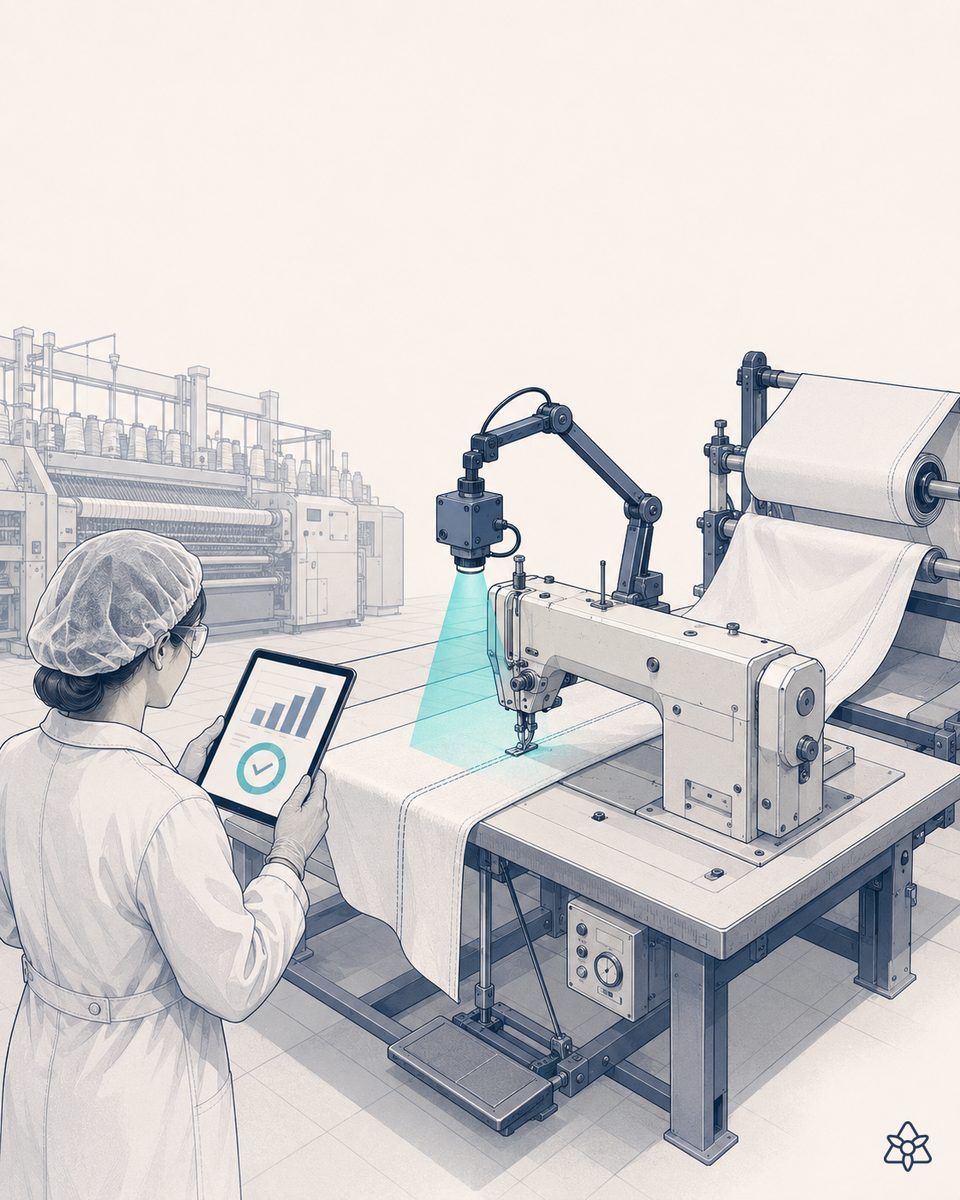
Four sources that are never on the same table at the same time.
A compliant EN 388 dossier is the intersection of four things that, in most technical textile plants, each live on a different island:
- The laboratory test — the notified body's report with the A-F levels of the Coup test and the final classification (e.g. 4X43C). In a folder belonging to the quality manager.
- The raw material certificate — the data sheet for the HPPE yarn, for the polyurethane coating, for the nitrile. It arrives by email from the buyer, as a PDF, in a different format from every supplier.
- The batch production order — machine, shift, knitting recipe, coating applied. It is in the MES or in the line lead's spreadsheet.
- The batch incidents — a yarn package change, a stoppage due to a defect, a batch held and then released. In the operator's head or on a paper report.
When an automotive, logistics or defense customer asks for the dossier of batch 24-XXXX, somebody spends two or three days hunting for each document, reconciling them and putting together a presentable PDF. It works 99% of the time — and that 1% is the one that arrives late to the audit, and then the contract is called into question.
iLEAN Writer does not add a fifth system — it seals the cracks between the four you already have.
The problem with the EN 388 dossier is not a lack of information: it is information living on islands that at the critical moment (the customer's request, the auditor turning up unannounced) does not cross-reference itself. iLEAN acts as the putty that fills those joints between the lab, the buyer, the MES and the shop floor, without asking you to change any of the systems you already have.
Connect captures the certificates wherever they are. Writer cross-references tests, raw material and production order. The dossier comes out signed and traceable, ready for the customer or the auditor. The person validates.
The iLEAN pieces applied to the EN 388 dossier for cut-resistant gloves:
- Connect — listens on every channel batch information comes in through: the notified body's PDF in the quality inbox, the HPPE yarn supplier's data sheet in the buyer's inbox, the shift lead's WhatsApp message about a package change, a forgotten spreadsheet with the coating recipe. It digitizes all of it and makes it available to the agent.
- Writer (the documentation agent) — lives on the Central platform and cross-references the four sources against the EN 388 classification declared on the batch labeling. If the test levels do not match the batch recipe, or if the yarn supplier changed mid-shift and the new data sheet has not been verified, Writer flags it as an exception before closing the dossier.
- Legacy integrations — ERP, MES and certificate folders are plugged in exactly as they are. If the coating dispenser is an old machine with no interface, Connect reads it in intermediate mode (every N minutes) or from a photo taken by the operator; the integration does not force you to throw anything away.
And the safety boundary: Writer proposes the dossier; the quality manager signs. The three rings of the IRIS system guarantee that nothing affecting the conformity declared to the customer goes out without human validation.
EN 388 dossier rebuilt by hand vs. dossier cross-referenced with iLEAN
| Aspect | Manual dossier | With iLEAN Connect + Writer |
|---|---|---|
| A customer request | Quality searches by hand in four places | Dossier available in minutes, already pre-assembled |
| HPPE yarn certificate | In the buyer's inbox, a different format per supplier | Captured by Connect the day it arrived, attached to the batch |
| Package change mid-batch | The operator remembers it, or does not | Recorded by Connect, flagged as an exception by Writer |
| Match against the declared EN 388 classification | Quality checks it by eye | Writer compares A-F levels with recipe and raw material |
| Surprise audit by the buyer | Three days of panic | The requested batch dossier in five minutes |
| Legal defense against a claim | Rebuilt after the fact, with gaps | A signed documentary chain, traceable back to raw material |
Impact estimate for your plant — to be validated with your numbers.
The block below is an estimate to be validated with the specific data of your plant. We put it forward so the committee has an order of magnitude; we refine it during the diagnostic.
- EN 388 cut-resistant glove plant with 3 knitting and coating lines, multi-customer (automotive + logistics + defense), dossiers requested several times a month.
- Writer pilot with integration to ERP/MES, Connect capture of the buyer's mailboxes (yarn and coating certificates) and a connection to the EN 388 laboratory report folder. First automated dossier within a few weeks.
- Indicative payback between 4 and 9 months, depending on the number of dossiers requested per year and the average cost in quality hours per dossier rebuilt by hand.
- Expected reduction in dossier assembly time of ≥ 30% from the first pilot line, with zero irreversible integration costs.
- The hard lever is a single surprise audit saved and a top customer contract that is no longer questioned because "we cannot find the yarn certificate for batch 24-XXXX".
And the quality director's reasonable doubt
“What if Writer hallucinates and puts data in the dossier that is not real?” — hallucination is a problem of free generation, not of anchored tasks. Writer does not invent: it recontextualizes a piece of data that already exists in another system (the yarn composition from the data sheet, the A-F level from the lab report, the recipe from the MES) into the dossier format. In anchored tasks, the best models brought error below 1.5% [1]. And even so, the dossier does not go out until the person signs.
[1] OpenAI paper “Why Language Models Hallucinate”, 2025 — on the reliability of AI in tasks anchored to the source.
What people ask about the EN 388 dossier for cut-resistant gloves
What does the EN 388 standard require of a cut-protection glove?
The EN 388 standard requires every glove protecting against mechanical risks to be classified with a four- to six-digit code covering abrasion, blade cut (Coup test), tear, puncture and, optionally, ISO 13997 cut (TDM) and impact. Each level requires a compliant laboratory test and a dossier proving that the batch produced corresponds to the batch tested: same raw material, same machine, same knitting pattern. If the dossier does not match the labeling, the EN 388 certificate protects neither the customer nor the manufacturer.
Why does the EN 388 dossier get stuck when a customer asks for it?
Because the data lives on islands: the test certificate is in a folder belonging to the quality manager, the yarn certificate is in the buyer's inbox, the production report is in the MES or in a spreadsheet, and the coating supplier changed three months ago without anyone telling the batch dossier. Rebuilding all of it by hand takes days — and the customer asked for it by tomorrow.
What does iLEAN Writer cross-reference to assemble a batch's EN 388 dossier?
Writer is a documentation agent that cross-references four sources: (1) the compliant EN 388 tests for the model, (2) the raw material certificate for the batch's yarn and coating (the supplier's data sheet), (3) the production order with machine, shift and knitting recipe, and (4) any incident recorded on the line by Connect or Edge. It assembles all of it as a signed dossier and leaves the file ready to send to the customer or the auditor.
How does Writer handle raw material certificates from the yarn supplier?
Connect captures the certificate through whatever channel it arrives on — a PDF in the buyer's inbox, a WhatsApp message from the supplier, a scanned copy in a shared folder — and Writer extracts the relevant parameters (yarn composition, weight, supplier batch) and attaches them to the dossier of the batch produced. If the supplier changed the certificate mid-batch, Writer flags it as an exception and raises the alert before closing the dossier.
How much does it cost to deploy Writer for EN 388 in a technical textile plant?
The Writer pilot needs nothing installed on the line: it starts by connecting the ERP, the MES and the buyer's certificate folders, and delivers value from the first week — the first automatic dossier for the next batch due for audit. A reasonable payback to present to the committee is a matter of several months; the hard lever is the quality time recovered and a single audit saved. We ask for your data and send you the estimated ROI in 48h, with your numbers.
More cases in other sectors
- Seam control on EN ISO 20345 safety footwear with AI — the skipped stitch reaches the customer.How iLEAN Vision inspects critical seams on EN ISO 20345 safety footwear to prevent bond-test failures…
- EN ISO 20471 high-visibility garment control with AI — one centimeter of band decides whether the garment is Class 2 or not.How iLEAN Vision controls retroreflective tape, fluorescent color and band position on EN ISO 20471…
- Critical seams on the EN 361 fall arrest harness with vision AI — the defect that eye fatigue lets through is the one that ends up in court.iLEAN Vision detects skipped stitches, loose stitching and pattern deviations in the critical seam of…
- Geotextile for civil works — one weak meter of the roll is the section that fails years later.How iLEAN Edge controls geotextile basis weight, thickness and uniformity in line with sensors and AI…
- GOTS organic cotton traceability — the TC that never arrived is the premium you lost.How iLEAN Tracer links farm, spinning and weaving with a GOTS chain of custody link by link, captures…
- An undetected yarn break is paid for in meters of scrap fabric — not on the quality report.How iLEAN Vision detects a yarn break on the industrial loom in real time, stops the shed and alerts the…
Tell us your case and in 48h we'll send you the estimated ROI of the automated EN 388 dossier for your plant.
We work on your plant's real data, not ours. Diagnostic with no commitment.
Request estimated ROI in 48h See technical textiles