Geotextile for civil works — one weak meter of the roll is the section that fails years later.
The basis weight, thickness and uniformity of a geotextile decide whether the drainage, separation or reinforcement function holds — and sampling-based control cannot see what happens between two specimens. iLEAN Edge integrates the continuous sensors, cross-references them with the line recipe and marks the stretches of the roll that are unfit for critical works before packing. The person signs. The supervising engineer receives real traceability, not a certificate.
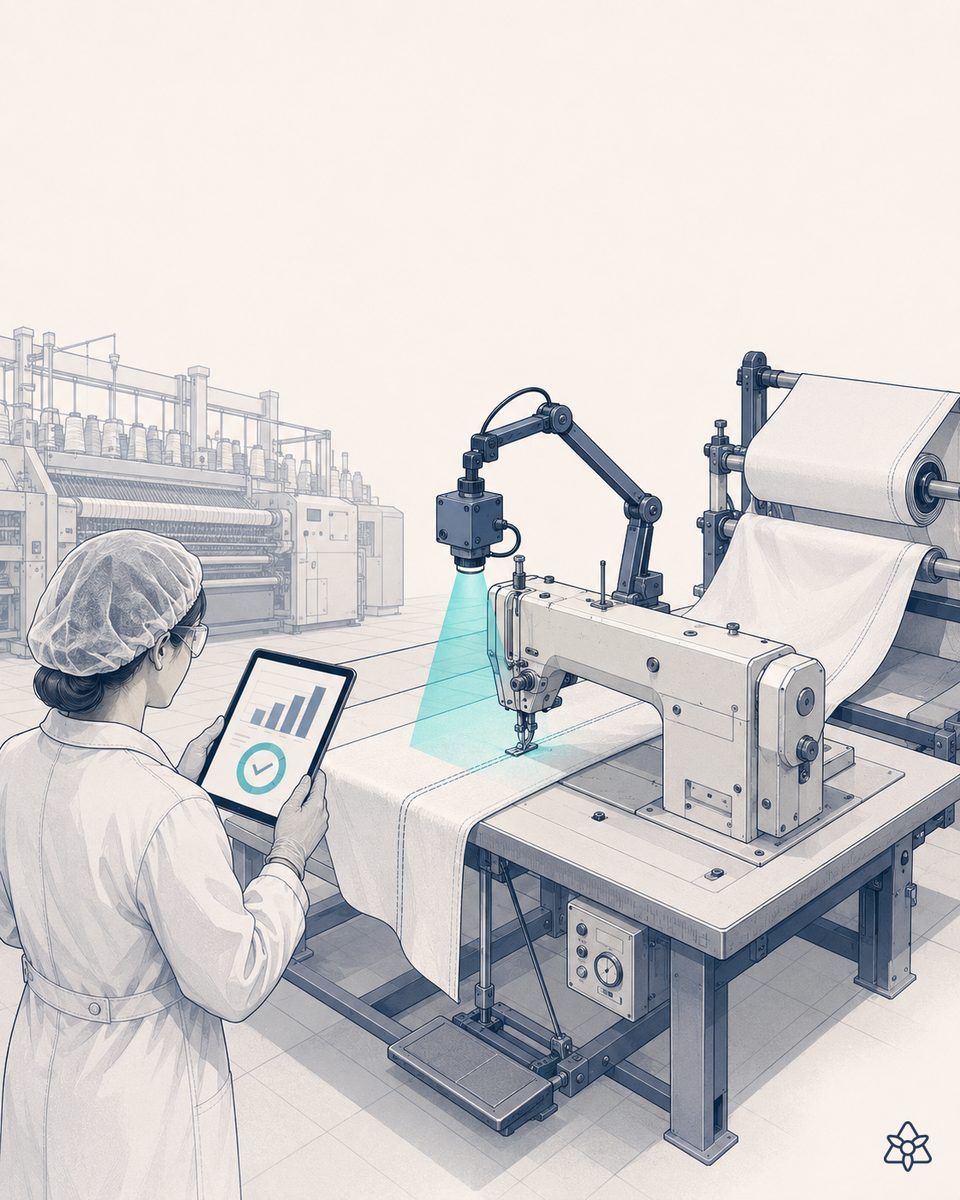
Sampling control cannot see what happens between two specimens — and in civil works that matters.
A geotextile going onto a site has to meet a handful of properties defined by standards — and meet them across the whole roll, not just in the specimen:
- Basis weight (EN ISO 9864) — the declared grams per square meter must be there along and across the roll, not only in the middle.
- Thickness under load (EN ISO 9863) — a roll that is thinner in one zone drains differently and resists less.
- Water permeability (EN ISO 11058) — a compacted zone drains worse.
- Tensile strength (EN ISO 10319) — a weak longitudinal band is the line along which the piece will tear under embankment load.
Classic control is lab sampling: cut a specimen, weigh it, test it. What happens between two samples is invisible. The line operator can read the signals from the needle loom and the calender, but is busy with something else and the drift slips through. When the roll reaches the site and the supervising engineer requires the acceptance test, the surprise may be a batch rejection — and several tons of reverse shipping.
iLEAN Edge does not replace your lab — it turns every roll into its own continuous dossier.
The problem with geotextiles is not a lack of standards: it is discrete measurement (a specimen every so many meters) on a continuous product (kilometers of roll). iLEAN Edge integrates the sensors you already have (or installs the ones you are missing) and leaves the continuous profile of every critical property linked to the roll number — without asking you to change the line.
Edge cross-references basis weight, thickness and vision sensors continuously. The CNN learns the drift patterns. The roll ships with its signed dossier — the unfit stretches are marked before packing.
The iLEAN pieces applied to geotextile control for civil works:
- Edge — a terminal that integrates the continuous sensors: basis weight (beta radiation or optical transmission), laser thickness, vision-based width, and optionally thermography of the calender. The neural network learns the longitudinal banding and cross-direction patterns your line produces when it drifts, and detects them before lab sampling picks them up. When a zone of the roll goes out of tolerance, it is marked — the whole roll is not rejected, only that stretch is flagged. It works with no network: Edge keeps running on cabinet power.
- Connect — captures the batch recipe (ERP, MES, shift lead's sheet), the raw material certificate (supplier PDF), the customer specification (applicable standard, widened or tightened tolerance) and, at closing, the in-house lab test. The spreadsheets the R&D technician updates in the morning enter the system without anyone forwarding anything.
- Agent — assembles the per-roll dossier: continuous profiles, marked unfit stretches, linked lab tests, CE certificate and declaration of performance. When site technical control asks for traceability, it comes out signed by a person in seconds. And when the agent sees several rolls sharing the same drift pattern, it alerts production to review the line before the next shift.
Sampling control vs. continuous control with iLEAN Edge
| Aspect | Classic specimen-based control | With iLEAN Edge + Connect + Agent |
|---|---|---|
| Roll coverage | A specimen every X meters | Continuous profile along the entire roll |
| Longitudinal band detection | Only if it falls inside the specimen | The CNN detects it before it happens |
| Unfit stretch | Whole roll rejected | Only the stretch is marked, the rest ships |
| Dossier for the site | Batch certificate, not per roll | Per-roll dossier, profiles + tests + CE certificate |
| Process drift alert | After the lab (hours) | In real time (minutes) |
| Operation without a network | n/a | Edge keeps running on cabinet power |
Impact estimate for your plant — to be validated with your numbers.
The block below is an estimate to be validated with the specific data of your plant. We put it forward so the committee has an order of magnitude; we refine it during the diagnostic.
- Nonwoven plant (carded-needlepunched or spunbond) with 1-3 lines, basis weights from 100 to 1,000 g/m², civil works customers with demanding supervising engineers and rejections on site over recent months.
- Edge pilot on one line (the Pareto one: the one concentrating volume and claims). Continuous basis weight and thickness sensors + a CNN over the web + integration with the MES recipe. First value expected within a few weeks.
- Indicative payback between 4 and 9 months, depending on the average cost of a roll rejected on site (reverse shipping + work front stoppage + removal of the section already laid, where applicable) and the rejection frequency.
- Reduction in rolls rejected at site acceptance ≥ 30% (a defensible floor; the hard lever is a single avoided batch rejection on site, which pays for the pilot).
And the quality manager's reasonable doubt
“What if the CNN marks as unfit a stretch the lab would accept?” — the system classifies into three buckets, not two: fit / unfit / doubtful. The doubtful ones go to the lab test (the same one as always), not to shipping. And hallucination is a problem of free generation, not of anchored tasks: here the neural network compares continuous profiles against a known pattern, a task with metrics and adjustable thresholds, where the best models reach very low error rates [1]. And the quality manager stays in charge: what changes is that you no longer have to trust that the specimen represents the roll.
[1] OpenAI paper “Why Language Models Hallucinate”, 2025 — on the reliability of AI in anchored tasks.
What people ask about geotextile control for civil works
Which geotextile properties are critical in civil works?
Basis weight (EN ISO 9864), thickness under load (EN ISO 9863), water permeability (EN ISO 11058) and tensile strength (EN ISO 10319) — plus uniformity along and across the roll. A zone of the roll below the declared basis weight means the drainage, separation or reinforcement function fails exactly where it should not: on the embankment slope, under the road subbase or beneath the geomembrane of a landfill. The site does not detect the weak zone until the problem shows up at the surface, years later.
Why do two rolls from the same batch have different uniformity?
Because a nonwoven line (carded-needlepunched or spunbond) is sensitive to fiber feed, to needle loom speed, to the calendering profile and to oven temperature. Small process variations produce bands along the roll (longitudinal variation) or thinner zones on one side (cross-direction variation). Classic control is by sampling: a specimen cut every so many meters, weighed and tested in the lab. What happens between two samples is invisible to the system.
How does iLEAN Edge control geotextile uniformity in line?
iLEAN Edge integrates the line's sensors (continuous basis weight by beta radiation or optical transmission, laser thickness, vision-based width) and cross-references them in real time with the recipe and the line speed. The Edge CNN learns the banding and patch patterns that appear before they turn into a measured defect. When it detects drift, it proposes the adjustment to the operator (needle loom, speed, calendering) and, if the zone has already gone out of tolerance, marks that stretch of the roll as unfit for critical works. The person signs; the agent never touches the line without an operator.
What dossier travels with the geotextile roll to the site?
iLEAN assembles, roll by roll, a dossier that includes the continuous basis weight and thickness profiles along the full length, the positions marked as unfit, the batch lab test, the CE certificate / marking and the declaration of performance. When the roll reaches the site, the supervising engineer has real traceability on screen, not a sampling certificate. That removes the reasonable doubt (“does this specific roll comply?”) and makes site technical acceptance far faster.
How much does a geotextile roll rejected on site cost?
More than it looks. A roll rejected on site means: reverse shipping (the roll weighs hundreds of kilos), the work front stopped until a replacement arrives, delays to the supervising engineer's schedule and, if the rejection is discovered after installation, removal of the section already laid. That is exactly the Edge lever: every unfit roll that does not leave the plant avoids the cost of that whole chain. We ask for your plant's data and send you the estimated ROI in 48h.
More cases in other sectors
- EN ISO 20471 high-visibility garment control with AI — one centimeter of band decides whether the garment is Class 2 or not.How iLEAN Vision controls retroreflective tape, fluorescent color and band position on EN ISO 20471…
- Critical seams on the EN 361 fall arrest harness with vision AI — the defect that eye fatigue lets through is the one that ends up in court.iLEAN Vision detects skipped stitches, loose stitching and pattern deviations in the critical seam of…
- EN 388 dossier for cut-resistant gloves with AI — the batch file, ready when the customer asks for it.iLEAN Writer assembles the EN 388 dossier for every cut-resistant glove batch: tests, raw material and…
- GOTS organic cotton traceability — the TC that never arrived is the premium you lost.How iLEAN Tracer links farm, spinning and weaving with a GOTS chain of custody link by link, captures…
- An undetected yarn break is paid for in meters of scrap fabric — not on the quality report.How iLEAN Vision detects a yarn break on the industrial loom in real time, stops the shed and alerts the…
- Outdoor membrane lamination control with AI vision — the bubble the eye cannot see is found by the customer's first wash.iLEAN Vision detects delamination, bubbles and poorly bonded areas in the waterproof-breathable membrane…
Tell us your case and in 48h we'll send you the estimated ROI of this AI project for your geotextile plant.
We work on your plant's real data, not ours. Diagnostic with no commitment.
Request estimated ROI in 48h See textiles