EN ISO 20471 high-visibility garment control with AI — one centimeter of band decides whether the garment is Class 2 or not.
On an EN ISO 20471 garment, a badly sewn retroreflective tape, an off-shade fluorescent color or a band out of tolerance turns a Class 2 garment into non-conforming product — and the complaint from the public-sector buyer or the professional retailer always arrives late. iLEAN Vision watches the tapes, the color and the band positions right on the sewing floor, flags the suspect garment and leaves the decision to the inspector. The person signs.
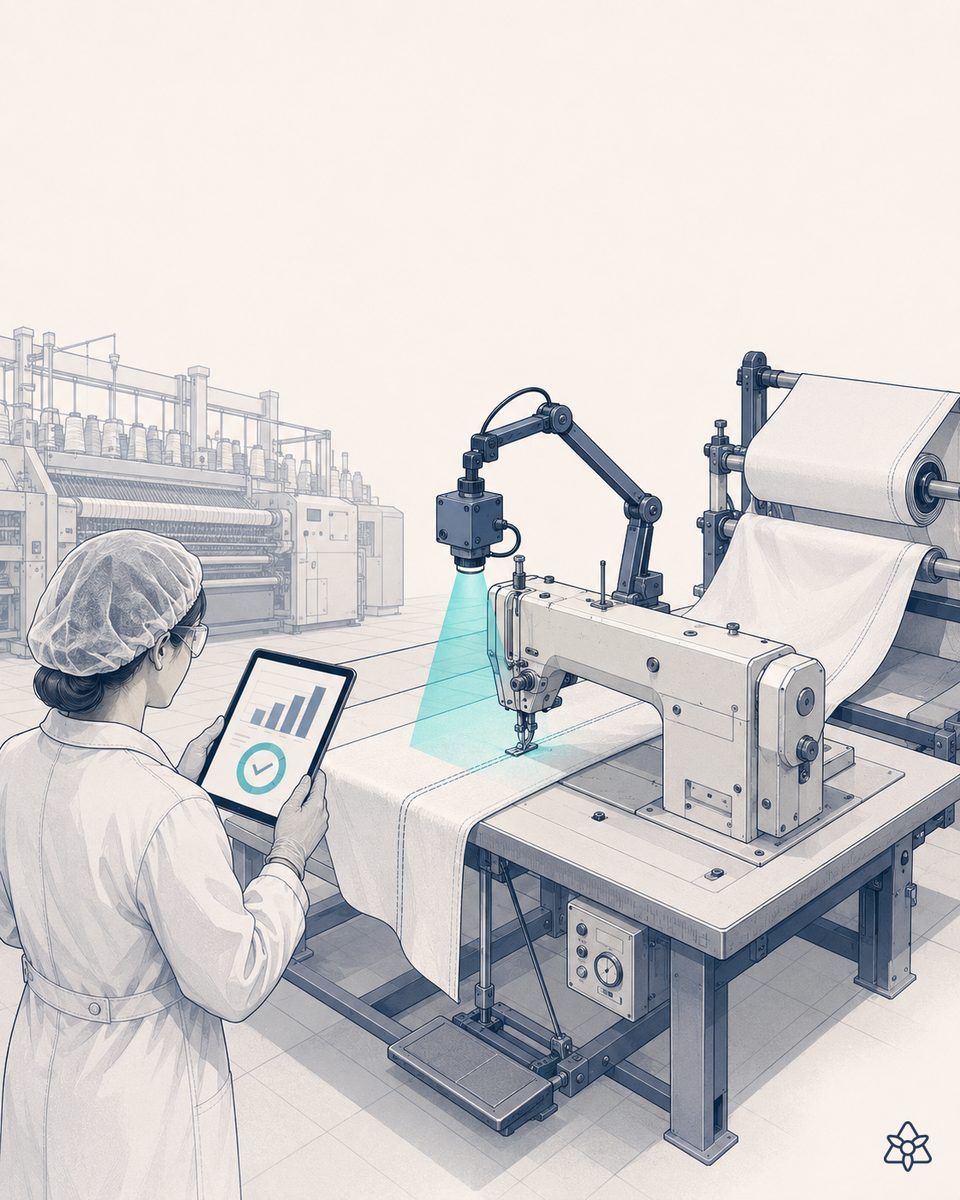
Three data points the standard decides on, and that are almost never available at once.
An EN ISO 20471 Class 2 garment (vest, polo, parka) is not just “the yellow one with the tapes”. It is a set of surfaces measured in m², a colorimetric shade inside a declared CIELAB box, and a band geometry that follows the standard point by point. If any of the three drifts out, the garment labeled as Class 2 is not Class 2 — and the complaint comes in through the side that hurts most.
- Badly positioned retroreflective tapes — lack of continuity, poor alignment with the seam, insufficient clearance from the hem, a band on the wrong model because of an error at the SKU changeover.
- Fluorescent color drifting batch to batch — the first roll of the supplier's new lot is inside the range, the second is not, and the garment is sewn with two panels of different shade.
- Size, configuration and labeling crossed — size S ends up with the band configuration of size XL because cutting skipped a station. Detectable at the end, not before.
The quality manager knows all this, but nobody can measure bands with a ruler across 1,200 garments per shift. The classic system (final visual check + destructive type sampling in the lab) works 99% of the time. That 1% is the batch held by the public-sector buyer, or the complaint from the retailer who has very little patience with a PPE supplier. The hard cost: return, reverse logistics, rework. The medium cost: dropping off the approved supplier list.
iLEAN does not touch your cutting room — it measures the bands and the color where nobody reaches today.
The problem with EN ISO 20471 control is not a lack of procedure: it is information living in islands (the production order in the ERP, the geometric pattern on the manager's sheet, the colorimetry in the lab, the final check in the inspector's eye) that at the critical moment (the model changeover, the fabric batch change) does not arrive in time. iLEAN acts as the putty that fills those gaps, without asking you to change your sewing line.
The camera measures tapes and color. The agent cross-references with the order and the declared class. Any garment out of tolerance is set aside before labeling. The person signs.
The three iLEAN pieces applied to EN ISO 20471 garment control:
- Edge (Vision) — a terminal with a CNN camera over the tape bonding/sewing station and over the final inspection table. It measures tape position and continuity, width and clearance to the seam, and colorimetry of the fluorescent background. It classifies by severity and routes the garment to the rework or rejection lane. It works with no network.
- Connect — captures the production order from the ERP/MES, the geometric pattern for the size and model, the notified body's type certificate and the prior tests on the fluorescent fabric batch and the retroreflective tape batch. It also captures the quality plan from the retailer or public buyer at second zero, with nobody having to forward anything.
- Agents — cross-reference the visual inspection with the order, the fabric batch, the tape batch and the declared class. If a run of garments starts coming out of tolerance or the shade drifts systematically, the agent proposes to the quality lead that the batch be stopped and assembles the inspection dossier — with photo and measurement — ready for the retailer's auditor. The person validates and signs; the batch is never labeled on its own.
Final check + sampling vs. in-line AI inspection with iLEAN Vision
| Aspect | Final inspection + sampling + type test | With iLEAN Vision + Connect + Agents |
|---|---|---|
| Tape position | Inspector's eye, finished garment | Measured automatically by camera, during sewing |
| Background colorimetry | Sample sent to the lab | In-line colorimetric camera, batch by batch |
| Band geometry per size | Paper pattern, visual check | Pattern loaded from the order, measured automatically |
| Size / configuration mix-up | Only detectable at the end, sometimes not at all | Detected as the garment reaches the table |
| Operation with no network | n/a | Vision keeps inspecting on cabinet power |
| Dossier for retailer / public buyer | Rebuilt by hand, days of work | Per batch, automatic, with measurements and photos |
Impact estimate for your plant — to be validated with your numbers.
The block below is an estimate to be validated with the specific data of your plant. We put it forward so the committee has an order of magnitude; we refine it during the diagnostic.
- Sewing plant for EN ISO 20471 garments (vest, polo, parka) Class 2 and 3, 1-3 lines, main customers: public-sector buyers and professional retailers.
- iLEAN Vision pilot on one tape bonding/sewing station + the final inspection table: CNN camera + colorimetric camera + integration with the ERP/MES. First value expected in a few weeks (detection of out-of-tolerance bands and off-shade color above 90%).
- Indicative payback between 4 and 9 months, depending on the history of returns from public buyers or retailers, the cost of rework and the weight of your current destructive sampling.
- Hard levers: ≥ 30% reduction in rework caused by badly positioned bands or off-shade color, a per-batch inspection dossier that closes the customer's audit, and a single batch return avoided — which on its own pays for the pilot.
And the quality manager's reasonable doubt
“What if the AI flags garments my lab would approve?” — hallucination is a problem of free generation, not of anchored tasks. Measuring a band against a geometric pattern and comparing a color against a declared CIELAB box are tasks anchored to the reality of your garment. In that family of tasks, the best models brought error below 1.5% [1]. And even so, what is critical is never decided alone: iLEAN measures and sets aside, and the inspector signs before the garment returns to the flow. The three safety rings exist precisely for this.
[1] OpenAI paper “Why Language Models Hallucinate”, 2025 — on the reliability of AI in anchored tasks.
What people ask about EN ISO 20471 garment control
What does EN ISO 20471 require for retroreflective tape and fluorescent color?
EN ISO 20471 (high-visibility clothing for professional use) defines three classes (1, 2 and 3) based on the minimum area of fluorescent background material and of retroreflective material, counted separately in m². It requires colorimetry of the fluorescent background inside the yellow, red-orange or red coordinates defined in the standard, both before and after the type-test wash cycles. It requires retroreflection of the tapes (R'min in cd/(lx·m²)) above the thresholds after washing and before end of life. And it requires band geometry: continuous tapes, minimum width 50 mm, standard configurations (horizontal bands on the torso, vertical bands over the shoulders, arm bands), minimum clearance between band and seam. Any deviation in sewing makes the garment non-conforming with the class declared on the label.
How does iLEAN Vision detect a badly positioned band?
iLEAN Vision installs a CNN camera over the tape bonding/sewing station or over the finished-garment inspection table. It compares the real garment against the geometric pattern for that size and model (band configuration, clearance to shoulder and waist, left/right symmetry, continuous tape width). If a band is out of tolerance beyond the margin, if a section is missing, if it is misaligned with the seam or cut unevenly, it flags the garment and alerts the station. The person decides rework or rejection. It works with several sizes and models loaded at once — the system recognizes the garment before measuring it.
Does it tell washed fluorescent color from new?
Fluorescent color loses intensity with wear and washing — that is covered by the notified body's type test. On the sewing floor, the Vision system controls batch-to-batch variability of the new color: a fabric batch different from the approved one, rolls mixed within the same garment (one panel more yellow than another), off-shade dyeing after a supplier change. The colorimetric camera with a CNN compares against the plant reference and raises an alert when the shade moves outside the accepted range. For real aging (after the user's own washing), the control remains the notified body's laboratory.
Does it adapt to several sizes and models on the same line?
Yes, and this is one of the points where manual control suffers most. iLEAN Connect reads the production order at second zero and passes the expected model and size to Vision. Vision recognizes the garment on the table (short vest, long-sleeve polo, hooded parka), applies the corresponding geometric pattern and measures. If the size does not match the order — a piece routed to the wrong station, a swapped label — the system raises the alert before sewing. The person signs.
How much does a pilot cost on a high-visibility PPE sewing line?
The order of magnitude of an iLEAN Vision pilot on an EN ISO 20471 garment sewing line is that of any industrial Edge pilot: terminals with camera + lighting + integration with the ERP/MES, plus an annual license. A reasonable payback is measured in a few months — the hard lever is a single batch return avoided from a professional retailer or from a public-sector buyer, and the automatic inspection dossier that closes the distributor's audit with no meetings. We ask for your plant's data and send you the estimated ROI in 48h, with your numbers.
More cases in other sectors
- Color batch matching in dyeing — an off-shade batch is water, energy and a broken delivery date.How iLEAN Edge controls dye bath color with an in-line spectrophotometer and adjusts the formula in real…
- EN 14683 surgical mask control with AI — basis weight, BFE and welding reconciled before packing.iLEAN Edge controls basis weight, BFE and ultrasonic welding on the EN 14683 surgical mask line with…
- Seam control on EN ISO 20345 safety footwear with AI — the skipped stitch reaches the customer.How iLEAN Vision inspects critical seams on EN ISO 20345 safety footwear to prevent bond-test failures…
- Critical seams on the EN 361 fall arrest harness with vision AI — the defect that eye fatigue lets through is the one that ends up in court.iLEAN Vision detects skipped stitches, loose stitching and pattern deviations in the critical seam of…
- EN 388 dossier for cut-resistant gloves with AI — the batch file, ready when the customer asks for it.iLEAN Writer assembles the EN 388 dossier for every cut-resistant glove batch: tests, raw material and…
- Geotextile for civil works — one weak meter of the roll is the section that fails years later.How iLEAN Edge controls geotextile basis weight, thickness and uniformity in line with sensors and AI…
Tell us your case and in 48h we'll send you the estimated ROI of this AI project for your high-visibility PPE line.
We work on your plant's real data, not ours. Diagnostic with no commitment.
Request estimated ROI in 48h See technical textiles