Critical seams on the EN 361 fall arrest harness with vision AI — the defect that eye fatigue lets through is the one that ends up in court.
On an EN 361 fall arrest harness, the difference between defending yourself and giving up in an expert report is having the image of the critical seam linked to the product's serial number. iLEAN Vision detects skipped stitches, loose stitching and pattern deviations on the line, and pairs every photo with the batch and the serial number. The person validates.
The sustained human eye on a line does not exist — the expert report does.
An EN 361 fall arrest harness is made from polyester webbing, metal buckles and seams of Dyneema or high-tenacity nylon thread stitched in reinforced patterns over the critical points: dorsal D-ring, sternal D-ring, chest buckle joint, reinforcement at the attachment points. The piece has to hold a real human fall. And the defects that compromise it are:
- Skipped stitches in the reinforcement of the attachment point — millimeters that unzip the seam when the dynamic load arrives.
- Irregular thread tension — the stitch looks well made until it is pulled and comes loose.
- Deviation from the programmed pattern — the seam closes outside the intended reinforcement, on free webbing.
- Mixed thread spools — an undocumented thread change halfway through the batch.
Sustained 100% human control, shift after shift, is not real: the eye tires, the pace is unforgiving, and subtle defects slip through on 1-2% of production. In automotive, the demanding standard is in the order of 25 PPM (parts per million) [1]; in fall protection PPE, where one piece can end up in a court expert report, that 1-2% is not an acceptable number — it is a brand risk and a legal defense risk.
iLEAN Vision does not replace the sewing operator — it puts a net underneath.
The problem with critical seams is not that the operator is careless: it is that sustained human fatigue is a constant of reality, and nobody can look at 100% of the pieces with the same attention at eight in the morning as at eight in the evening. iLEAN acts as the putty that fills the gap between the sewing operator's skill and the inevitable fatigue of the shift, without asking the operator to be infallible.
Vision sees every critical seam on the line. The agent pairs it with the serial number. The harness file is assembled. The person validates — the safety net is held up by the machine.
The iLEAN pieces applied to critical seams on the EN 361 harness:
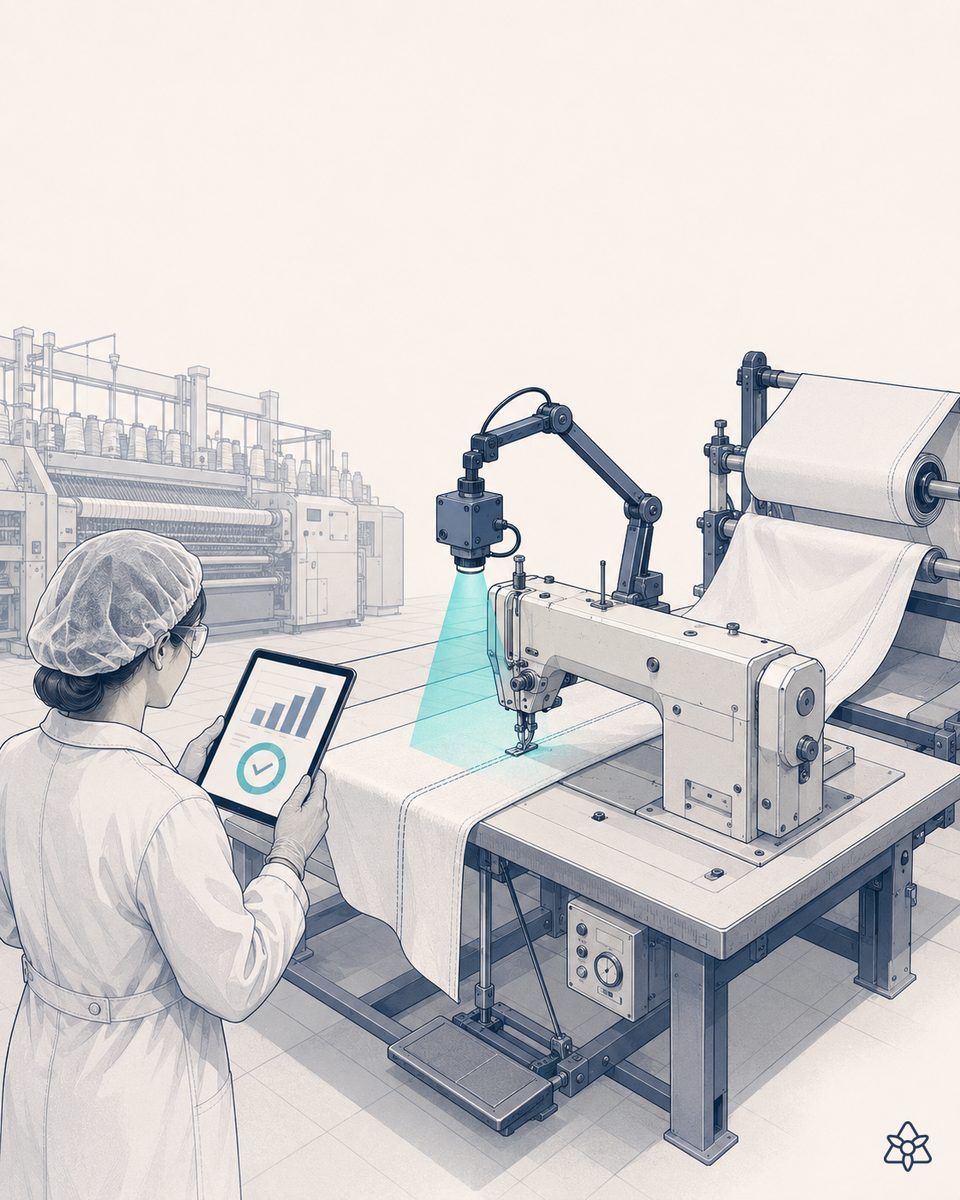
- Vision (an Edge with a CNN trained on EN 361 seams) — installed at the exit of every critical sewing machine. It looks at every dorsal D-ring, every buckle joint, every attachment point reinforcement. It detects skipped stitches, loose stitching, pattern deviation and changes in thread tension. If it finds a defect: stack light + ejector in milliseconds — before the serial number is marked. It works with no network: if the plant loses WiFi, Vision keeps looking.
- Connect — captures spool changes, incident reports, the pattern recipe from the MES and the buyer's thread certificates. Everything hangs off the batch.
- Traceability agent — links the image of the critical seam with the serial number about to be marked on the piece and files the pair under the batch record in Central. If in three years an expert report arrives for the harness with serial number XYZ, the dossier comes out in minutes.
And the safety boundary: Vision holds; the quality manager signs. The three rings of the IRIS system guarantee that no piece flagged as defective by the AI goes back onto the line without human validation.
Human visual control vs. critical seams with iLEAN Vision
| Aspect | Human visual control | With iLEAN Vision + agent |
|---|---|---|
| Inspection coverage | Sampling (1 in 10) or 100% with accumulated fatigue | Genuinely 100%, held up by the camera shift after shift |
| Skipped stitch detection | 1-2% get through, depending on pace and shift | Detected and ejected in milliseconds |
| Undocumented spool change | The operator remembers, or does not | Captured by Connect, linked to the batch |
| Link to the harness serial number | Nonexistent — you trust the piece is good | Photo of the critical seam + serial number in Central |
| Expert report three years later | “We don't have the detail for that harness” | The file for that specific harness in minutes |
| Recall of a model from the market | Precautionary, the whole batch just in case | Limited to the pieces flagged on the line |
Impact estimate for your plant — to be validated with your numbers.
The block below is an estimate to be validated with the specific data of your plant. We put it forward so the committee has an order of magnitude; we refine it during the diagnostic.
- Fall protection PPE plant with 3-4 critical sewing lines, multi-model (EN 361, EN 358, EN 813), traceability by serial number.
- Vision pilot on one line (camera over the critical seams + actuator + integration with the MES and serial number marking). First value within a few weeks.
- Indicative payback between 4 and 9 months, depending on volume and the frequency of incidents documented over recent years. Expected reduction of escaped defects ≥ 30% from the first pilot line onward.
- The hard lever is a single legal claim avoided and the chain of evidence available for defense in an expert report. One serious claim pays for the entire installation.
And the quality director's reasonable doubt
“What if Vision flags good pieces as bad?” — hallucination is a problem of free generation, not of anchored tasks. Vision does nothing but compare the real seam against the conforming pattern — it recontextualizes an image against an approved pattern. In anchored tasks, the best models brought error below 1.5% [2]. And even so, no flagged piece goes back onto the line without the operator validating it and the quality manager signing.
[1] Automotive quality standard ≈ 25 PPM (parts per million). Symestic.
[2] OpenAI paper “Why Language Models Hallucinate”, 2025 — on the reliability of AI in tasks anchored to the source.
What people ask about seam control on the EN 361 harness
What does the EN 361 standard require of fall arrest harness seams?
The EN 361 standard requires a fall arrest harness to withstand the dynamic load of a fall without any attachment point failing. The critical seams (chest and dorsal D-rings, webbing-to-buckle joints, reinforcement at the attachment point) are where a badly made harness breaks first. Every harness must be marked with the model, the serial number and traceability to the production batch, because after an accident the court asks for the file of that specific harness, not for the model in general.
Why do visual seam checks fail in production?
Because sustained 100% human visual control on a line does not exist: the eye tires, the pace is unforgiving, and subtle defects (a half-centimeter skipped stitch, irregular thread tension, a pattern deviation at the buckle joint) go unnoticed on 1-2% of the pieces. On a fall arrest harness, that 1-2% is exactly the problem: the defect that reaches the shelf and, eventually, the courtroom.
What does iLEAN Vision detect in fall arrest harness seams?
iLEAN Vision is an Edge terminal with machine vision (CNN) installed at the exit of every critical sewing machine. It detects skipped stitches, loose or slack stitching, deviation from the programmed pattern, irregular thread tension and incomplete reinforcement at the attachment points. If it finds a defect, it triggers the stack light and the ejector in milliseconds — the piece leaves the line before the serial number is marked.
How is the seam image linked to the harness serial number?
Vision pairs every seam image with the serial number about to be marked on the piece, and an agent files the pair under the batch record in Central. If three years from now a harness fails and an expert report is requested, the manufacturer pulls from the archive the photo of the critical seams of that specific harness, with its serial number, its batch, its operator, its machine and its shift. That chain of evidence is the difference between defending yourself and giving up.
How much does it cost to deploy Vision for EN 361 harness seams?
The order of magnitude of a Vision pilot on a critical harness sewing line is similar to any Edge vision pilot: an initial investment covering terminal + cameras + actuator + MES integration, plus an annual license. A reasonable payback to present to the committee is a matter of several months, and the hard lever is not only the scrap avoided: it is the eliminated cost of a single lawsuit or a single product recall from the market. We ask for your data and send you the estimated ROI in 48h.
More cases in other sectors
- EN 14683 surgical mask control with AI — basis weight, BFE and welding reconciled before packing.iLEAN Edge controls basis weight, BFE and ultrasonic welding on the EN 14683 surgical mask line with…
- Seam control on EN ISO 20345 safety footwear with AI — the skipped stitch reaches the customer.How iLEAN Vision inspects critical seams on EN ISO 20345 safety footwear to prevent bond-test failures…
- EN ISO 20471 high-visibility garment control with AI — one centimeter of band decides whether the garment is Class 2 or not.How iLEAN Vision controls retroreflective tape, fluorescent color and band position on EN ISO 20471…
- EN 388 dossier for cut-resistant gloves with AI — the batch file, ready when the customer asks for it.iLEAN Writer assembles the EN 388 dossier for every cut-resistant glove batch: tests, raw material and…
- Geotextile for civil works — one weak meter of the roll is the section that fails years later.How iLEAN Edge controls geotextile basis weight, thickness and uniformity in line with sensors and AI…
- GOTS organic cotton traceability — the TC that never arrived is the premium you lost.How iLEAN Tracer links farm, spinning and weaving with a GOTS chain of custody link by link, captures…
Tell us your case and in 48h we'll send you the estimated ROI of EN 361 harness seam control with vision AI.
We work on your plant's real data, not ours. Diagnostic with no commitment.
Request estimated ROI in 48h See technical textiles