Roll-to-VIN traceability is earned day by day — not at 10 pm when the call-back lands.
For an airbag or seat-belt tier-2, proving roll-to-VIN when the OEM's request arrives means cross-referencing yarn lot, loom, roll, cutting, sewing and module within hours. iLEAN Tracer keeps that graph live with an agent that works 24/7, leaves the file on the quality manager's desk, and the person signs — the dossier does not go out to the tier-1 on its own.
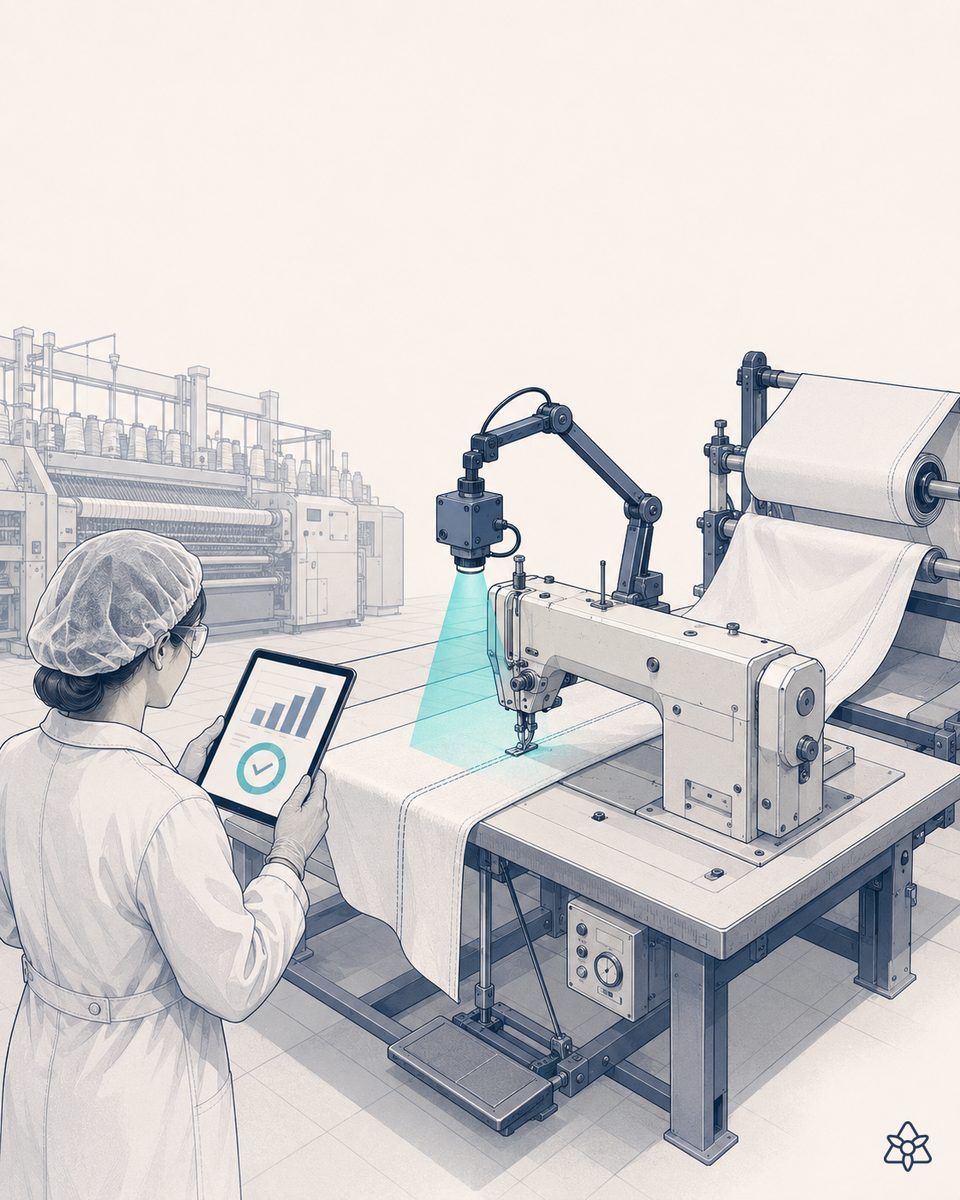
The traceability exists — but across six different systems.
In a mid-sized airbag or seat-belt tier-2, the information linking the roll to the VIN exists — but it lives scattered: the yarn supplier's certificate in a PDF in the purchasing manager's folder, loom reports in the MES, roll scans in a spreadsheet kept by the cutting supervisor, module lot in the ERP, the tier-1's purchase order number in emails, VINs in the system the tier-1 sends back days later. When an OEM call-back arrives, someone has to reconstruct the graph by hand. And reconstructing is slow, expensive and prone to the kind of errors an IATF 16949 auditor spots.
The three realities almost nobody manages to cross-reference on the floor in time:
- Which yarn lot is in this particular roll — including mid-roll lot mixes, which happen often.
- Which cuts and which modules came out of that roll — and where the defective meters were discarded.
- Which VINs each module ended up in — data that comes back from the tier-1 days or weeks later.
The classic system (chaining it by hand when the tier-1 asks) works 99% of the time. The remaining 1% is the call-back widened as a precaution to 10x the VINs actually affected — because the boundary could not be proven with data in time.
iLEAN Tracer does not replace the quality manager — it keeps the dossier permanently assembled for them.
The roll-to-VIN traceability problem is not a lack of knowledge: the quality manager knows exactly what to cross-reference. The problem is speed and volume: cross-referencing thousands of rolls and modules a month against thousands of delivery notes, reports and emails, while keeping the graph always ready. iLEAN acts as the putty between the six systems where traceability lives on islands.
Connect captures everything that comes in (delivery notes, tier-1 emails, scans). Tracer chains roll-cutting-module and keeps the graph. The person signs every file that goes out to the tier-1 — the AI does not.
The iLEAN pieces applied to roll-to-VIN traceability:
- iLEAN Tracer (Agent) — a specialized agent from the iLEAN Agents family; it lives in Central and works 24/7. It maintains the yarn lot → loom → roll → cutting → module → tier-1 → VIN graph. When the tier-1 asks for data, the graph already exists. When a call-back arrives, the agent returns the affected VINs bounded — not estimated upward as a precaution.
- Connect — captures everything: yarn delivery notes, supplier certificates (PDF), loom reports (MES), QR/RFID scans in and out of cutting, module lots (ERP), tier-1 emails with purchase order numbers and returned VINs. Email, WhatsApp, the cutting panel, paper: it all comes in and becomes graph.
- iLEAN Edge — wherever it is needed, at the QR/RFID scan of the roll entering cutting or of the module leaving the line. Local reading, asking nothing of the old MES.
Traceability reconstructed by hand vs. a live file with iLEAN Tracer
| Aspect | Manual reconstruction when needed | With iLEAN Tracer |
|---|---|---|
| State of the graph | Exists, chopped up across 6 systems | Live and unified in Central |
| Response to an OEM call-back | Hours or days reconstructing | Minutes: the graph already covers it |
| Affected VINs | Widened as a precaution | Bounded with data |
| Mixed lot in a single roll | Assumption: all one lot | Transition meter recorded |
| Operation with no network on the floor | n/a | Edge keeps scanning QR codes |
| File for the IATF 16949 auditor | Prepared in the preceding weeks | Generated on the spot, with signature |
Impact estimate for your plant — to be validated with your numbers.
The block below is an estimate to be validated with the specific data of your plant. We put it forward so the committee has an order of magnitude; we refine it during the diagnostic.
- Mid-sized airbag/seat-belt tier-2: 4-12 looms, 1-3 cutting lines, 1-2 sewing/module lines, supplying a European or American tier-1 under IATF 16949.
- Tracer pilot (agent + Connect capturing suppliers and tier-1 + Edge QR/RFID scanning across roll-cutting-module). First value expected within a few weeks: the first roll-to-module file chained on its own.
- Indicative payback between 4 and 9 months, depending on monthly module volume, audit frequency and historical exposure to nonconformity or call-backs.
- Reduction in response time to a tier-1 request in the order of ≥30% already in the pilot — plus a lower risk of a recall being widened for lack of data in time.
- The hard lever is twofold: recurring savings on the pre-audit office work, and a lower cost for any recall that does arrive, by bounding the VINs actually affected.
And the quality manager's reasonable doubt
“What if the agent makes up a roll-to-module association?” — the agent only recontextualizes data that already exists. It extracts lots from real PDFs, chains real QR scans, associates reports and modules by their identifiers. It does not generate identifiers or VINs. Hallucination is a problem of free generation, not of anchored tasks: the best models brought the error below 1.5% on tasks anchored to the source [1]. And even so, the person signs every file that goes out to the tier-1 — the AI does not.
[1] OpenAI paper “Why Language Models Hallucinate”, 2025 — on the reliability of AI in tasks anchored to the source.
What people ask about airbag roll-to-VIN traceability with AI
What does an automotive tier-1 require regarding roll-to-VIN traceability?
Proving the full chain from raw material to the vehicle on the road: incoming yarn lot (with supplier certificate), loom and shift, woven roll (with the defective meters flagged where applicable), scheduled cutting, sewing into the module, assembly into the final part (airbag or pretensioner) and delivery to the tier-1 with the module lot. The tier-1 cross-references all of that with the vehicle VIN. When a call-back comes in, the OEM wants to know within hours which affected VINs carry the problem part. If traceability is not already a piece of data but something you reconstruct, you arrive late and the recall is widened as a precaution.
How does iLEAN Tracer build the file without any manual reconstruction?
iLEAN Tracer is a specialized agent from the iLEAN Agents family that lives in Central and works 24/7 against everything Connect captures: delivery notes and certificates from yarn suppliers, loom and shift reports, rolls scanned (QR/RFID) as they enter cutting, cutting output with the defective meters discarded, sewing lot, module lot and delivery to the tier-1 with its purchase order number and, finally, the VIN information the tier-1 sends back. The agent cross-references, orders and keeps the full graph live. The person signs — the AI does not.
What happens if a roll mixes yarn from two lots?
The agent detects it and records it explicitly. A roll with a yarn lot change halfway through is flagged with its transition meter. If one of those yarn lots later goes into a supplier alert, the agent identifies exactly which rolls, which cuts, which modules and which VINs (via the tier-1) are affected — and which are not. That is the difference between a bounded recall and a massive precautionary one. Fine-grained traceability is the economic lever of the hot bed: the OEM comes in asking for data and finds it already resolved.
What if the IATF 16949 auditor asks for data and the AI made something up?
The agent only recontextualizes data that already exists — it extracts the lot from the PDF of the supplier's delivery note, associates the lot with the woven roll (via the scanned QR), chains roll-cutting-module. It does not invent lots and it does not generate VINs. Hallucination is a problem of free generation, not of anchored tasks: the best models brought the error below 1.5% on tasks anchored to the source. And the human signature on every file closes the IATF loop — traceability from auditor back to the original document is explicit.
How much does roll-to-VIN AI traceability cost in an airbag tier-2?
The pilot covers supplier capture (Connect: delivery notes, certificates, emails), roll scanning at cutting inbound and outbound (QR/RFID Edge), the Tracer agent in Central, and the validation workflow with the tier-1. First value expected within a few weeks: the first lot with a roll-to-module file chained on its own. Indicative payback between 4 and 9 months, depending on monthly module volume, audit frequency and historical exposure to nonconformity or call-backs. The hard lever is twofold: recurring savings on the reconstruction work for audits, and a lower cost for any call-back that does arrive. We ask for your plant's data and send back ROI in 48h.
More cases in other sectors
- Submarine manufacturing with AI — a bead out of window is not an incident, it is a life.How iLEAN assists pressure-hull welding, hydrostatic testing and hull-number traceability in submarine…
- Technical textiles — when the garment is PPE, the seam is a legal requirement.Documented iLEAN cases in technical textiles: EN 361 and EN 388 seam control, GOTS and OEKO-TEX…
- A pore in airbag fabric is not a defect — it is a recall on the finished vehicle.How iLEAN Vision inspects airbag fabric in line, detecting pores, irregular seams and weft defects…
- Aramid (Kevlar) spinning control with AI — the micro-break is invisible, the ballistic test is not.How iLEAN Edge watches tension, speed and micro-breaks in aramid (Kevlar) spinning and alerts before the…
- Pore detection in filter bags — a single one sends the whole batch back.How iLEAN Vision inspects filter bags to detect pores and loose seams before shipment to cement or…
- Carbon fiber prepreg traceability with AI — the clock starts the moment it leaves the freezer.How iLEAN Tracer logs out-of-freezer hours roll by roll for carbon fiber prepreg and builds the per-roll…
Tell us your case and in 48h we'll send you the estimated ROI of this AI project for your airbag tier-1 traceability.
We work on your plant's real data, not ours. Diagnostic with no commitment.
Request estimated ROI in 48h See other sectors