The heat number stops getting lost between the dock and the filing cabinet
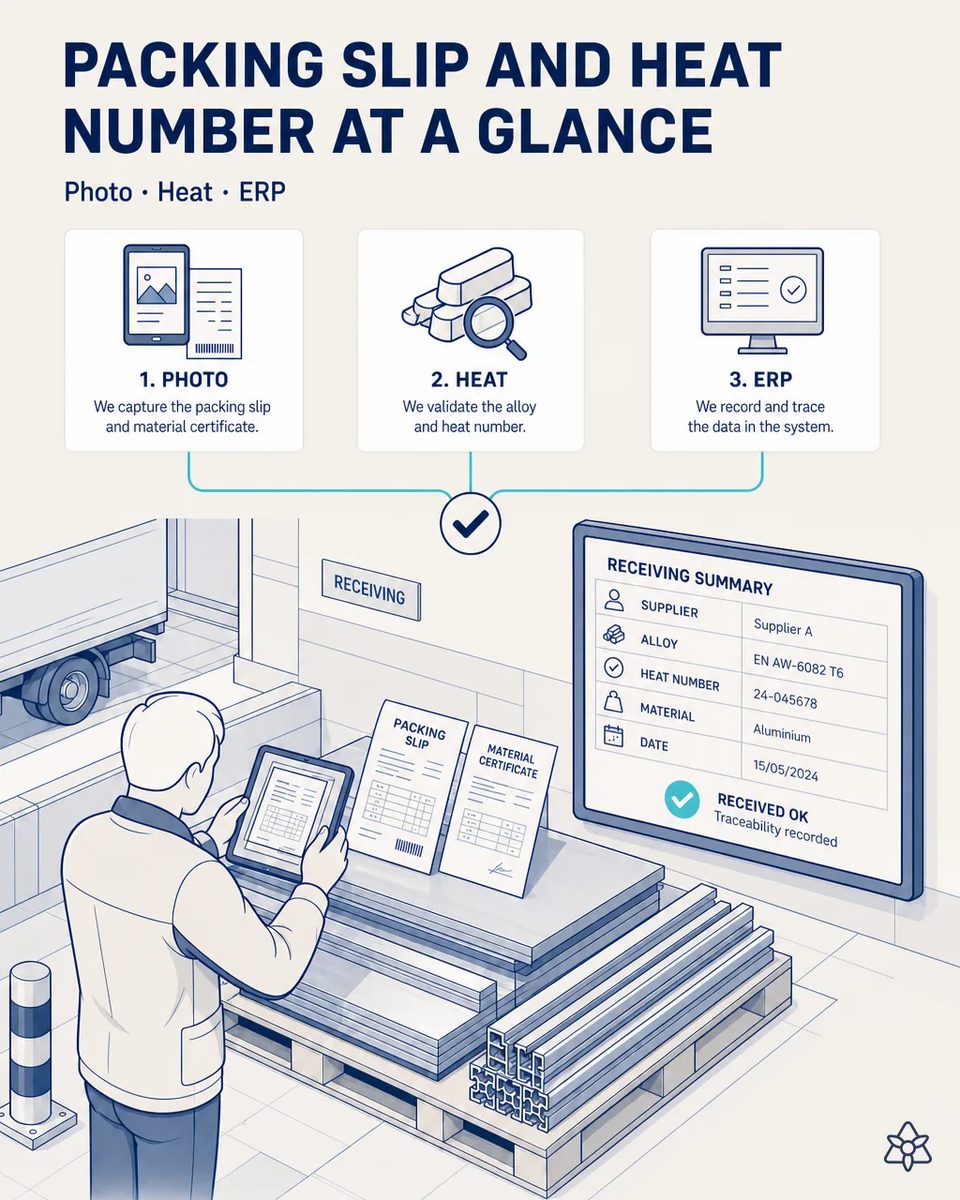
The material arrives — aluminium plate, stainless bar, Delrin sheet, structural profile — and with it a multi-line packing slip and, on the jobs that require it, the certificate with its heat number. Today you have to sign and then key it in line by line, and the certificate is filed where nobody finds it again. With Connect it is two photos and one tap.
It is the first thing that blows up in an audit.
Material traceability is precisely what aerospace and medical device customers ask for, and it is the first thing to break in an audit. The certificate arrives on paper or as a PDF, gets filed "somewhere", and months later you have to prove which specific heat went into the fixture delivered to a given customer. Rebuilding that by hand takes days, and sometimes it cannot be rebuilt at all. In parallel, the packing slip is keyed in fast with the driver waiting, which is exactly when quantity and part-number errors happen.
- Material traceability is exactly what aerospace and medical device customers ask for.
- The certificate arrives on paper or as a PDF and gets filed “somewhere”; months later you have to prove which specific heat went into the tooling delivered to a given customer.
- Reconstructing that by hand takes days, and sometimes it cannot be reconstructed at all.
- And the delivery note gets keyed in fast with the carrier waiting, which is when the quantity and reference errors happen.
Connect in photo mode over documents — two photos and one tap.
Connect in document photo mode.
The heat stays tied to the physical stock and, later, to the job that consumes it. That chain is what breaks at the dock today and gets paid for in the audit.
- It recognises the packing slip with its supplier-dependent table structure, the material certificate and the labels on the raw stock itself: barcode, QR or plain OCR.
- It extracts supplier, part numbers, quantities, dimensions, alloy or grade and heat number.
- It summarises on screen for one-tap validation.
- It posts to the ERP through the API, leaving the heat tied to the physical material and, later, to whichever job consumes it.
Keyed receiving vs. captured receiving
| Aspect | Today | With iLEAN Connect |
|---|---|---|
| Delivery note entry | Keyed with the truck waiting | Photo and one tap |
| Raw stock labels | By eye | Barcode, QR or OCR |
| Heat certificate | Filed “somewhere” | Tied to the physical stock |
| Heat → job traceability | Days, or impossible | Instant lookup |
| Quantity and reference errors | Those of the rush | Caught in the validation |
| Purchasing module licenses | 3 users | 1, the validator |
heat→job traceability rebuildable in days (or not at all) → immediate query by job or by heat. Packing slip entry with the truck waiting → photo and validation in one tap.
Impact estimate — to validate against your numbers.
The block below is an estimate to be validated against your plant's actual data. We put it forward so the committee has an order of magnitude; we refine it during the assessment.
- Shops receiving aluminum plate, stainless bar, engineering plastic sheet and structural profile with certificates.
- CFO angle: today the purchasing module needs a user for everybody who books goods in; with Connect they capture by photo and only one validates.
- From 3 licenses to 1: between 50% and 70% less recurring cost on that module, plus the carrier demurrage that disappears.
- Indicative payback of 4 to 8 months. The larger value is not the time: it is answering an audit without shutting the shop down for two days.
CFO angle — the purchasing and receiving module today needs a seat for every person who books material in; with Connect they capture by photo and only one validates: from 3 licences to 1, between −50% and −70% of that module's recurring cost, plus the carrier demurrage that disappears. Estimated payback 4-8 months. The bigger value is not the time: it is answering an audit without freezing the shop for two days. *Estimate to be validated.*
And the fair question from the production manager
“What if it extracts a quantity wrong?” — extracting a table from a delivery note is an anchored task over a structured document, where the best models drop below 1.5% error [1]. And the keying error with the carrier waiting is considerably more frequent. Here the summary is validated with the truck still at the dock.
[1] OpenAI paper "Why Language Models Hallucinate", 2025 — on the reliability of AI in anchored tasks.
What people ask about digitizing material receiving
Do suppliers have to use a standard delivery note?
No, and that is what makes the case viable. Every material supplier sends theirs however they want and standardizing formats is not in your hands. Vision recognizes the tabular structure of the document rather than relying on fixed templates.
What about the heat certificate?
It is captured the same way and stays tied to the physical stock, which is the part lost today. On aerospace or medical device work that document gets requested, and hunting for it in a filing cabinet a year later is exactly what turns an audit into two days of stopped shop.
How does the heat get tied to the job?
The material enters traced and the link closes when that stock is consumed on an order. From then on the lookup works both ways: which heat is in this tooling, and which tooling came out of this heat — which is the question asked when a problem appears.
Does it replace the RF terminal?
At the receiving point, largely yes, and part of the saving is there. In the rest of the store nothing is touched.
What if the note does not match the order?
The discrepancy is flagged for review instead of entering as it is. The lead sees it highlighted and decides: accept, correct or reject the line. It is exactly the case where today it gets keyed fast and the problem appears weeks later.
More cases from this series
- The delivery file stops being assembled by hand on the last dayDrawing, heat, dimensions, images and signatures organised by each customer's standard while the job…
- A tooling shop's core pain is not cost, it is the dateFour coordinated rings from material receiving to the shipping dock: intake, start, execution and…
- You already own the good pieces — they just needed stitchingThe measurement report and the machining program tie themselves to the job and its revision. Without…
- A late drawing revision is the most expensive mistake in the shopThe revision lands by email or WhatsApp and the plate is already on the machine. iLEAN catches it the…
- Your most veteran machining centre can finally talkAn external camera reads the proprietary control of your veteran machining centre: spindle hours,…
- The dimensional report stops being retyped three timesiLEAN reads the dimensional report when it is saved and, after validation, posts it to the ERP and the…
Tell us how long it would take you today to prove the heat of a delivered fixture.
We work on your plant's real data, not ours. Assessment with no commitment.
Request estimated ROI within 48h ‹ See all cases of precision fixtures and frames See metal fabrication