A tooling shop's core pain is not cost, it is the date
A fixture delivered late does not arrive late on its own: it arrives late to the line launch of a customer who was waiting for it, and that is paid for in the relationship, not the invoice. The second edge of the same pain is right the first time, because on one-off work repeating means rebuying material, reprogramming and waiting on finishing again. The flagship coordinates everything above against that pain.
Each cause is individually small. Together they are why the date never improves.
Today the date is committed on the shop lead's intuition, held together by his personal attention to the schedule, and lost to causes spotted too late: a revision that came in by WhatsApp, material that did not arrive when it should, a badly prepared setup, a part that came back wrong from anodizing. Each cause is individually small, and together they are the reason on-time delivery does not improve year after year no matter how hard everyone pushes.
- The date is committed on the shop lead's intuition and held together by their personal attention to the schedule.
- It is lost to causes detected late: a revision that arrived by WhatsApp, material that did not come in when it should, a badly prepared setup, a part that came back wrong from anodizing.
- Tooling that arrives late does not arrive late alone: it arrives late to the line launch of a customer who was waiting for it.
- And that is paid in the relationship, not in the invoice — the part no cost calculation captures.
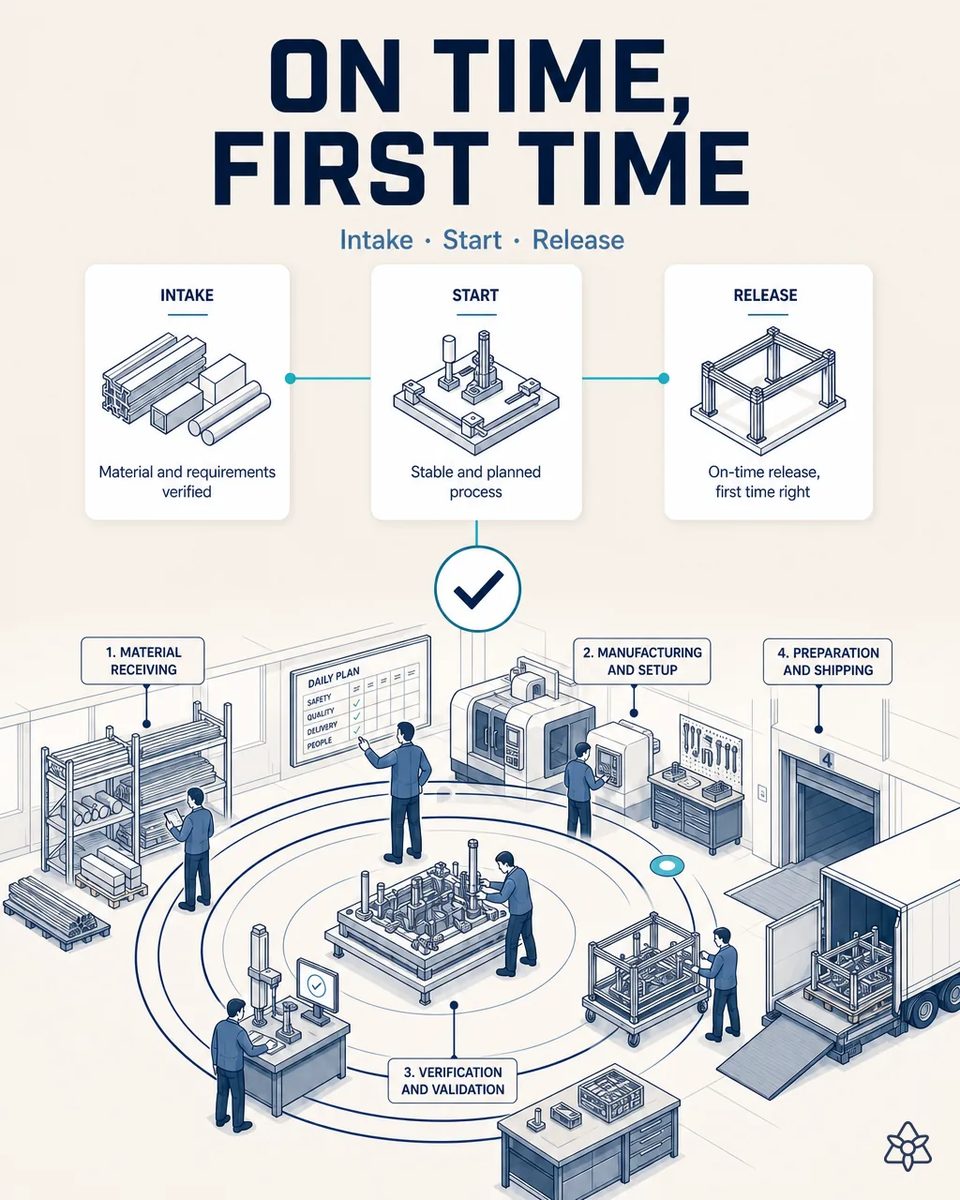
Four coordinated rings, from intake to release.
On one-off work, repeating means rebuying material, reprogramming and waiting on treatment again. That is why first time right and on-time delivery are the same problem seen from two sides.
- Ring 1 · Intake (cases 3 and 7): everything arriving from outside — enquiry, drawing revision, material and its heat — is captured and matched against live jobs the minute it lands. No job starts against a stale revision or unidentified material.
- Ring 2 · Start (case 10): the setup is validated against the reference state before the first cut. JIDOKA AI will not release the cycle if material, workholding, tooling or revision do not match, and SMED AI makes that check shorten the setup. This is where right-first-time is won.
- Ring 3 · Execution (cases 1, 2, 4 and 9): clocked operations, spindle hours, downtime, the shop lead's notes and finish inspection before outside treatment continuously feed schedule status. Drift becomes visible while there is still time to react.
- Ring 4 · Release (cases 6, 8 and 11): validated dimensions, dimensional report posted and first article dossier assembled on its own. The fixture ships with its paperwork the same day it finishes.
A date held by hand vs. a date held by the system
| Aspect | Today | With the four rings |
|---|---|---|
| Who holds the schedule | One person's attention | Four rings that warn on their own |
| Deviation | Known on delivery day | Known with days to spare |
| Obsolete revision | Latent risk | Cross-referenced within a minute |
| First part right | Craft and luck | Verification before the cut |
| Return from treatment | Found on receipt | Caught at the bench |
| Delivery documentation | The last day | Assembled by itself |
on-time delivery held together by one person's personal attention → held by four rings that raise their own alarms. Drift known on the delivery date → known days in advance. Right-first-time by craft and luck → by objective verification before the cut.
Impact estimate — to validate against your numbers.
The block below is an estimate to be validated against your plant's actual data. We put it forward so the committee has an order of magnitude; we refine it during the assessment.
- Custom tooling shops serving audited customers and competing on delivery reliability.
- Indicative improvement in on-time delivery of +10 to +25 percentage points.
- And a reduction of ≥30% in one-off repeats from startup or revision errors.
- Indicative payback between 6 and 12 months. The return defensible in committee is not the internal saving: it is retaining customers who pick suppliers on delivery reliability.
estimated improvement in on-time delivery in the range of +10 to +25 percentage points, and a ≥30% reduction in one-off repeats caused by start-up or revision errors. Estimated payback 6-12 months. The return you defend in committee is not the internal saving: it is retaining audited customers who choose suppliers on delivery reliability. *Estimate to be validated* against the real on-time delivery history.
And the fair question from the production manager
“Do all four rings have to be deployed for this to be worth anything?” — no, and it would be a bad idea. Each ring works and pays for itself on its own; what the four together give is that the date stops depending on one person. The usual order starts with intake and startup, which are the cheapest and prevent the most expensive errors.
[1] OpenAI paper "Why Language Models Hallucinate", 2025 — on the reliability of AI in anchored tasks.
What people ask about the four rings
Where do you start?
With the intake ring and the startup ring. They are the cheapest, and between them they cut the two errors that cost the most days: machining against an obsolete revision and starting with the table badly prepared. Execution and release come afterwards, on top of what is already captured.
How long does the full deployment take?
Ring by ring, over months rather than weeks, and that is deliberate. Each ring goes live, gets validated on one machine or one job and gets replicated. A shop that tries to deploy all four at once ends up with four half-finished projects, which is the usual failure mode.
How do you measure whether the date really improves?
Against your own on-time history, which is the baseline to put on the table before starting. Without it there is no honest way to defend the return, and it is also the number an audited customer looks at when picking a supplier.
What if the real problem is that we quote impossible lead times?
Then this will make that obvious, which is already something. With real hours per job and measured capacity per machine, the conversation about what lead time is committable stops being an argument in an office. Several shops discover there that the problem was not in the shop.
Does it work if we are a small shop?
The rings are the same; what changes is how many machines and how many jobs need covering. In a small shop the dependency on one person tends to be greater, so the value of the date not depending on their personal attention is greater too.
More cases from this series
- The delivery file stops being assembled by hand on the last dayDrawing, heat, dimensions, images and signatures organised by each customer's standard while the job…
- You already own the good pieces — they just needed stitchingThe measurement report and the machining program tie themselves to the job and its revision. Without…
- A late drawing revision is the most expensive mistake in the shopThe revision lands by email or WhatsApp and the plate is already on the machine. iLEAN catches it the…
- Your most veteran machining centre can finally talkAn external camera reads the proprietary control of your veteran machining centre: spindle hours,…
- The heat number stops getting lost between the dock and the filing cabinetPhotograph the packing slip and the mill certificate: supplier, alloy and heat number enter the ERP with…
- The dimensional report stops being retyped three timesiLEAN reads the dimensional report when it is saved and, after validation, posts it to the ERP and the…
Tell us your real on-time delivery over the last twelve months.
We work on your plant's real data, not ours. Assessment with no commitment.
Request estimated ROI within 48h ‹ See all cases of precision fixtures and frames See metal fabrication