You already own the good pieces — they just needed stitching
Nothing needs buying here. The measuring machine issues a correct report and the programming system stores the program each part was cut with. The problem is that neither of them knows which job order or which drawing revision what they just produced belongs to. iLEAN Connect stitches both systems to the job, without replacing either.
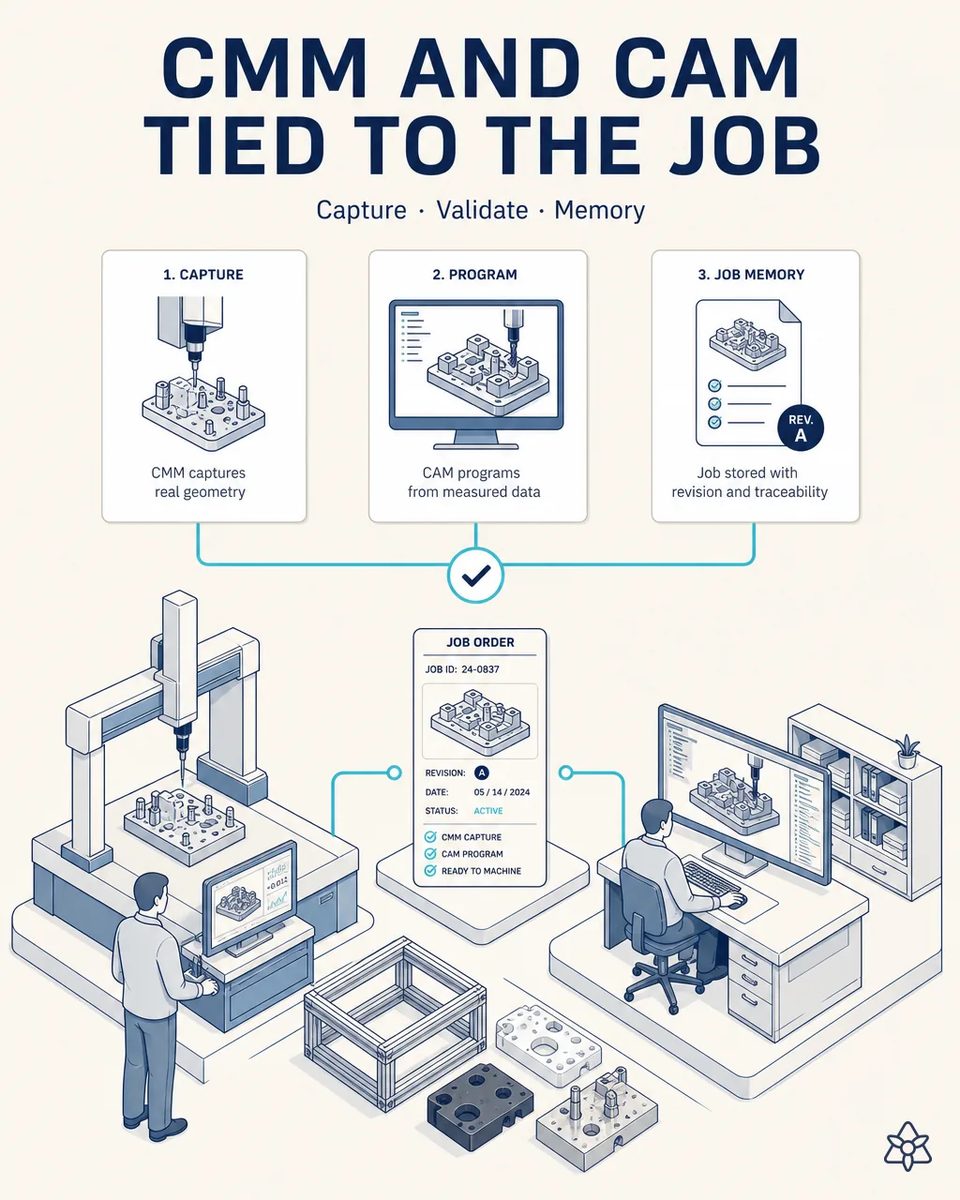
The classic “almost integrated”: three ends joined by a naming convention.
This is the classic "almost integrated". The CMM exports its report to a folder, the programmer saves the CAM file in another, and the job order lives in the ERP or on paper. Nothing joins them except a naming convention, and conventions break: a rush job, a misspelled name, a revision that changes halfway. When months later you have to prove which program and which drawing a part was made against, the answer depends on one person's memory — and that person is not always around.
- The CMM exports its report to a folder, the programmer saves the CAM to another, and the work order lives in the ERP or on paper.
- Nothing joins them but a naming convention, and conventions break: a rush job, a misspelled name, a revision that changes halfway.
- When months later you have to prove which program and which drawing a part was made against, the answer depends on one person's memory.
- And that person is not always there.
Connect acts as the stitching between the three ends — nothing to buy.
Connect acts as the seam, by API or export, between the three ends: CMM report ↔ CAM program ↔ job order and revision.
Here the hardware is already bought and depreciated. The CMM issues a correct report and CAM stores the program: all that was missing was for them to know which order what they just produced belongs to.
- When a measurement closes it is bound to the job, to the current revision and to the specific program that produced it.
- What happens in one is reflected in the others automatically.
- Without replacing the CMM, changing the CAM or touching the ERP.
Naming convention vs. automatic link
| Aspect | Today | With iLEAN Connect |
|---|---|---|
| Report ↔ program ↔ order link | Manual naming convention | Automatic and auditable |
| When the convention breaks | Nobody notices | There is no convention to break |
| Current revision | Inferred | Tied to the measurement |
| Historical reconstruction | Depends on one person | Direct lookup |
| CMM software | — | Untouched |
| Equipment investment | Already made | None new |
report↔program↔job link held by a manual naming convention → automatic and auditable link. Historical reconstruction depending on one person → direct query.
Impact estimate — to validate against your numbers.
The block below is an estimate to be validated against your plant's actual data. We put it forward so the committee has an order of magnitude; we refine it during the assessment.
- Shops that already run a CMM and CAM but disconnected from the work order.
- Indicative payback between 5 and 10 months, with low CAPEX because the hardware is already bought and depreciated.
- To confirm first: that the CMM software exposes automatic export or an API. It is the only technical unknown in the case.
- The real return shows up in the audit, when you have to prove which program and which drawing a specific part was made against.
estimated payback 5-10 months, with low CAPEX because the hardware is already bought and depreciated. *Estimate to be validated* once the CMM software is confirmed to expose automatic export or an API.
And the fair question from the production manager
“What if our CMM is old and exposes nothing?” — that is the first check and it happens before anything is committed. Most measuring software allows automatic export to a folder, which is enough. If a particular unit does not, that gets said and another route is used — normally the camera over the panel, which is another case in this matrix — rather than forcing the integration.
[1] OpenAI paper "Why Language Models Hallucinate", 2025 — on the reliability of AI in anchored tasks.
What people ask about stitching CMM, CAM and order
Does the measuring machine have to be replaced?
No, and that is the point of the case: there is nothing to buy. The CMM already issues the right report and CAM already stores the program. What is missing is not capability, it is the link to the order, which today rests on file names.
Why does the naming convention fail?
Because it depends on nobody ever making a mistake, in an environment where a rush job comes in and things get reprogrammed halfway. One misspelled name or one revision change is enough to lose the link, and no alarm goes off: it is discovered months later, when it is needed.
What about jobs already closed?
They can be tied backwards if the files keep some reliable trace, but it is best not to promise it: the cases where the convention broke are precisely the ones that cannot be reconstructed. What is guaranteed is everything from here on.
Does it work if CAM is from another vendor?
Yes. What gets stitched is the export or API each system already offers, not a proprietary integration. The pattern is the same regardless of the CMM or CAM vendor.
How long does it take to implement?
It is among the fastest cases precisely because there is no hardware to install and no habits to change: nobody in the shop notices anything different. The work is in confirming the export routes and building the stitching.
More cases from this series
- The delivery file stops being assembled by hand on the last dayDrawing, heat, dimensions, images and signatures organised by each customer's standard while the job…
- A tooling shop's core pain is not cost, it is the dateFour coordinated rings from material receiving to the shipping dock: intake, start, execution and…
- A late drawing revision is the most expensive mistake in the shopThe revision lands by email or WhatsApp and the plate is already on the machine. iLEAN catches it the…
- Your most veteran machining centre can finally talkAn external camera reads the proprietary control of your veteran machining centre: spindle hours,…
- The heat number stops getting lost between the dock and the filing cabinetPhotograph the packing slip and the mill certificate: supplier, alloy and heat number enter the ERP with…
- The dimensional report stops being retyped three timesiLEAN reads the dimensional report when it is saved and, after validation, posts it to the ERP and the…
Tell us which CMM and which CAM you run and we will confirm within 48h whether they stitch.
We work on your plant's real data, not ours. Assessment with no commitment.
Request estimated ROI within 48h ‹ See all cases of precision fixtures and frames See metal fabrication