The dimensional report stops being retyped three times
The most important spreadsheet in the business lives in the quality folder: the dimensional report. Live data, measured on the CMM, the micrometer and the height gauge, and where the call is made on whether the fixture ships or gets reworked. And yet somebody has to retype it into the ERP and into each customer's template. With Connect, iLEAN observes the folder, reads the file when it is saved and, after human validation, posts it to both by itself.
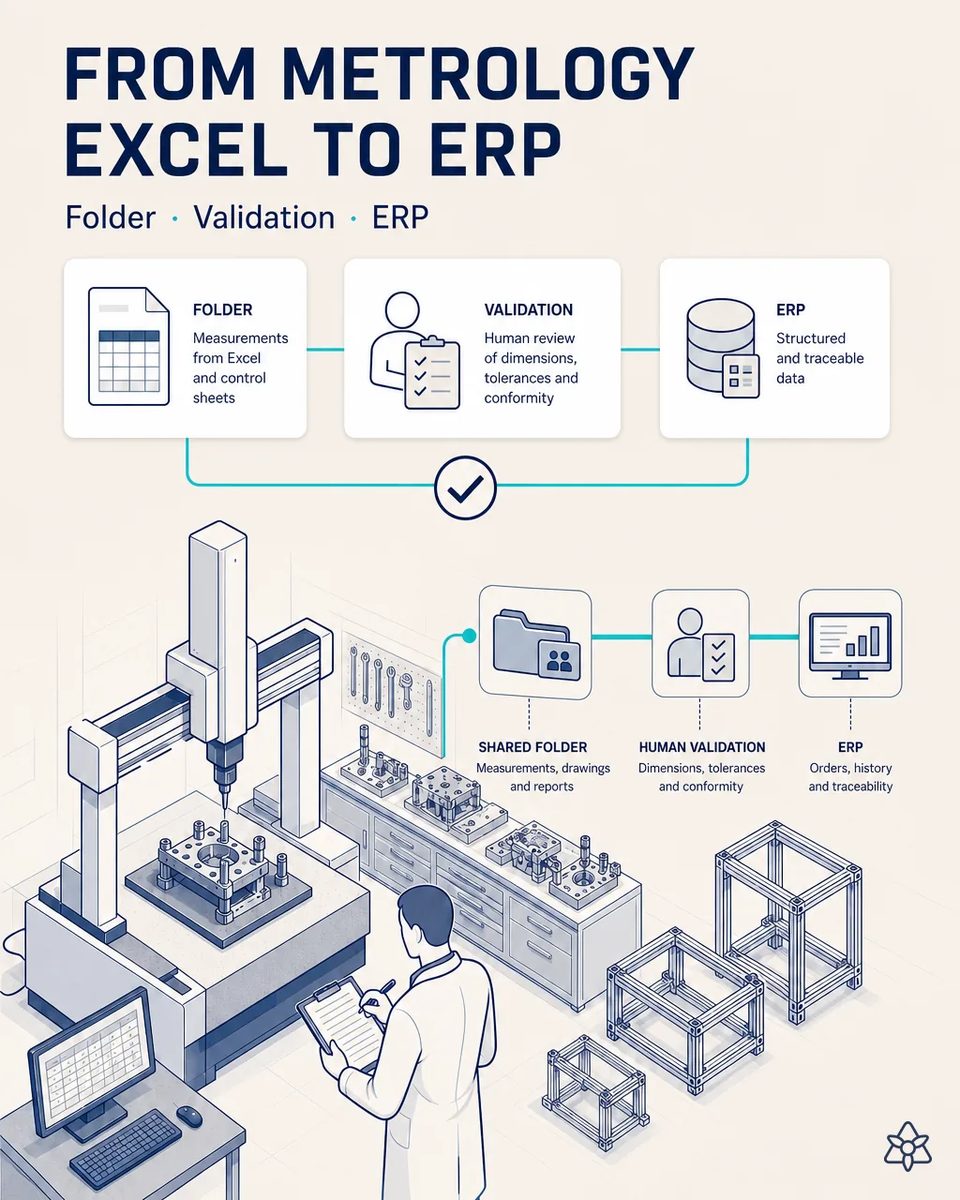
Double and triple keying is structural, not carelessness.
Double and triple transcription is structural. The same number is typed into the spreadsheet, into the ERP and into whatever format each customer demands, each with its own template. Every hop is a chance to introduce an error and a stretch of a highly qualified person doing data entry. And because the ERP updates late, the quality status the office sees is not the shop's real status. In a one-off business where the dimensional report is part of the deliverable, that is paid for twice: in hours and in credibility.
- The same number is typed into the spreadsheet, into the ERP and into the format each customer demands, each with its own template.
- Every hop is an opportunity for error and a stretch of a qualified person acting as a typist.
- Because the ERP updates late, the quality status the office sees is not the shop's real status.
- And on one-off work the dimensional report is part of the deliverable: that gets paid twice, in hours and in credibility.
Connect in listen-inward mode — it watches the folder, not the person.
Connect "listening inward".
The parser interprets the structure of the spreadsheet even when the format changes between customers. A fixed cell mapping breaks the first time somebody inserts a row.
- iLEAN observes the shared folder and reads the file when it is saved; it does not observe the person.
- A grounded model parses the spreadsheet structure even when the format varies between customers and extracts it dimension by dimension.
- It is stored in central memory tied to the job and its revision.
- After tablet validation, it posts to the ERP through the API and fills the customer template.
An isolated spreadsheet vs. an integrated one
| Aspect | Today | With iLEAN Connect |
|---|---|---|
| Times the same number is typed | 2-3 | Once, when measuring |
| Spreadsheet → ERP lag | Days | Immediate |
| Customer template | Assembled by hand per job | Generated from validated data |
| Quality status in the office | Days old | The real one |
| Copying errors | Those of repetitive work | There is no copying |
| Quality module licenses | 4 users | 1, the validator |
dimensional report retyped 2-3 times with days of lag → posted once, validated and immediately available. Customer report assembled by hand per job → generated from already-validated data.
Impact estimate — to validate against your numbers.
The block below is an estimate to be validated against your plant's actual data. We put it forward so the committee has an order of magnitude; we refine it during the assessment.
- Shops whose deliverable includes a dimensional report in each customer's format.
- CFO angle: today everybody who transcribes needs a quality module user; with Connect only the validating lead needs a license.
- Typical ratio from 4 licenses to 1: between 50% and 80% less recurring cost on that module, year after year and without renegotiating the contract.
- Indicative payback of 3 to 7 months: among the fastest in the set. To be calibrated against the real ERP invoice.
CFO angle — today everyone who retypes needs a seat in the quality module; with Connect only the supervisor who validates needs a licence. Typical ratio: from 4 licences to 1, between −50% and −80% of that module's recurring cost, year after year, with no contract renegotiation. Estimated payback 3-7 months, one of the fastest in the set. *Typical sector range; to be calibrated against the real ERP invoice. Estimate to be validated.*
And the fair question from the production manager
“What if I change the sheet format for a new customer?” — nothing breaks, and that is the reason for parsing with a language model instead of a fixed cell mapping. If a change leaves something ambiguous it is flagged in the validation rather than entering wrong. In a shop working for customers with different templates, a rigid parser would last a week.
[1] OpenAI paper "Why Language Models Hallucinate", 2025 — on the reliability of AI in anchored tasks.
What people ask about integrating the dimensional report
Do customer templates have to be unified?
No, and it would be impossible: every audited customer imposes its own and it is not negotiable. What gets unified is the data inside; the output template is filled from there, as many times as there are formats.
Is the quality team being monitored?
What is watched is the shared folder, not the people: the system detects that a file has been saved and reads the delta. There is no tracking of who works how much, and it is worth saying before anyone asks because it is the first reaction.
Are ERP licenses really saved?
It is the argument that convinces a finance director fastest, and it is worth checking against the invoice before promising it. If today everybody who transcribes needs a quality module user, with on-screen validation only the lead does. That saving is recurring.
What if the CMM already exports its own format?
Better: then it gets stitched there rather than through the folder, and that is another case in this matrix. Framing it on Excel exists because that is what is in most shops of this size, not because it is ideal.
Can the history be loaded?
It can if the old sheets are available, and it is usually done with the last few months. It is not essential to start, but normalized history is what makes comparing across projects mean something from the beginning.
More cases from this series
- The delivery file stops being assembled by hand on the last dayDrawing, heat, dimensions, images and signatures organised by each customer's standard while the job…
- A tooling shop's core pain is not cost, it is the dateFour coordinated rings from material receiving to the shipping dock: intake, start, execution and…
- You already own the good pieces — they just needed stitchingThe measurement report and the machining program tie themselves to the job and its revision. Without…
- A late drawing revision is the most expensive mistake in the shopThe revision lands by email or WhatsApp and the plate is already on the machine. iLEAN catches it the…
- Your most veteran machining centre can finally talkAn external camera reads the proprietary control of your veteran machining centre: spindle hours,…
- The heat number stops getting lost between the dock and the filing cabinetPhotograph the packing slip and the mill certificate: supplier, alloy and heat number enter the ERP with…
Tell us how many ERP licenses you pay for just to retype dimensions.
We work on your plant's real data, not ours. Assessment with no commitment.
Request estimated ROI within 48h ‹ See all cases of precision fixtures and frames See metal fabrication