A late drawing revision is the most expensive mistake in the shop
The customer's engineer sends a revised drawing and sends it the way everybody does: a PDF in an email or a photo over WhatsApp. It lands with one person, who sees it when they can. Meanwhile there is an aluminium plate clamped on the table being cut to the previous revision. With Connect the system sits on silent copy: it reads the message as it lands, matches it against live jobs and warns before the chips get expensive.
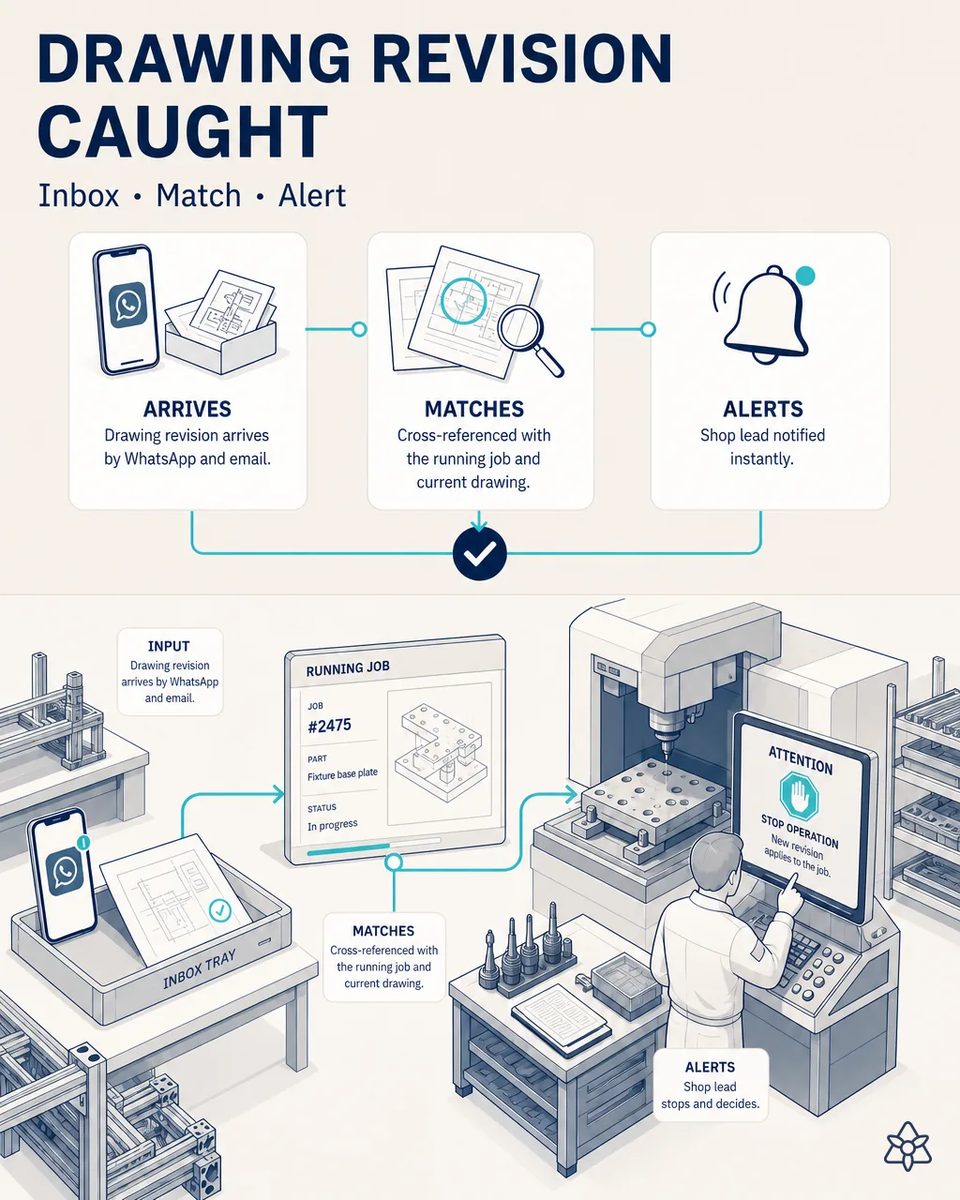
The inbound channel is irregular by nature, and discipline does not fix it.
This is the most expensive mistake in the trade and the hardest to prevent with discipline, because the inbound channel is irregular by nature: the customer writes wherever it suits them. Machining a one-off part to the wrong revision means lost material, lost machine hours, the promised date at risk and an awkward conversation about who absorbs the cost. And because the part is unique, there is no second piece in the batch to rescue the job. Document discipline does not fix it: the message will keep arriving through whatever channel the customer picks.
- The customer writes wherever is convenient: a PDF in an email, a photo on WhatsApp. It reaches one person, who sees it when they can.
- Meanwhile there is a plate clamped on the table being machined to the previous revision.
- On one-off work there is no second part in the batch to rescue the job: material lost, machine hours lost, the committed date at risk.
- And an awkward conversation about who absorbs the cost, which is the part that appears on no spreadsheet.
Connect in chaotic-sources mode — listening continuously.
Connect in chaotic-sources mode.
iLEAN warns and proposes; the decision to stop the machine belongs to the person. What changes is not who decides, it is when they find out.
- A dedicated mailbox on copy and a WhatsApp Business number listen continuously.
- The grounded model extracts intent — drawing revision, scope change, pulled-in date, non-conformance — and identifies part number and revision level.
- It matches against running jobs.
- On a match with a live job, it alerts the shop lead and the programmer with the concrete suggested action: stop the operation, revalidate the program, confirm with the customer. Humans in command: iLEAN warns and proposes; stopping the machine is the person's call.
A revision that arrives late vs. one cross-referenced in a minute
| Aspect | Today | With iLEAN Connect |
|---|---|---|
| Detecting the revision | When somebody opens the email | Within a minute of arrival |
| Channel | Whatever the customer picks | The same, listened to |
| Affected order | Has to be found | Already identified |
| What reaches the shop lead | A forwarded message | The suggested action |
| Scrap from an obsolete revision | Permanent latent risk | Risk bounded by design |
| Who decides to stop | The shop lead | The shop lead |
revision caught whenever someone opens the inbox (hours, sometimes next day) → caught the minute it lands, with the affected job already identified. Scrap from a superseded revision as a permanent latent risk → risk bounded by design.
Impact estimate — to validate against your numbers.
The block below is an estimate to be validated against your plant's actual data. We put it forward so the committee has an order of magnitude; we refine it during the assessment.
- One-off shops whose customers send revisions through informal channels.
- Indicative payback between 3 and 8 months, dominated by avoiding scrapped one-off parts.
- Plus the effect on on-time delivery, which is what keeps an audited customer.
- To be checked against the real history of revision incidents over the last few years.
estimated payback 3-8 months, driven by one-off parts that no longer get scrapped and by the effect on on-time delivery. *Estimate to be validated* against the real history of revision incidents.
And the fair question from the production manager
“Are you going to read my sales team's messages?” — what gets listened to is a dedicated inbox and a WhatsApp Business number set up to receive technical documentation. Nobody's personal messaging is touched. And what comes out is an alert about a work order, not a report about a person.
[1] OpenAI paper "Why Language Models Hallucinate", 2025 — on the reliability of AI in anchored tasks.
What people ask about catching the revision in time
Isn't it enough to require customers to use a portal?
You can require it and it is worth trying, but the message will keep arriving wherever the customer's engineer has their hand. This case exists because you do not control the channel: instead of fighting that, the real channel is listened to and cross-referenced with live orders.
How does it know the revision affects a job in progress?
It extracts part number and revision level from the message and checks them against open orders. If it matches a live job, the alert goes out with the order already identified; if not, it is still recorded against the part, for when that job is released.
Can it stop the machine by itself?
No. It proposes the action — halt the operation, revalidate the program, confirm with the customer — and the shop lead decides. Stopping a machine has schedule consequences a model is not in a position to weigh.
What if the message has no part number?
It still gets routed, flagged as ambiguous, rather than discarded. A doubtful alert that reaches a person still beats a PDF sitting in an inbox; what the system does not do is act alone on an unsafe reading.
Does it also cover scope or date changes?
Yes, and it is usually the second benefit: the same listening catches date pull-ins, scope extensions and nonconformities. They arrive through the same irregular channel and with the same delay.
More cases from this series
- The delivery file stops being assembled by hand on the last dayDrawing, heat, dimensions, images and signatures organised by each customer's standard while the job…
- A tooling shop's core pain is not cost, it is the dateFour coordinated rings from material receiving to the shipping dock: intake, start, execution and…
- You already own the good pieces — they just needed stitchingThe measurement report and the machining program tie themselves to the job and its revision. Without…
- Your most veteran machining centre can finally talkAn external camera reads the proprietary control of your veteran machining centre: spindle hours,…
- The heat number stops getting lost between the dock and the filing cabinetPhotograph the packing slip and the mill certificate: supplier, alloy and heat number enter the ERP with…
- The dimensional report stops being retyped three timesiLEAN reads the dimensional report when it is saved and, after validation, posts it to the ERP and the…
Tell us how many parts you have scrapped because a revision arrived late.
We work on your plant's real data, not ours. Assessment with no commitment.
Request estimated ROI within 48h ‹ See all cases of precision fixtures and frames See metal fabrication