Your most veteran machining centre can finally talk
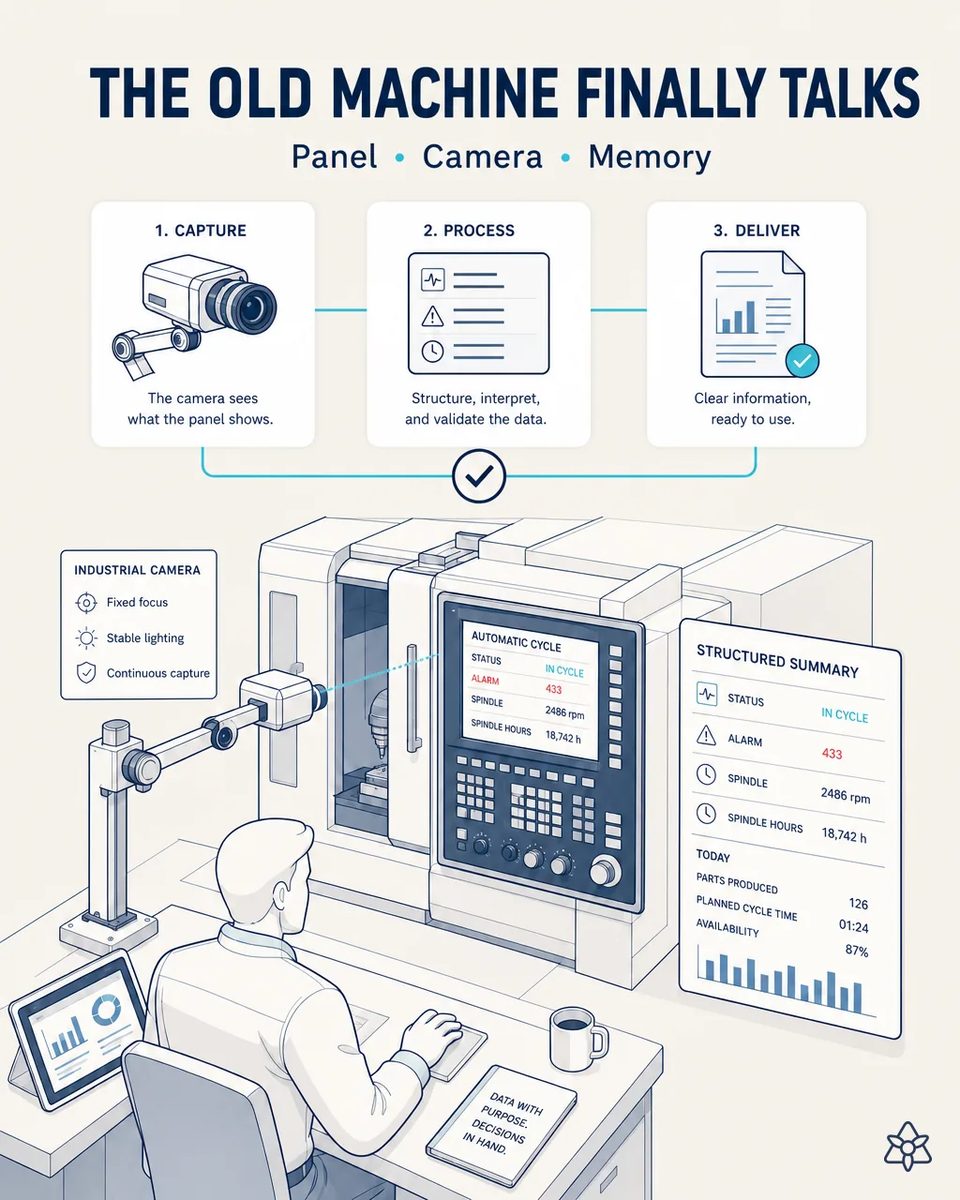
The oldest machine on the floor still holds tolerance, which is exactly why nobody will replace it: replacement costs several years of capital budget and weeks without capacity. But its control talks to no one, and its screen holds everything the shop would need to know its real capacity. With Connect, one external camera pointed at the control is enough.
Capacity gets planned on the shop lead's intuition.
Capacity is planned by feel, on the shop lead's experience, because nobody knows how many spindle hours each machine has run this week or how long it sat waiting on material, program or tooling. When a customer asks whether their fixture will land on the promised date, the answer is built on intuition, not data. And the veteran machines are the ones used most for roughing, so they hide the most information. The manual mill with its readout is blinder still.
- Nobody knows how many spindle hours each machine has given this week, nor how long it sat waiting on material, program or tooling.
- When the customer asks whether their tooling lands on time, the answer is built on a hunch, not on a figure.
- The veteran machines are exactly the ones used most for roughing, so they are the ones hiding the most information.
- The manual mill with a readout is blinder still, and in a tooling shop it runs every day.
Connect in photo mode over the panel — without touching the machine software.
Connect in photo mode on the panel.
Replacing those controls costs several years of capital budget plus weeks without capacity. The camera avoids that discussion entirely and leaves the CAPEX where it was.
- A fixed industrial camera framing the control, and another on the manual mill's readout.
- OCR with a grounded model reads each frame, ignores what does not change and structures the time series: cycle, alarm, stoppage, spindle hours.
- It is cross-referenced with the active job to know which project was in the machine at any moment. The machine's software is never touched, and neither is its warranty.
A mute machine vs. a machine that reports
| Aspect | Today | With iLEAN Connect |
|---|---|---|
| Spindle hours | Estimated | Measured per machine |
| Downtime causes | Anecdotal | Recorded and classified |
| Manual mill | Invisible | Read from its readout |
| Committing a date | A hunch | Measured capacity |
| Work on the control | — | None: no cable, no firmware |
| Replacement CAPEX | On the list for years | Deferrable |
zero machine data and planning by intuition → spindle hours and downtime causes per machine and per job. Date commitments based on a hunch → based on measured capacity.
Impact estimate — to validate against your numbers.
The block below is an estimate to be validated against your plant's actual data. We put it forward so the committee has an order of magnitude; we refine it during the assessment.
- Shops where the machine holding the tolerances is the oldest one and nobody is going to change it.
- Indicative payback between 5 and 10 months.
- Plus indefinite deferral of the CAPEX to replace the old controls.
- And the reliability of the committed date, which is what this sub-sector actually sells.
estimated payback 5-10 months. Indefinite deferral of the CAPEX to replace legacy controls, plus better reliability of the promised date. *Estimate to be validated.*
And the fair question from the production manager
“Is a camera reading an old control reliable?” — it depends more on the mounting than on the model: fixed camera, stable framing, controlled lighting. Under those conditions reading digits off a panel is about as anchored as tasks get. It is checked in the first week against manual readings, and if a particular control will not read, that gets said before anything is committed.
[1] OpenAI paper "Why Language Models Hallucinate", 2025 — on the reliability of AI in anchored tasks.
What people ask about reading the machine control
Does it affect the machine's warranty?
No, because nothing is touched. The camera is an external element looking at the screen exactly as a person would. That is what makes the case viable: any route requiring work on the control of the asset that holds your tolerances stops dead forever.
What about machines with no screen at all?
The manual mill is covered through its digital readout, which is where that machine's information is. For equipment with no indication at all this case does not apply: there the data comes in through the traveler captured by photo, which is another case in this matrix.
Does it know which project each hour belongs to?
It is cross-referenced with the active work order, which is why it matters that the traveler is captured. Without that link you would have ownerless spindle hours; with it you have hours per project, which is what lets you compare quoted against real.
How often does it capture?
Every few seconds, ignoring whatever does not change. No video is stored: what is stored is the reconstructed time series — cycle, alarm, stop, spindle hours — which takes little space and is actually useful.
Is it worth it in a shop with few machines?
It is usually worth more than in a large one, because with few machines every spindle hour weighs far more on the committed date. What changes is not the volume of data: it is that for the first time you can answer with a figure when the customer asks whether it lands.
More cases from this series
- The delivery file stops being assembled by hand on the last dayDrawing, heat, dimensions, images and signatures organised by each customer's standard while the job…
- A tooling shop's core pain is not cost, it is the dateFour coordinated rings from material receiving to the shipping dock: intake, start, execution and…
- You already own the good pieces — they just needed stitchingThe measurement report and the machining program tie themselves to the job and its revision. Without…
- A late drawing revision is the most expensive mistake in the shopThe revision lands by email or WhatsApp and the plate is already on the machine. iLEAN catches it the…
- The heat number stops getting lost between the dock and the filing cabinetPhotograph the packing slip and the mill certificate: supplier, alloy and heat number enter the ERP with…
- The dimensional report stops being retyped three timesiLEAN reads the dimensional report when it is saved and, after validation, posts it to the ERP and the…
Tell us which machines you have and we will say within 48h which ones read.
We work on your plant's real data, not ours. Assessment with no commitment.
Request estimated ROI within 48h ‹ See all cases of precision fixtures and frames See metal fabrication