Zero out-of-specification units on site: four verification rings
A dock equipment manufacturer's capital pain is the unit arriving on site and not being exactly the one the project needs. There is no recovery margin: the pit is dug, the crane hired, the installer on site and the customer's dock stopped. The iLEAN system coordinates Connect, Edge and Agents into four verification rings that cross-check each other; if the four do not match, the unit does not get on the truck.
The more customization you sell, the more error surface you have.
A unit with the wrong capacity, dimension, lip, voltage or finish means a re-shipment, a second crane, a site penalty and a distributor claim costing many times the equipment's price. And the greater damage is not the direct one:
- The distributor decides which brand it specifies on the next project — and an installation incident weighs more in that decision than ten correct deliveries.
- There is a structural aggravator — the customization that wins the order is the same thing that exposes you to losing it at installation. More options, more error surface.
- And if there is a new plant ramping up, every incident feeds the doubt of whether the equipment built there is just as good — a doubt that costs far more to dispel than to sow.
All of that is decided at the same point: whether the unit that gets on the truck is exactly the one the project asked for — and today that rests on four checks that do not talk to each other.
Four rings that cross-check — and in all four, a person always releases.
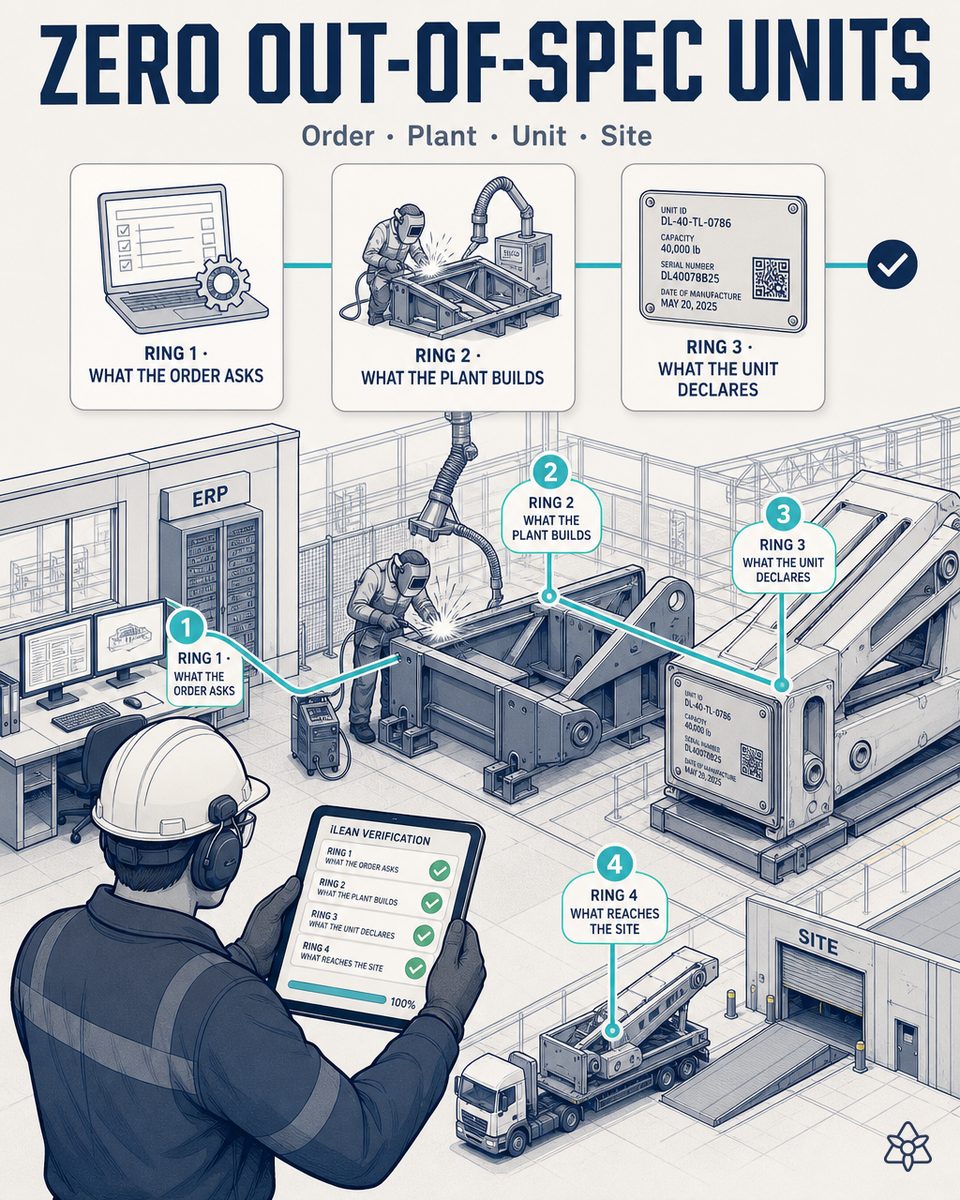
The flagship adds no pieces: it coordinates the previous eleven. Each ring answers a different question about the same unit, and the value appears when the four answers are compared with each other.
What the order asks for, what the plant builds, what the unit declares and what the file proves. If the four do not match, the unit does not get on the truck. In all four rings the system stops and presents the evidence: a person always releases.
The four rings, and what each one checks:
- Ring 1 · What the configured order asks for — Connect guarantees that what is on the shop paper and what arrived by email from the site are inside the system and are the same thing. If the installer changed the dimension, ring 1 knows before cutting.
- Ring 2 · What the plant builds — Edge verifies that the tooling was the model's, that the booth was purged of the previous color and that the critical seams conform. JIDOKA AI blocks or flags the unit at the stage where correcting is still cheap.
- Ring 3 · What the unit declares — the marker engraves on the nameplate what the ERP says, with no typing, and a camera reads the engraved plate and cross-checks it with the order. If the rated capacity does not match, the unit does not pass to shipping.
- Ring 4 · What the file proves — Agents checks that the unit has a complete file — heat, curing curve, measured thickness, load test, electrical check, seam images — before releasing the shipment. No complete file, no delivery note.
- And SMED AI accelerates model changes so the cross-verification does not penalize productivity.
Four checks that do not talk vs. four cross-checked rings
| Aspect | Without coordination | With the iLEAN flagship |
|---|---|---|
| Where the deviation is detected | The installer detects it on site | In the plant, at the stage where correcting costs minutes |
| A change arrived from the site | Discovered when it is already expensive | Ring 1 knows before cutting |
| Tooling, purge and seams | Signed blind | Verified by Edge, ring 2 |
| Rated capacity on the nameplate | Typed, unchecked | Engraved from the ERP and read by camera, ring 3 |
| Shipping | With a delivery note and no file | No complete file, no delivery note |
| Consistency between plants | A promise based on trust | Demonstrable unit by unit and comparable |
Impact estimate for your plant — to be validated with your own numbers.
The block below is an estimate to be validated against your plant's actual data. We put it forward so the committee has an order of magnitude; we refine it during the assessment.
- Configure-to-order dock equipment manufacturer, with distributors that specify a brand and, where applicable, a new plant ramping up.
- Phased deployment: start with the shortest-payback Connect cases, raise rings 1 and 3, incorporate Edge and close with the file.
- Protection against the direct cost of the site incident — equipment, transport, crane, installer and penalty — and against the far greater indirect cost of losing the distributor's specification.
- Estimated payback between 6 and 12 months against the first avoided incident. Estimate to be validated with the site incident history of the last three years.
- And the effect that weighs most with a new plant: consistency between facilities stops being a promise based on trust and becomes demonstrable unit by unit and comparable between plants.
And the fair question from general management
"Isn't this too much project to start with?" — you do not start here. The flagship is the destination: you get there in phases, starting with the shortest-payback Connect cases, which finance the next ones. And on the reliability of the whole: everything the AI does in these four rings is an anchored task — reading a known data point, comparing against a reference state, cross-checking two records — where the best models brought the error below 1.5% [1]. And in all four rings the system stops and presents the evidence: a person always releases.
[1] OpenAI paper "Why Language Models Hallucinate", 2025 — on the reliability of AI in anchored tasks.
What people ask about the zero-out-of-spec flagship
Why is there no recovery margin on site?
Because when the unit arrives, everything else is already committed: the pit is dug, the crane hired, the installer on site and the customer's dock stopped. A unit with the wrong dimension, capacity, lip, voltage or finish is not adjusted there: it is sent back. That means a re-shipment, a second crane, a site penalty and a distributor claim costing many times the equipment's price. It is not a problem good will can solve in the moment — the only solution is the correct unit leaving the plant.
What does it mean that the rings cross-check?
That each answers a different question about the same unit and the four answers are compared. What the order asks for (ring 1), what the plant builds (ring 2), what the unit declares on its nameplate (ring 3) and what the file proves (ring 4). Separately, none detects a deviation: the order can be right and the plate wrong, or the manufacturing correct and the file incomplete. Cross-checked, any discrepancy jumps out — and it jumps out before the unit gets on the truck.
Does production stop when something does not add up?
No: the unit stops, at the stage where correcting is still cheap, and the system presents the evidence of what does not add up. A dimension change detected by ring 1 before cutting is resolved by reconfiguring; wrong tooling detected by ring 2 is corrected before welding; a non-matching plate detected by ring 3 prevents passing to shipping but does not stop the line. And in all four cases a person always releases: the system holds and shows, it does not decide.
Why does customization increase the risk?
Because it is a structural aggravator of the business model: the more options a configure-to-order manufacturer sells, the more error surface it has. Every combination of height, capacity, dimensions, lip type, voltage, color and options is a distinct unit that can deviate at a distinct point. Customization is what wins the order and it is exactly the same thing that exposes you to losing it at installation. That is why the answer cannot be reducing options — it has to be verifying that the specific combination that left is the one that was ordered.
How is the economic case built?
With your own site incident history of the last three years: how many there were and what each cost across equipment, transport, crane, installer and penalty. That is the direct cost. But the argument that usually decides with management is the indirect one: the distributor is who decides which brand it specifies on the next project, and an installation incident weighs more in that decision than ten correct deliveries. That damage appears on no invoice and is the hardest to reverse — above all if there is a new plant ramping up whose reputation is being built.
More cases from this series
- The conformity file assembles itself, unit by unitEach unit generates its dossier as it is built: seam, curing curve, thickness, load test, heat and…
- The curing oven starts to talk: the real curve, unit by unitAn external camera reads the curing oven’s proprietary panel and digitizes the real curve per unit,…
- The nameplate, engraved from the ERP and with no typingConnect stitches the nameplate marker to the ERP via API: serial, model, rated capacity and markings…
- The manufacturing folder enters on its own: one photo and the unit exists in the systemEach leveler’s manufacturing folder enters the system with a photo: configuration, signatures and…
- The finish and load tests enter the ERP on their owniLEAN reads the thickness, adhesion and load test Excel on save, ties it to the serial number and feeds…
- The change arriving from the site, in time for it to cost nothingiLEAN reads email and messaging silently copied, cross-references the installer’s notice with the…
Calculate what a site incident costs in your operation.
We work on your plant's real data, not ours. With your incident history of the last three years we put numbers on each ring. Assessment with no commitment.
Calculate it with an iLEAN consultant ‹ See all 12 loading dock equipment cases See metal fabrication