The manufacturing folder enters on its own: one photo and the unit exists in the system
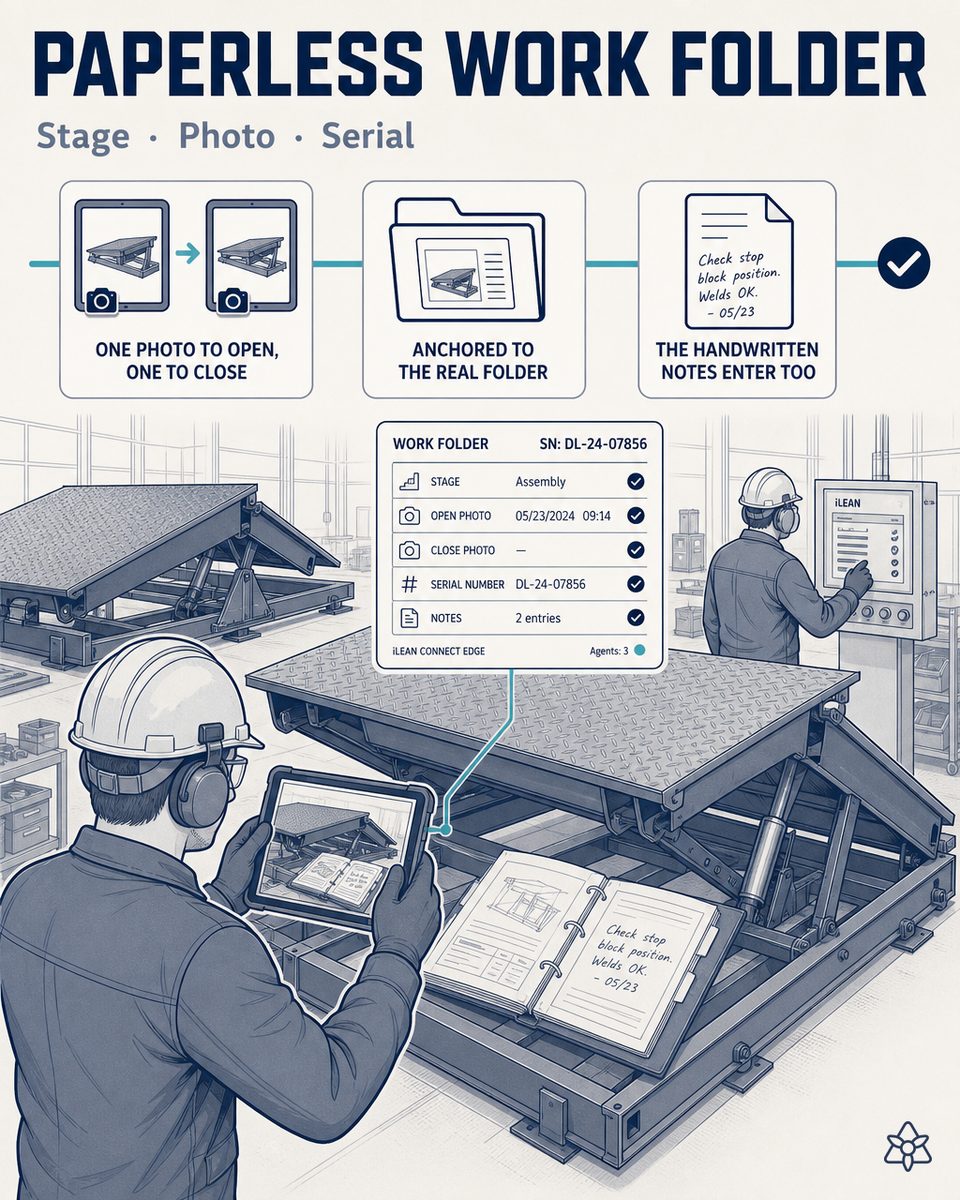
In a dock leveler and vehicle restraint factory, every unit starts its journey with a paper folder holding everything that makes it unique: dock height, rated capacity, platform dimensions, lip type, tension, color and options. That folder travels through cutting, welding, painting and assembly collecting signatures and handwritten notes, and ends up in a tray in the production office. With iLEAN Connect, the operator takes one photo when opening the unit and another when closing each stage.
At a configure-to-order manufacturer, paper is not a relic of the past.
It is the only place where this unit's specific combination lives, along with who validated it. And the handwritten notes — the reinforcement that was added, the lip the customer changed at the last minute, the missing kit — are exactly the ones that never reach the ERP:
- The cost is not felt daily, it hits all at once — when a claim arrives from a site months later and reconstructing what was actually built requires finding a folder in a filing cabinet, deciphering handwriting and trusting the shop manager's memory.
- Four to eight hours of latency, sometimes days — between what happens in the shop and what the central system knows. In that stretch, everything decided is decided on a configuration that may have changed.
- And part of it is never transcribed — because it fits in no ERP field. Precisely the part that explains why this unit is not exactly like the drawing.
Add to that the production manager's time spent transcribing, which is pure administrative work on information that already existed in writing.
Connect in photo-the-analog mode — there is still a folder and there is still a pen.
The paper is not replaced, the process is not changed and no training is needed. The only thing added is a photo at two moments: when opening the unit and when closing each stage.
An anchored model recognizes the document's structure and extracts serial number, model, capacity, dimensions, lip type, tension, color, options, signatures and handwritten notes. Everything stays tied to the serial number in central memory, and the summary passes through human verification on the tablet before crossing into the ERP master.
How Connect photo operates on the manufacturing folder:
- One photo when opening and one when closing each stage — cutting, welding, painting and assembly. That way the history is not a final snapshot but the trace of where the unit went and what was signed at each point.
- Anchored to the house's real folder — the model knows its structure: which box holds the capacity, which the platform dimensions, which the lip type and the tension.
- The handwritten notes enter too — the added reinforcement, the lip changed at the last minute, the missing kit. They are stored as searchable text, which is what gets lost today.
- Tied to the serial number — not to the order or the date. At a configure-to-order manufacturer, the serial number is the only key that works when a claim arrives from a site.
- Human verification before the master — the summary passes through the tablet and a person confirms. Nothing crosses into the ERP without a signature.
Paper folder vs. folder digitized with Connect
| Aspect | Classic folder in a filing cabinet | With iLEAN Connect photo |
|---|---|---|
| Shop → central system latency | 4-8 h, sometimes days | Second zero |
| A claim from a site | Find the folder and decipher the handwriting | Complete history by serial number, from the browser |
| Handwritten notes | Lost: they fit in no ERP field | Captured and searchable |
| History per stage | Loose signatures on a paper | Trace of cutting, welding, painting and assembly |
| Manager's transcription time | Daily administrative work | Recovered |
| Operator's habit | The same folder — plus someone else's transcription | The same folder — plus a photo |
Impact estimate for your plant — to be validated with your own numbers.
The block below is an estimate to be validated against your plant's actual data. We put it forward so the committee has an order of magnitude; we refine it during the assessment.
- Configure-to-order dock leveler and vehicle restraint manufacturer, with a paper manufacturing folder traveling through cutting, welding, painting and assembly.
- Connect photo pilot on the folder — with the phone or the industrial tablet already in the plant, without replacing the paper or changing the process. First value expected within a few weeks.
- Indicative payback between 4 and 9 months depending on units per day and the current cost of transcription and document searching. Estimate to be validated with the plant's real volume.
- The lever that appears all at once: responding to a claim from a site stops being a search through a filing cabinet and becomes a query by serial number.
- It is also the enabler of the rest of the matrix: without the unit existing in the system from second zero, neither the oven curve nor the weld seam has anything to attach to.
And the fair question from the shop manager
"What if the model misreads a dimension or a note?" — hallucination is a problem of free generation, not of anchored tasks. Here the AI recontextualizes what is already written against the house's real folder: the best models brought the error below 1.5% [1] in that kind of task. And the summary passes through the verification tablet before crossing into the master: a doubtful field gets flagged and a person confirms it.
[1] OpenAI paper "Why Language Models Hallucinate", 2025 — on the reliability of AI in anchored tasks.
What people ask about digitizing the manufacturing folder
Does the paper have to be replaced?
No, and it is a condition of the approach. At a configure-to-order manufacturer, the folder works: it physically accompanies the unit through cutting, welding, painting and assembly, and collects signatures where they happen. Replacing it with a tablet at every station would be a project with its resistance and its timeline. With Connect there is still a folder and there is still a pen: the only thing added is a photo when opening the unit and another when closing each stage. No training is needed because there is nothing new to learn.
Why tie everything to the serial number and not the order?
Because the serial number is the key problems arrive by. When a site claims months later, nobody asks about the work order: they ask about that specific unit installed at that dock. At a configure-to-order manufacturer, two units from the same order can carry different dimensions, lips or options, so the order does not identify enough. With the configuration, signatures and notes tied to the serial number, the query needed on the day of the claim is direct.
What happens with the handwritten notes?
They are kept as searchable text, and they tend to be the most valuable part. The reinforcement that was added, the lip the customer changed at the last minute, the missing kit — they are exactly the things that fit in no ERP field and that is why they get lost in transcription today. Connect does not try to turn them into structured data or interpret them: it stores them as they are, tied to the serial number and the stage, and keeps them available for whenever someone investigates that unit.
Why a photo per stage and not just one at the end?
Because what matters is not only the final configuration, but what was signed at each point of the journey. A photo when closing cutting, another when closing welding, another when closing painting and another when closing assembly build the unit's real trace: who validated what and at what moment. With a single photo at the end you would have the configuration but not the history, and it is precisely the history that is needed when a stage has to be proven conforming — or when finding out in which one a deviation was introduced.
How long until it delivers value?
A pilot on one product line can deliver value within a few weeks: anchor the model to the house's folder and start accumulating units. The first deliverable is simple: being able to query from the browser the complete configuration and signature history of a specific unit, without going to the filing cabinet. From there, every week of history makes the system more useful, and it is the base the curing oven curve and the weld seam inspection later rest on, since they need a unit to attach to.
More cases from this series
- The conformity file assembles itself, unit by unitEach unit generates its dossier as it is built: seam, curing curve, thickness, load test, heat and…
- The curing oven starts to talk: the real curve, unit by unitAn external camera reads the curing oven’s proprietary panel and digitizes the real curve per unit,…
- The nameplate, engraved from the ERP and with no typingConnect stitches the nameplate marker to the ERP via API: serial, model, rated capacity and markings…
- The finish and load tests enter the ERP on their owniLEAN reads the thickness, adhesion and load test Excel on save, ties it to the serial number and feeds…
- The change arriving from the site, in time for it to cost nothingiLEAN reads email and messaging silently copied, cross-references the installer’s notice with the…
- A photo of the steel delivery note: heat traceability from unloadingA photo of the delivery note, the material certificates and the labels: the heat is tied to the ERP from…
See how a manufacturing folder is digitized without touching the process.
We work on your plant's real data, not ours. We show you the reading working on your own folder. Assessment with no commitment.
See how we would apply it in your plant ‹ See all 12 loading dock equipment cases See metal fabrication