The nameplate, engraved from the ERP and with no typing
The nameplate is the last information leaving the factory and the first an inspector, an installer or an expert witness looks at: serial number, model, rated capacity, voltage, conformity markings. The marker that engraves it already has an API, but it is isolated from the ERP, so when the model changes someone types the data into its panel. With iLEAN the two systems get stitched.
The textbook case of the "almost integrated but not" system.
A modern machine, with an interface available, still fed by hand because integrating it properly is never the week's most urgent thing. And the consequence here is not a mismatch:
- One wrong digit in the rated capacity means a platform goes out to a site declaring more load than it is designed to bear.
- That is not fixed with a sticker — it forces intervening on the already-installed unit, with disassembly or a technician's visit, and compromises the declared conformity.
- And since the error is rare, nobody prioritizes it — it is exactly the risk profile that gets discovered late: low frequency, high consequence.
That is why this gap survives year after year: it generates no weekly noise forcing attention, but when it appears it admits no cheap correction.
Connect stitching two modern systems via API, replacing neither.
When both ends already have a way to communicate, stitching is not a project: it is closing a specific gap. And here, moreover, the loop can be closed with a verification.
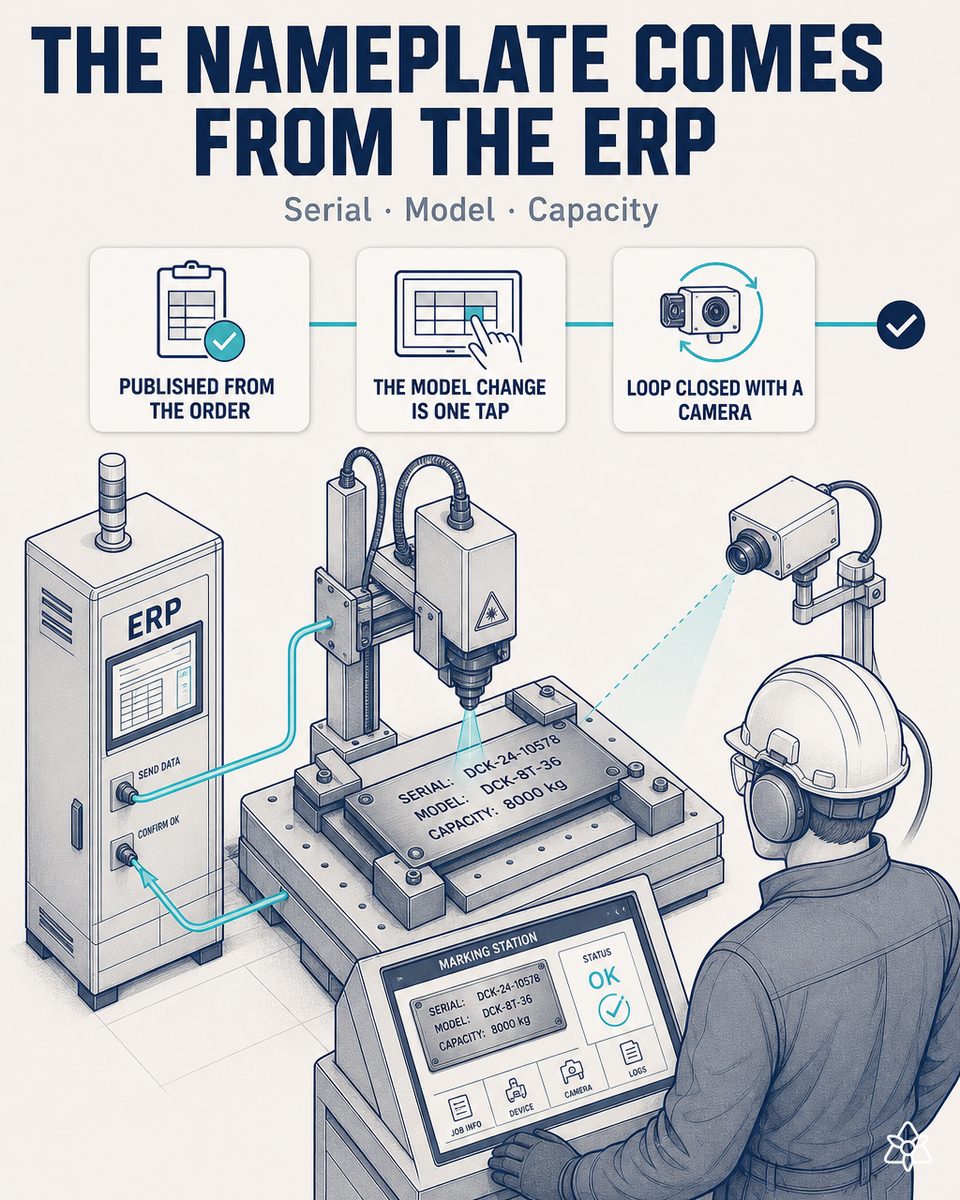
When the ERP marks the unit as ready for marking, it automatically publishes serial, model, capacity, dimensions, voltage and conformity markings to the marker. A camera reads the engraved plate and cross-checks it with the order: if they do not match, the unit does not pass to shipping.
How Connect operates on the nameplate marker:
- Automatic publication from the active order — serial, model, capacity, dimensions, voltage and conformity markings. Nobody transcribes them.
- The model change is one tap in the ERP — not typing at the machine's panel between two units.
- Loop closed with a camera — the already engraved plate is read and cross-checked with the order. Sending the correct data is not enough: you must check the machine applied it.
- If it does not match, it does not pass to shipping — the block sits at the last point where correcting is still cheap, before the unit leaves the plant.
- If the marker exposes no API, an adapter — solves the connection without changing the machine. It raises the initial CAPEX but does not break the case.
Isolated marker vs. marker stitched to the ERP with verification
| Aspect | Data typed at the panel | With iLEAN Connect via API |
|---|---|---|
| Origin of the plate | Typing at the machine's panel | The active work order |
| Model change | A key sequence | One tap in the ERP |
| Errors in declared information | Sporadic but of serious consequence | Zero of human origin |
| Check of what was engraved | None | A camera cross-checking the plate with the order |
| A unit with a non-matching plate | Goes out to the site | Does not pass to shipping |
| Corrective interventions on installed equipment | Disassembly or a technician's visit | Eliminated at their main cause |
Impact estimate for your plant — to be validated with your own numbers.
The block below is an estimate to be validated against your plant's actual data. We put it forward so the committee has an order of magnitude; we refine it during the assessment.
- Dock equipment plant with a modern nameplate marker isolated from the ERP and several models in production.
- Connect pilot stitching the ERP and the marker via API, with camera verification before shipping. Without replacing the machine. First value expected within a few weeks.
- Estimated payback between 3 and 6 months, more through avoided risk than through saved time. Estimate to be validated.
- The logic is that of a low-frequency, high-consequence risk: it generates no weekly noise, but a platform declaring more load than it bears forces intervening on installed equipment and compromises the declared conformity.
- If the current marker model exposes no API, an intermediate adapter solves the connection without changing the machine — worth confirming before committing to deadlines.
And the fair question from the technical director
"What if the AI invents a capacity?" — it cannot: here the AI does not generate data, it transports it anchored from the ERP's active order. It is an anchored task, where the best models brought the error below 1.5% [1]. And there is a second ring closing the loop: a camera reads the already engraved plate and cross-checks it with the order. If they do not match, the unit does not pass to shipping — so neither a transmission error nor a failure of the marking machine itself ever leaves the plant.
[1] OpenAI paper "Why Language Models Hallucinate", 2025 — on the reliability of AI in anchored tasks.
What people ask about stitching the nameplate marker to the ERP
Why isn't it already integrated if the machine has an API?
It is the textbook case of the "almost integrated but not" system: a modern machine, with an interface available, still fed by hand because integrating it properly is never the week's most urgent thing. The work is small and falls between the ERP project's scope and the marker vendor's, so it gets postponed indefinitely. And since the resulting error is rare, it does not generate enough pressure to climb the list either. Connect exists to close exactly that kind of gap without opening a full integration project.
What is the consequence of one wrong digit?
That a platform goes out to a site declaring more load than it is designed to bear. And that is not fixed with a sticker: it forces intervening on the already-installed unit — with disassembly or a technician's visit — and compromises the equipment's declared conformity. It is the difference between an administrative error and an error on a safety product. That is why the case is defended more through avoided risk than saved time: the typing time is small, the consequence is not.
What does the camera verification add?
It closes the loop. Publishing the correct data from the ERP eliminates the typing error, but it does not guarantee the machine applied it — there can be a transmission failure, a residue from the previous unit or a problem in the marking equipment itself. That is why a camera reads the already engraved plate and cross-checks it with the active order. If they do not match, the unit does not pass to shipping. The block sits at the last point where correcting is still cheap: before it leaves the plant and not later, on site.
What if our marker exposes no API?
An intermediate adapter solves the connection without changing the machine. It raises the initial CAPEX, but it does not break the case — above all because this one is defended by avoided risk and not by time savings. What is worth doing is knowing it before committing to a deadline, so the first diagnostic question is the specific installed model. In relatively modern laser or dot-peen marking equipment the interface is usually available and nothing else is needed.
Why is this kind of error discovered late?
Because it has the classic low-frequency, high-consequence profile. It does not happen every week, so it generates none of the operational noise that would force attention, and when it happens it is usually detected outside the plant — by an inspector, an installer or an expert witness looking at the plate. That is exactly the kind of risk a verification system solves well and an awareness campaign does not: it does not depend on anyone remembering to check, because the check is built into the flow.
More cases from this series
- The conformity file assembles itself, unit by unitEach unit generates its dossier as it is built: seam, curing curve, thickness, load test, heat and…
- The curing oven starts to talk: the real curve, unit by unitAn external camera reads the curing oven’s proprietary panel and digitizes the real curve per unit,…
- The manufacturing folder enters on its own: one photo and the unit exists in the systemEach leveler’s manufacturing folder enters the system with a photo: configuration, signatures and…
- The finish and load tests enter the ERP on their owniLEAN reads the thickness, adhesion and load test Excel on save, ties it to the serial number and feeds…
- The change arriving from the site, in time for it to cost nothingiLEAN reads email and messaging silently copied, cross-references the installer’s notice with the…
- A photo of the steel delivery note: heat traceability from unloadingA photo of the delivery note, the material certificates and the labels: the heat is tied to the ERP from…
See how a marker is stitched to the ERP without changing the machine.
We work on your plant's real data, not ours. We look at your marker and your ERP and size the gap. Assessment with no commitment.
See how we would apply it in your plant ‹ See all 12 loading dock equipment cases See metal fabrication