The curing oven starts to talk: the real curve, unit by unit
The automated powder coating line is one of the most expensive investments in a dock equipment plant, and its curing oven decides whether the finish lasts twenty years outdoors or degrades in two. Its panel shows temperature per zone, chain speed and dwell time, but it is proprietary and lives isolated: the data dies every time the screen rotates. With iLEAN Connect, an external camera aimed at the panel is enough.
The usual record is a sheet where someone writes down the setpoint, not the real curve.
The powder coating process certification audits precisely that the process is controlled and recorded. And there the distance appears between what gets recorded and what happened:
- The setpoint is noted, not what the parts went through — two different things the moment a zone drifts, a door closes worse or the chain changes pace.
- Facing an adhesion defect, nobody can correlate — what was happening in the oven while those parts crossed it. The investigation stays at hypotheses and the corrective action at a new "just in case" setpoint.
- And the obvious alternative does not justify itself — renewing the line's control so it exposes data is an investment on the order of hundreds of thousands of euros with an associated stoppage, impossible to defend just to have traceability.
The result is one of the plant's most expensive investments running as a black box, exactly at the stage that decides the product's twenty-year durability.
Connect in photo mode on the panel — the line stays the same machine.
The missing information is already on the screen. What does not exist is the path from that glass to the central system. Connect solves it by looking, without touching or opening the original control.
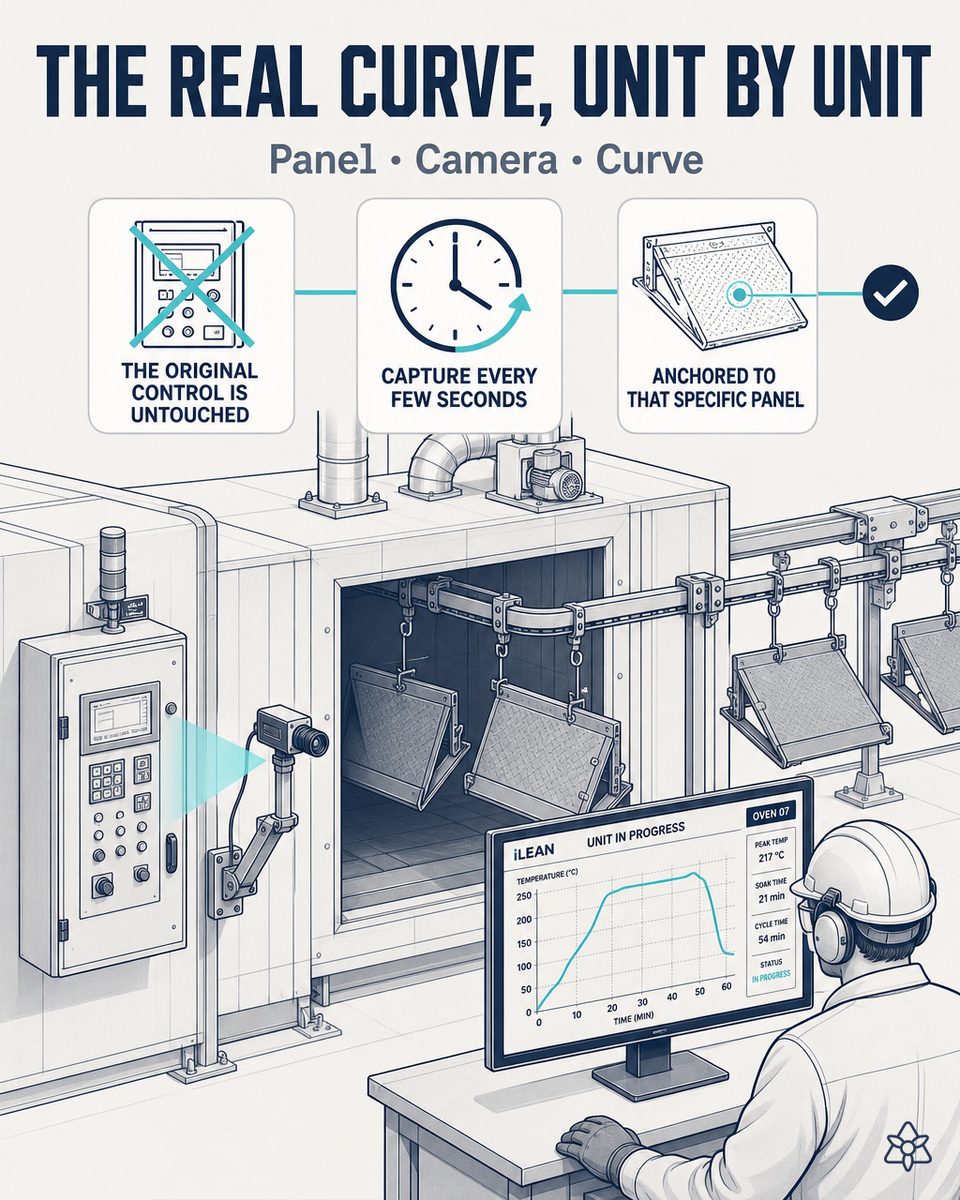
A fixed industrial camera aimed at the panel, capturing every few seconds. OCR with an anchored model interprets each reading and reconstructs the real time curve, which is cross-referenced with which units were inside the oven during that stretch — so every serial number carries its curve.
How Connect operates on the curing oven panel:
- Without touching or opening the original control — a camera on an external mount. The line's electronics are not intervened and its warranty is not compromised, and the installation happens without stopping production.
- Capture every few seconds — which allows reconstructing the real curve, with its drifts, instead of the theoretical setpoint.
- Anchored to that specific panel — temperature per zone, chain speed and dwell time, read at known positions.
- Cross-referenced with the units that were inside — every serial number carries the curve it actually went through. Without that cross-reference the series is useless for investigating a defect in a specific unit.
- The same setup works for other closed-panel machines — press brake, punching machine, shot blaster or load test bench. The pattern replicates with no new project.
Oven as a black box vs. curve digitized with Connect
| Aspect | Isolated proprietary panel | With iLEAN Connect on the panel |
|---|---|---|
| Curing curve ↔ finish defect correlation | Zero | Root cause analysis per unit, in minutes |
| Record for the process certification | A setpoint noted by hand | Continuous objective record, audit-ready |
| What is known about a specific unit | That the setpoint was correct | The curve it actually went through |
| Corrective action on a defect | A new "just in case" setpoint | On the identified cause |
| Control renewal CAPEX | Hundreds of thousands of euros and a stoppage | Deferred indefinitely |
| Other closed-panel machines | Just as opaque | The same setup digitizes them |
Impact estimate for your plant — to be validated with your own numbers.
The block below is an estimate to be validated against your plant's actual data. We put it forward so the committee has an order of magnitude; we refine it during the assessment.
- Dock equipment plant with an automated powder coating line and a curing oven with an isolated proprietary panel.
- Connect pilot on the oven panel: external mount, model anchoring and cross-reference with the units in transit. First value expected within a few weeks.
- Indicative payback between 5 and 10 months. Estimate to be validated.
- Add to that the avoidance of the line control renewal CAPEX — on the order of hundreds of thousands of euros — that today is not justified just to have traceability, and the reduction of repaints from curve ↔ defect correlation.
- And a cheap expansion lever: the same setup works for the press brake, punching machine, shot blaster or load test bench, without opening a new project per machine.
And the fair question from the quality manager
"Is a camera-read record valid for the process certification?" — what the certification asks is that the process be controlled and recorded, and a continuous time series of the real curve is a better record than a setpoint noted by hand. On reading reliability, hallucination is a problem of free generation, not of anchored tasks: reading a value at a known position is where the best models brought the error below 1.5% [1], with redundant reading and discarding of frames that do not reach the threshold.
[1] OpenAI paper "Why Language Models Hallucinate", 2025 — on the reliability of AI in anchored tasks.
What people ask about digitizing the curing oven
Is the line's control touched?
No. A fixed industrial camera on an external mount aimed at the panel is installed, and that is where the intervention ends: the control is not opened, nothing is connected to the line's electronics and its warranty is not compromised. That is what allows installing without stopping production and without opening a conversation with the line's manufacturer. And it is also what makes the case economically viable: the alternative — renewing the control so it exposes data — is an investment on the order of hundreds of thousands of euros nobody justifies for traceability alone.
What is the difference between the setpoint and the real curve?
All the difference. The setpoint is what was programmed; the real curve is what the parts went through. And they diverge the moment a zone drifts a few degrees, a door closes worse or the chain changes pace. Today the usual record is a sheet where someone notes the setpoint, so when an adhesion defect appears the record says everything was fine — and the investigation is left with nothing to work with. Recording the real curve is what turns a hypothesis into a root cause analysis.
How is the curve associated with a specific unit?
By cross-referencing the time series with which units were inside the oven during that stretch, which the system knows because the digitized manufacturing folder already tied each serial number to its journey. That way, each unit carries the curve it actually went through, not the shift's or the day's. That association is what makes the data useful: when a series of units shows a finish defect, you can look at exactly what was happening in the oven while those parts crossed it, not before or after.
Does it work for other machines in the plant?
Yes, and it tends to be the most profitable expansion path. The same setup — external camera, model anchored to the specific panel, time series cross-referenced with the unit — works on any closed-panel machine: press brake, punching machine, shot blaster or load test bench. No new project is needed for each one: what gets replicated is the pattern. In a metal fabrication plant with a heterogeneous machine park, that allows digitizing machine by machine by priority, instead of proposing a global integration that never gets approved.
What is gained on repaints?
The ability to attack the cause instead of the consequence. Today, facing an adhesion defect, the typical corrective action is raising the setpoint "just in case" — which sometimes works, sometimes does not and always costs energy. With the real curve cross-referenced with the affected units you can see whether the problem was a specific zone, a faster chain stretch or an insufficient dwell time, and correct that. The reduction in repaints comes from no longer repeating the same defect for not knowing where it came from.
More cases from this series
- The conformity file assembles itself, unit by unitEach unit generates its dossier as it is built: seam, curing curve, thickness, load test, heat and…
- The nameplate, engraved from the ERP and with no typingConnect stitches the nameplate marker to the ERP via API: serial, model, rated capacity and markings…
- The manufacturing folder enters on its own: one photo and the unit exists in the systemEach leveler’s manufacturing folder enters the system with a photo: configuration, signatures and…
- The finish and load tests enter the ERP on their owniLEAN reads the thickness, adhesion and load test Excel on save, ties it to the serial number and feeds…
- The change arriving from the site, in time for it to cost nothingiLEAN reads email and messaging silently copied, cross-references the installer’s notice with the…
- A photo of the steel delivery note: heat traceability from unloadingA photo of the delivery note, the material certificates and the labels: the heat is tied to the ERP from…
See how an external camera digitizes a closed-panel machine.
We work on your plant's real data, not ours. We show you the reading working on your own panel. Assessment with no commitment.
See how we would apply it in your plant ‹ See all 12 loading dock equipment cases See metal fabrication