The change arriving from the site, in time for it to cost nothing
The installer measures the real pit and discovers the dimension is not the drawing's; or the customer changes the opening direction; or wants the restraint with the lip barrier included. That information enters by email or messaging to the account's salesperson: the business's most informal channel for its most critical data. By the time it reaches production, the platform is already welded. With iLEAN Connect the system reads the message at second zero and returns the concrete action to whoever can execute it.
The cost of finding out late does not grow gradually: it grows in jumps.
Detected before cutting it costs nothing. Detected after welding it costs the whole structure. Detected after shipping it costs a crane, an idle installer and a site penalty. And yet:
- The channel is an inbox someone checks between two visits — the salesperson who runs the account, who is also on the road. It is the business's most informal channel for its most critical data.
- Typical latency is between twelve and forty-eight hours — exactly the interval in which a unit crosses cutting and enters welding. The change arrives exactly when it stops being free.
- And one order carries several units at different stages — the right decision is not the same for the one not yet cut as for the one already in paint, and nobody has that picture at hand when the message arrives.
So the decision is taken late and without the detail it would need: either everything is redone out of caution, or a risk is accepted on units that may no longer admit a change.
Connect in chaotic-sources mode — unit by unit, not order by order.
The information arrives through whatever channel the installer chooses to write on, and that is not going to change. What can change is what happens in the following second: reading it, cross-referencing it with the real state and returning something actionable.
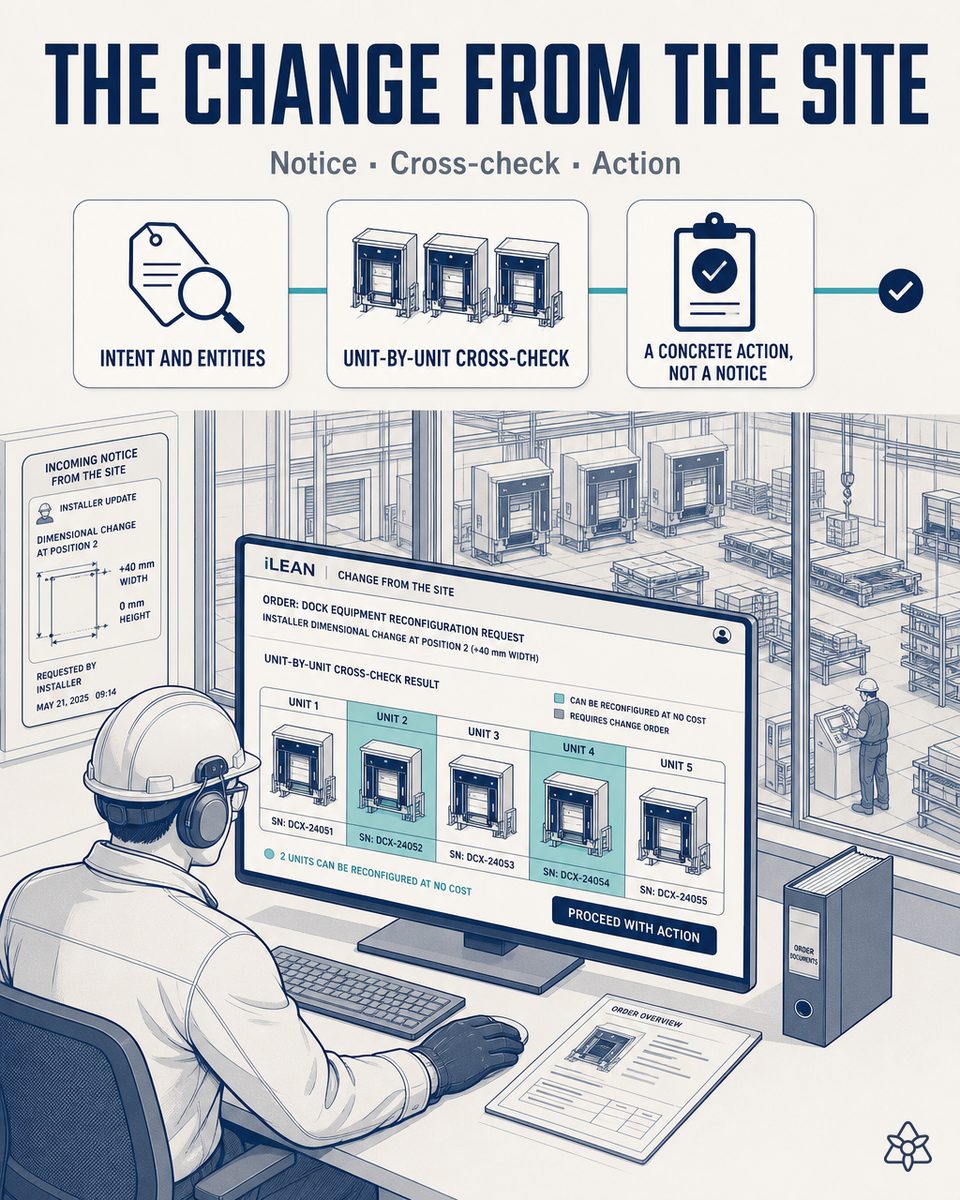
When the message enters, iLEAN extracts intent — dimension change, configuration change, site access delay, installation incident — and entities — order, serial number, customer, dimension, installation date —, and cross-references them with the order's real state in the ERP unit by unit. It returns which units can be reconfigured at no cost and which require a decision.
How Connect operates on site notices:
- A dedicated mailbox and a business messaging number, silently copied 24 h — the installer and the customer keep writing where they write, with no new portal.
- Intent and entities — it tells a dimension change from a site access delay and from an installation incident, and extracts order, serial number, customer, dimension and installation date.
- Unit-by-unit cross-reference — knowing which order is not enough: you need to know which stage each unit is at, because the right answer differs for the one not yet cut and the one already in paint.
- A concrete action, not a notice — which units can be reconfigured at no cost and which require a decision. The manager receives the picture already built.
- The decision is always taken by a person — the system calculates the impact and puts it in front; whoever decides what gets redone and what does not is the one who answers for it.
A site notice in an inbox vs. a notice cross-referenced unit by unit
| Aspect | An email to the account's salesperson | With iLEAN Connect copied in |
|---|---|---|
| Notice → production latency | 12-48 h | Seconds |
| When the change is decided on | When it is already expensive | While it is still free |
| Granularity of the response | Per order | Unit by unit, by its stage |
| Redone structures | Recurring | Direct reduction |
| Re-shipments and crane | Accepted as part of the business | Avoided by deciding in time |
| What the manager receives | "An email has arrived" | Which units to reconfigure at no cost and which to decide |
Impact estimate for your plant — to be validated with your own numbers.
The block below is an estimate to be validated against your plant's actual data. We put it forward so the committee has an order of magnitude; we refine it during the assessment.
- Configure-to-order dock equipment manufacturer, with dimension and configuration changes arriving from the site by email and messaging.
- Connect pilot on a dedicated mailbox and a messaging number, cross-referenced against each unit's real state in the ERP. First value expected within a few weeks.
- Indicative payback between 3 and 7 months depending on the frequency of last-minute changes in the project mix. Estimate to be validated.
- The figure that best sizes the case is the cost staircase: a change detected before cutting costs nothing, after welding it costs the whole structure and after shipping it costs a crane, an idle installer and a site penalty.
- And the detail missing today: the right answer is not the same for all of an order's units, and without that picture the decision is taken out of caution or out of risk.
And the fair question from the operations director
"What if the AI misreads an installer's email and we stop a unit that was fine?" — stopping before cutting is reversible and costs minutes; redoing a welded structure is not. That is why the system pushes the proposal towards the cheap side, but a person signs the decision with the impact in front of them. On the reading, hallucination is a problem of free generation, not of anchored tasks: extracting order, serial number and dimension from a message and cross-referencing them with the ERP is where the best models brought the error below 1.5% [1].
[1] OpenAI paper "Why Language Models Hallucinate", 2025 — on the reliability of AI in anchored tasks.
What people ask about catching the site change in time
Do we have to ask the installer to change channels?
No, and it would be counterproductive. The installer is on site, measuring a pit, and writes through whatever feels natural: an email from the phone or a message. Asking them to log into a portal to communicate a dimension is guaranteeing they will not. Connect is silently copied on a dedicated mailbox and a business messaging number, twenty-four hours, and works on what arrives as it arrives. The informal channel is respected; what changes is what happens in the second after the message enters.
Why is cross-referencing unit by unit so important?
Because one order usually carries several units at different stages, and the right decision is not the same for each. The one not yet cut is reconfigured at no cost; the one already welded demands weighing whether to redo it; the one in paint or assembled is another conversation. Today, when the message arrives, nobody has that picture at hand — so the answer ends up being either redoing everything out of caution or accepting a risk. With the per-unit cross-reference, each one receives the decision it deserves.
What does finding out late really cost?
The cost grows in jumps, not gradually, and that is the key to the case. Detected before cutting it costs nothing: reconfigure and move on. Detected after welding it costs the whole structure, because on a leveler the welded platform cannot be modified. Detected after shipping it costs a crane, an installer idle on site and a penalty for installation delay. The typical 12-to-48-hour latency falls exactly in the interval where the unit crosses cutting and enters welding — that is, exactly where the cost jump is biggest.
What exactly does the production manager receive?
A concrete action, not an alert. Instead of "an email has arrived from the installer", they receive which units of that order can be reconfigured at no cost and which require a decision, with each one's real state. That difference is what allows responding in minutes instead of opening an investigation: the picture is already built when the person looks at it. And the decision remains theirs — the system calculates the impact, it does not execute it.
What if the installer's message is ambiguous?
It gets flagged as incomplete instead of resolving on its own. If the message gives a dimension without clearly identifying the order, or mentions a change without specifying which units it affects, the system shows what it did understand and what it did not, together with the candidate units by context, and waits for a person to complete it. We prefer a notice with a visible gap over a confident proposal built on a forced interpretation — above all when the alternative to deciding well is redoing a welded structure.
More cases from this series
- The conformity file assembles itself, unit by unitEach unit generates its dossier as it is built: seam, curing curve, thickness, load test, heat and…
- The curing oven starts to talk: the real curve, unit by unitAn external camera reads the curing oven’s proprietary panel and digitizes the real curve per unit,…
- The nameplate, engraved from the ERP and with no typingConnect stitches the nameplate marker to the ERP via API: serial, model, rated capacity and markings…
- The manufacturing folder enters on its own: one photo and the unit exists in the systemEach leveler’s manufacturing folder enters the system with a photo: configuration, signatures and…
- The finish and load tests enter the ERP on their owniLEAN reads the thickness, adhesion and load test Excel on save, ties it to the serial number and feeds…
- A photo of the steel delivery note: heat traceability from unloadingA photo of the delivery note, the material certificates and the labels: the heat is tied to the ERP from…
See how a site email becomes a plant action.
We work on your plant's real data, not ours. We show you the reading working on your own notices. Assessment with no commitment.
See how we would apply it in your plant ‹ See all 12 loading dock equipment cases See metal fabrication