The conformity file assembles itself, unit by unit
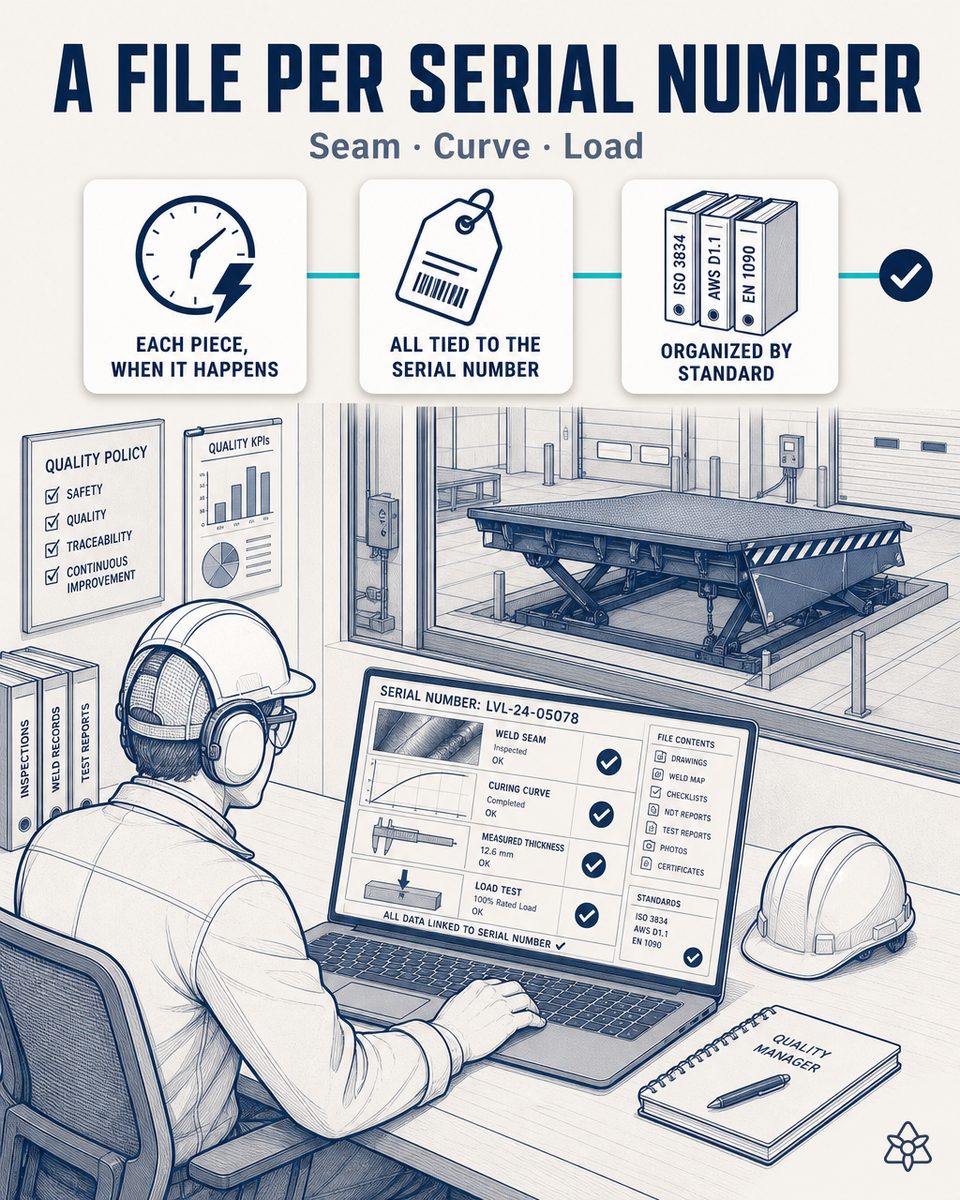
The day the quality system auditor arrives, or the finish certification program's, or the corporate customer demanding a per-unit file before accepting the supply, someone spends days reconstructing by hand what happened. With iLEAN Edge and Agents, every unit generates its file automatically as it is built, organized by certifying standard and downloadable by serial number.
The auditor does not raise a nonconformity because the unit was wrong, but because it cannot be proven it was right.
And those are two very different things — only one costs money. Today preparing an audit consists of finding the folder, finding the month's spreadsheet, finding the steel's certificate and asking the shop manager to remember:
- It is days of work from the people with the least free time — and it repeats every audit cycle, with nothing reusable left for the next one.
- The auditor asks for proof, the plant shows papers — and the nonconformities come from documentary gaps more than from real process failures.
- And there is a market trend making it worse — large corporate customers are starting to demand the per-unit file as a condition of acceptance of the supply, not as a courtesy. Whoever does not have it is not on the list.
In other words: what until now was a periodic administrative burden is becoming a commercial entry barrier.
Edge captures, Agents organizes — the quality manager reviews and releases, does not compile.
The key is that every piece of evidence is generated the moment it happens, not afterwards. What Agents does is order it, not fabricate it.
The seam image, the real curing curve, film thickness measured per point, the load test result, the cabinet's electrical check, the steel's certificate and heat, the data engraved on the nameplate and the signatures of each stage. All tied to the serial number, organized by certifying standard and published in a lookup portal.
How a unit's file is assembled:
- Every piece is generated when it happens — there is no later documentation step someone can forget. The evidence is a consequence of the work itself.
- All tied to the serial number — which is the unit the auditor, the customer and the expert witness all ask about.
- Organized by applicable certifying standard — the same material presented as each framework demands, duplicating nothing.
- A lookup portal — where the auditor downloads the period's and the customer downloads its unit's. That second path is what answers the new demand from large accounts.
- The quality manager reviews and releases: does not compile — their work goes from gathering papers to validating an already-assembled file. Humans in command.
Manual reconstruction vs. a file assembled as it is built
| Aspect | Days of prior work | With iLEAN Edge + Agents |
|---|---|---|
| Preparation before each audit | Days from the busiest people | Zero |
| Risk of a documentary nonconformity | High: the auditor finds the gaps | A complete, consistent file per unit |
| Before the corporate customer | "Trust us" | A downloadable file of its unit |
| The quality manager's work | Compiling | Reviewing and releasing |
| Adaptation to each standard | The dossier is redone | Same material, different organization |
| Looking up a specific unit | Find folder, sheet and certificate | Download by serial number |
Impact estimate for your plant — to be validated with your own numbers.
The block below is an estimate to be validated against your plant's actual data. We put it forward so the committee has an order of magnitude; we refine it during the assessment.
- Dock equipment manufacturer with quality system and finish certification audits, and corporate accounts starting to demand a per-unit file.
- Deployment resting on the Edge and Connect cases already running: they generate the evidence, Agents organizes it. First value expected within a few weeks of units being recorded.
- Continuous protection of the certifications that enable sales and elimination of the pre-audit work spike.
- And a direct commercial lever at large accounts and in the qualification of a new plant: the per-unit file is going from courtesy to condition of acceptance.
- Estimated payback between 6 and 12 months depending on audit frequency and the weight of the accounts already demanding it. Estimate to be validated.
And the fair question from the quality manager
"Will an auditor accept a file assembled by AI?" — the auditor does not accept the file, they accept the evidence: the seam image, the real curing curve, the thickness measured per point, the heat certificate and the signature of each stage. Agents generates no content: it organizes existing evidence by standard, which is an anchored task — where the best models brought the error below 1.5% [1]. And the one who reviews and releases is still a person: what changes is that they no longer have to compile.
[1] OpenAI paper "Why Language Models Hallucinate", 2025 — on the reliability of AI in anchored tasks.
What people ask about the per-unit conformity file
What does a unit's file contain?
Everything that demonstrates how it was built: the seam image of the critical points, the real curing curve it went through in the oven, the film thickness measured per point, the result of the load test at rated capacity, the cabinet's electrical check, the steel's certificate and heat, the data engraved on the nameplate and the signatures of each stage. All tied to the serial number. That is: not a procedure saying what should be done, but the proof of what was done on that specific unit.
Why are customers starting to demand this?
Because large corporate customers are passing down to their suppliers the level of traceability they themselves must demonstrate. The per-unit file is going from courtesy to condition of acceptance of the supply: it is requested before accepting the delivery, not after a problem. And that turns an administrative burden into an entry barrier — whoever does not have it is not on the approved supplier list. It is a structural shift, and it tends to be the argument that weighs most with management when this case is proposed.
What is the difference between the unit being right and being able to prove it?
All the difference separating a plant that builds well from one that can also prove it — and only the second collects payment without incidents. The auditor does not raise a nonconformity because the unit was wrong: they raise it because it cannot be proven it was right. Two very different things, and only one costs money. Today the evidence exists but is spread across a folder, a spreadsheet, a certificate and the shop manager's memory; the automatic file does not improve the process, it improves the ability to accredit it.
What exactly does the quality manager do?
They review and release: they do not compile. That is the structural change. Today their pre-audit work consists of gathering material from five different places and assembling it; with the automatic file, the material is already assembled and organized by standard, and what they do is validate it before publishing. It is the same responsibility — they still answer for what is delivered — but exercised over an already-built dossier instead of a pile of papers. Humans in command here too.
Does the same material serve all the standards?
Yes, and that is why a single source of evidence is kept with several organizations. The seam image, the curing curve or the measured thickness are the same regardless of who asks for them; what changes is how they must be presented and what counts as sufficient in each framework — the quality system, the finish certification program or the corporate customer's questionnaire. Agents reorders the same set for each one, so the same period or the same unit serves them all without redoing anything from scratch.
More cases from this series
- The curing oven starts to talk: the real curve, unit by unitAn external camera reads the curing oven’s proprietary panel and digitizes the real curve per unit,…
- The nameplate, engraved from the ERP and with no typingConnect stitches the nameplate marker to the ERP via API: serial, model, rated capacity and markings…
- The manufacturing folder enters on its own: one photo and the unit exists in the systemEach leveler’s manufacturing folder enters the system with a photo: configuration, signatures and…
- The finish and load tests enter the ERP on their owniLEAN reads the thickness, adhesion and load test Excel on save, ties it to the serial number and feeds…
- The change arriving from the site, in time for it to cost nothingiLEAN reads email and messaging silently copied, cross-references the installer’s notice with the…
- A photo of the steel delivery note: heat traceability from unloadingA photo of the delivery note, the material certificates and the labels: the heat is tied to the ERP from…
See an automatically generated conformity file.
We work on your plant's real data, not ours. We review what evidence you generate today and what would be missing. Assessment with no commitment.
See how we would apply it in your plant ‹ See all 12 loading dock equipment cases See metal fabrication