The finish and load tests enter the ERP on their own
In a dock equipment factory the laboratory is the test bench and the finish control station. There, every shift, someone fills a spreadsheet with film thickness per point, adhesion, load test at rated capacity, leak-free cycles and the cabinet's electrical check. That file lives in a shared folder the ERP does not see. iLEAN Connect reads it when it is saved, ties it to the serial number and, after validation, feeds it into the ERP.
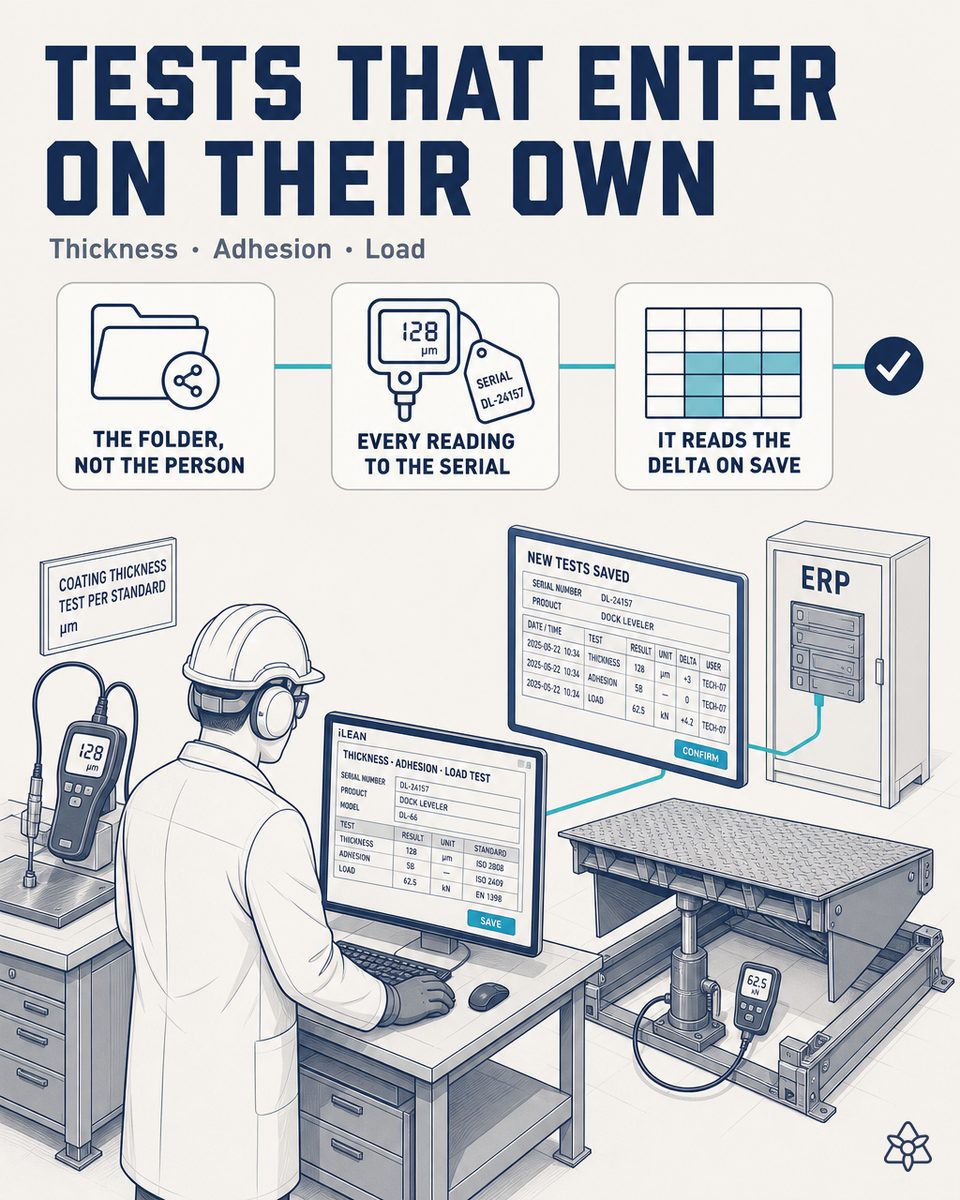
The ERP has a status field; the numbers are somewhere else.
Two parallel worlds coexist: the real file, where the measurements proving the unit complies live, and the official ERP, where there is a status field with no numbers behind it:
- Someone transcribes later, late and partially — on the order of half a day per month copying and pasting, with the typos that implies and a lag of weeks between the measurement and the official data.
- And when the site claim or the auditor arrives — the right month's file has to be opened and searched by hand.
- The evidence exists, but it is not where it should be — nor tied to what it should be: the serial number of the unit installed at that dock.
Add the cost that appears on no process sheet: for that transcription to be possible, several people need a quality module license — not because they manage quality in the system, but because it is the only way to enter their own results.
Connect in inward-listening mode — the folder, not the person.
The test bench sheet does not need to disappear or change. What is already measured needs to reach the ERP tied to the right unit, without anyone typing it again.
iLEAN watches the shared folder, reads the delta when the file is saved, and an anchored model interprets each measurement and ties it to the unit's serial number. The result is presented on screen for human validation and, after it, inserted into the ERP via API.
How Connect operates on the test bench sheet:
- The folder, not the person — worth stating precisely. Nothing is installed on the technician's computer and their activity is not logged: only the moment the file is saved is detected.
- Every measurement tied to the serial number — film thickness per point, adhesion, load test at rated capacity, leak-free cycles and the cabinet's electrical check. Not to the date or the shift: to the unit.
- It reads the delta — only the new measurements since the last feed, without reprocessing the history.
- Validation before the ERP — the responsible person confirms on screen. A single person validates what several used to type.
- The technician keeps working exactly the same — their spreadsheet stays their spreadsheet. What disappears is the transcription.
Disconnected Excel and ERP vs. automatic feed with Connect
| Aspect | Late manual transcription | With iLEAN Connect |
|---|---|---|
| Measurement → official data lag | Weeks | Second zero |
| Manual transcription | Half a day per month | Zero |
| What the ERP holds | A status field with no numbers | A file with measured values per point and per unit |
| Site claim or audit | Open the month's file and search by hand | Query by serial number |
| Quality module licenses | 5 users who only feed in results | 1: the validating manager's |
| Technician's habit | Their sheet — plus the ERP | Their sheet |
Impact estimate for your plant — to be validated with your own numbers.
The block below is an estimate to be validated against your plant's actual data. We put it forward so the committee has an order of magnitude; we refine it during the assessment.
- Dock equipment plant with its own test bench and finish control, results in a spreadsheet and an ERP billed per active user.
- Connect pilot on the shared folder with a feed into the ERP via API after validation. Without changing the sheet or the habit. First value expected within a few weeks.
- CFO angle — the ERP bills per active user. If today five quality and finish people hold a license only to feed in test results, that is five licenses; with Connect the validating manager's is enough. Typical reduction of 50-80% in quality and laboratory module licenses, with a recurring annual saving.
- Estimated payback between 4 and 9 months on top of that saving. Estimate to be validated with the last ERP invoice.
- Side lever: the ERP goes from holding a status field to holding the file with the measured values per point and per unit — which is what is needed on the day of a site claim.
And the fair question from the finance manager
"What if the model misreads a measurement and an out-of-specification unit enters as conforming?" — hallucination is a problem of free generation, not of anchored tasks. Here the AI reads cells from a known sheet and maps them to known fields, with plausible ranges: the best models brought the error below 1.5% [1]. And that remainder does not reach the ERP: Connect holds the feed until the responsible person validates, and an out-of-range value gets flagged instead of slipping through.
[1] OpenAI paper "Why Language Models Hallucinate", 2025 — on the reliability of AI in anchored tasks.
What people ask about feeding the finish and load tests into the ERP
Does the test bench spreadsheet have to change?
No. The technician keeps working exactly the same: their sheet stays their sheet, with its columns, its units and its way of recording thickness per point or leak-free cycles. The model anchors to that specific structure instead of asking anyone to redo it. The only thing that disappears is the later transcription into the ERP, which is where the lag, the error and the cost live. There is no new tool to learn and no process to redesign.
Why tie the measurements to the serial number?
Because it is the key problems come back by. When a claim arrives from a site, nobody asks about the shift or the date: they ask about that specific unit installed at that dock. Today the ERP has a status field — conforming or not — with no numbers behind it, so proving the unit passed the load test at rated capacity requires opening the right month's file and searching by hand. With every measurement tied to the serial number, the unit's file exists from the moment it was measured.
How is the license saving calculated?
The ERP bills per active user, so it is a direct calculation: count how many quality and finish people hold a license only to feed in test results. If it is five, that is five full licenses paid for a data-feeding function. With Connect the results enter via API and the validating manager's license is enough: the typical reduction is between 50% and 80% of that module, with a recurring annual saving. The exact amount is calculated against the last real ERP invoice — which is why that is the first document we ask for.
Does Connect log the test bench technician?
No, and it is worth stating precisely: it watches the folder, not the person. It detects when the file has been saved and reads what is new. No software is installed on their computer, their activity is not logged and their performance is not measured. It is an important distinction to frame well with the team, because the goal is exactly the opposite of monitoring: it is taking off their hands the half day per month they spend copying measurements between windows today.
What does an audit of the finish process gain?
The evidence stops living in a loose file. An auditor of the coating process asks to check that film thickness and adhesion are measured and recorded; today that means opening the month's sheet and locating the right rows. With the feed tied to the serial number, the evidence is in each unit's file, with its values per point, its date and who validated them. And it can be put next to that same unit's curing oven curve, which is what really explains an adhesion problem.
More cases from this series
- The conformity file assembles itself, unit by unitEach unit generates its dossier as it is built: seam, curing curve, thickness, load test, heat and…
- The curing oven starts to talk: the real curve, unit by unitAn external camera reads the curing oven’s proprietary panel and digitizes the real curve per unit,…
- The nameplate, engraved from the ERP and with no typingConnect stitches the nameplate marker to the ERP via API: serial, model, rated capacity and markings…
- The manufacturing folder enters on its own: one photo and the unit exists in the systemEach leveler’s manufacturing folder enters the system with a photo: configuration, signatures and…
- The change arriving from the site, in time for it to cost nothingiLEAN reads email and messaging silently copied, cross-references the installer’s notice with the…
- A photo of the steel delivery note: heat traceability from unloadingA photo of the delivery note, the material certificates and the labels: the heat is tied to the ERP from…
Calculate the license savings on your quality module.
We work on your plant's real data, not ours. With your last ERP invoice we calculate the recurring saving. Assessment with no commitment.
Calculate my savings with an iLEAN consultant ‹ See all 12 loading dock equipment cases See metal fabrication