A photo of the steel delivery note: heat traceability from unloading
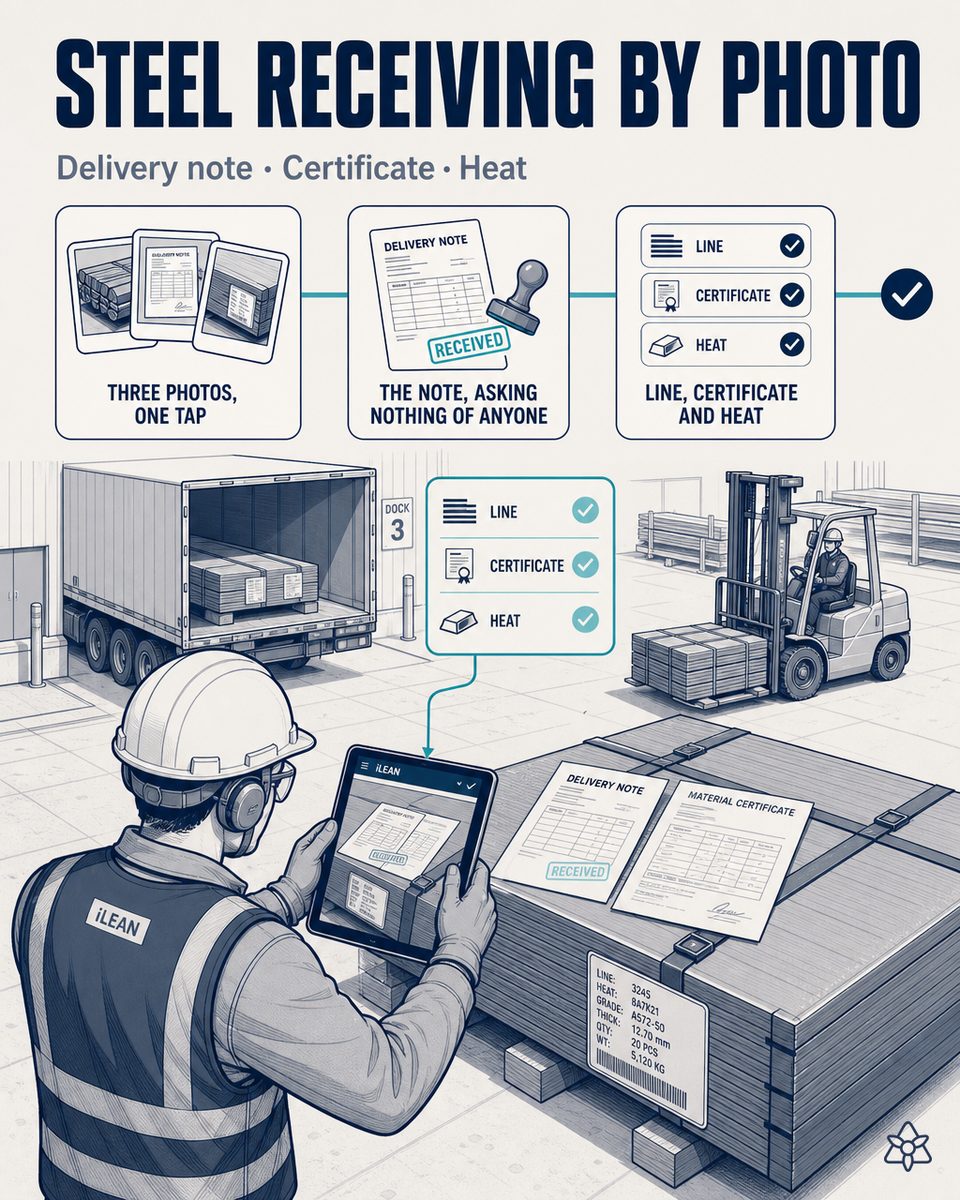
The truck arrives with packs of sheet, profiles, hydraulic cylinders and electrical components. The receiving manager has a delivery note of fifteen or twenty lines, the material certificates with their heat numbers and each package's labels, and has to sign and also type line by line into the ERP. With iLEAN Connect they take three photos, validate with one tap and everything enters the ERP tied from the first moment.
There are only two bad exits, and today one of the two is chosen every week.
Either the carrier waits thirty or forty-five minutes charging for the delay, or it is entered in a hurry and the heat ends up misassigned. And the second is the serious one:
- Heat traceability is the foundation of product liability in welded structures. If a platform's steel cannot be traced to its certificate, any incident on site stops being a technical problem and becomes a legal one.
- And that failure is never detected in the moment — it is detected months or years later, exactly on the day it most needs not to exist.
- Meanwhile nobody notices — receiving "works", the material enters and the plant produces. The gap only appears when it can no longer be corrected.
It is the point where saving two minutes today is paid, perhaps, with a legal case three years from now.
Connect in photo-the-analog mode — the heat tied from the origin.
The necessary information is already printed: on the delivery note, the material certificates and the labels. What is missing is the path to the ERP without a keyboard and, above all, the pairing between line and certificate that today is done by eye.
A photo of the delivery note, the material certificates and the package labels. Vision recognizes the delivery note's format without asking the supplier to change theirs, extracts the tabular structure and pairs each line with its material certificate and its heat number.
How Connect operates at the receiving dock:
- Three photos, one tap — delivery note, certificates and labels. The receiving manager keeps signing the delivery note as always: what disappears is the typing afterwards.
- The delivery note, asking nothing of the supplier — vision recognizes its format as it arrives and extracts the complete tabular structure.
- Line ↔ certificate ↔ heat pairing — the part done by eye in a hurry today, and the one sustaining all later traceability.
- Labels in any encoding — barcode, QR or plain text by OCR. Whatever is on the package is read with the tablet's camera.
- Insertion into the ERP via API with the heat tied — from the origin, not reconstructed later. The material → unit → site chain closes from unloading.
Typed receiving vs. photo receiving with the heat tied
| Aspect | Double typing with the truck waiting | With iLEAN Connect photo |
|---|---|---|
| Truck standing time | 30-45 min | Under 5 |
| Line ↔ certificate ↔ heat pairing | By eye, in a hurry | Automatic |
| Misassigned heats | Reappear at the worst moment | Complete traceability from unloading |
| Material → unit → site traceability | Reconstructed, if possible | Closed from the origin |
| Receiving/warehouse module licenses | 2-3 active | 1 who validates, without entering the ERP |
| Bulk capture module | Billed separately by many ERPs | No longer needed |
Impact estimate for your plant — to be validated with your own numbers.
The block below is an estimate to be validated against your plant's actual data. We put it forward so the committee has an order of magnitude; we refine it during the assessment.
- Dock equipment plant receiving sheet, profiles, hydraulic cylinders and electrical components with per-heat material certificates.
- Connect photo pilot at the dock with a feed into the ERP via API after one-tap validation. Without asking suppliers for changes. First value expected within a few weeks.
- CFO angle — the receiving and warehouse module typically demands 2-3 active licenses (receiving manager, support, supervisor); with Connect only the manager validates, with one tap and without entering the ERP. Typical reduction of 50-70% in receiving and warehouse module licenses, plus the bulk capture module many ERPs bill separately.
- Estimated payback between 3 and 8 months, adding the elimination of carrier delays. Estimate to be validated.
- The lever that does not fit in the spreadsheet: heat traceability. It is the foundation of product liability in welded structures, and its absence is only discovered on the day it is most needed.
And the fair question from the technical director
"What if it pairs a line with the wrong certificate?" — hallucination is a problem of free generation, not of anchored tasks. Pairing a delivery note reference with a certificate's heat number means printed data being read and cross-checked: an anchored task, where the best models brought the error below 1.5% [1]. And lines with a doubtful pairing arrive highlighted at validation: nothing enters without the receiving manager confirming. It is more reliable than pairing by eye with the truck waiting.
[1] OpenAI paper "Why Language Models Hallucinate", 2025 — on the reliability of AI in anchored tasks.
What people ask about steel receiving by photo
Why is heat traceability so critical?
Because it is the foundation of product liability in welded structures. A dock leveler is safety equipment with a declared rated capacity, and its platform is a structure welded from specific sheet and profiles. If that platform's steel cannot be traced to its material certificate, any incident on site stops being a technical problem and becomes a legal one — because it cannot be demonstrated what material it was built with. And that gap is never detected in the moment: it is detected months or years later, on the day it most needs not to exist.
Do we have to ask the supplier to change their delivery note?
No. Connect's vision recognizes the delivery note's format as it arrives and extracts its tabular structure, with no predefined templates. Same with the package labels, whether they come as barcode, QR or plain text. Asking steel suppliers to adopt a specific format does not work in practice and would delay the project by months. The adapting is done by the system, not the supplier or the person at the dock.
What exactly is the line-certificate pairing?
It is the part done by eye and in a hurry today: relating each delivery note line — a reference, a quantity — with the material certificate that corresponds to it and its heat number. One truck brings several packs from different heats and a handful of certificates; associating each correctly is what sustains all later traceability. Connect does it by reading both documents and cross-checking them, and presents highlighted the lines where the pairing is not unambiguous so the person decides. It is precisely the operation where hurried typing introduces the error that reappears years later.
How does it translate into ERP licenses?
The receiving and warehouse module typically demands 2-3 active licenses — receiving manager, support and supervisor. With Connect only the manager validates, with one tap on the tablet and without entering the ERP, so the rest no longer need access: the usual reduction is between 50% and 70%. Add the bulk capture module, which many ERPs bill separately for booking receivings with a scanner and which stops being needed. And the carrier delays, which today get paid on invoices but accepted as part of the process.
How long does receiving a truck really take this way?
The goal is going from 30-45 minutes to under 5. The bulk of the current time is not spent unloading: it is spent typing fifteen or twenty lines and pairing certificates. With Connect that is three photos — delivery note, certificates and labels — and one validation over the summary, where only the lines flagged as doubtful demand attention. The receiving manager keeps signing the paper delivery note with the carrier present, because that signature has contractual value: what disappears is the second typing.
More cases from this series
- The conformity file assembles itself, unit by unitEach unit generates its dossier as it is built: seam, curing curve, thickness, load test, heat and…
- The curing oven starts to talk: the real curve, unit by unitAn external camera reads the curing oven’s proprietary panel and digitizes the real curve per unit,…
- The nameplate, engraved from the ERP and with no typingConnect stitches the nameplate marker to the ERP via API: serial, model, rated capacity and markings…
- The manufacturing folder enters on its own: one photo and the unit exists in the systemEach leveler’s manufacturing folder enters the system with a photo: configuration, signatures and…
- The finish and load tests enter the ERP on their owniLEAN reads the thickness, adhesion and load test Excel on save, ties it to the serial number and feeds…
- The change arriving from the site, in time for it to cost nothingiLEAN reads email and messaging silently copied, cross-references the installer’s notice with the…
See a complete steel receiving in under five minutes.
We work on your plant's real data, not ours. We look at your real delivery notes and certificates and calculate the case with you. Assessment with no commitment.
See how we would apply it in your plant ‹ See all 12 loading dock equipment cases See metal fabrication