Edge reads the weld seam before the defect becomes invisible
A leveler platform is a welded structure bearing the rated load on its nameplate with a loaded forklift passing over it thousands of times a year: the seam is a safety element, not a finish. Today it is inspected by eye, unit by unit, plus sampling with non-destructive testing. iLEAN Edge places a camera at the robotic cell's exit, infers in milliseconds and flags the unit before it enters paint.
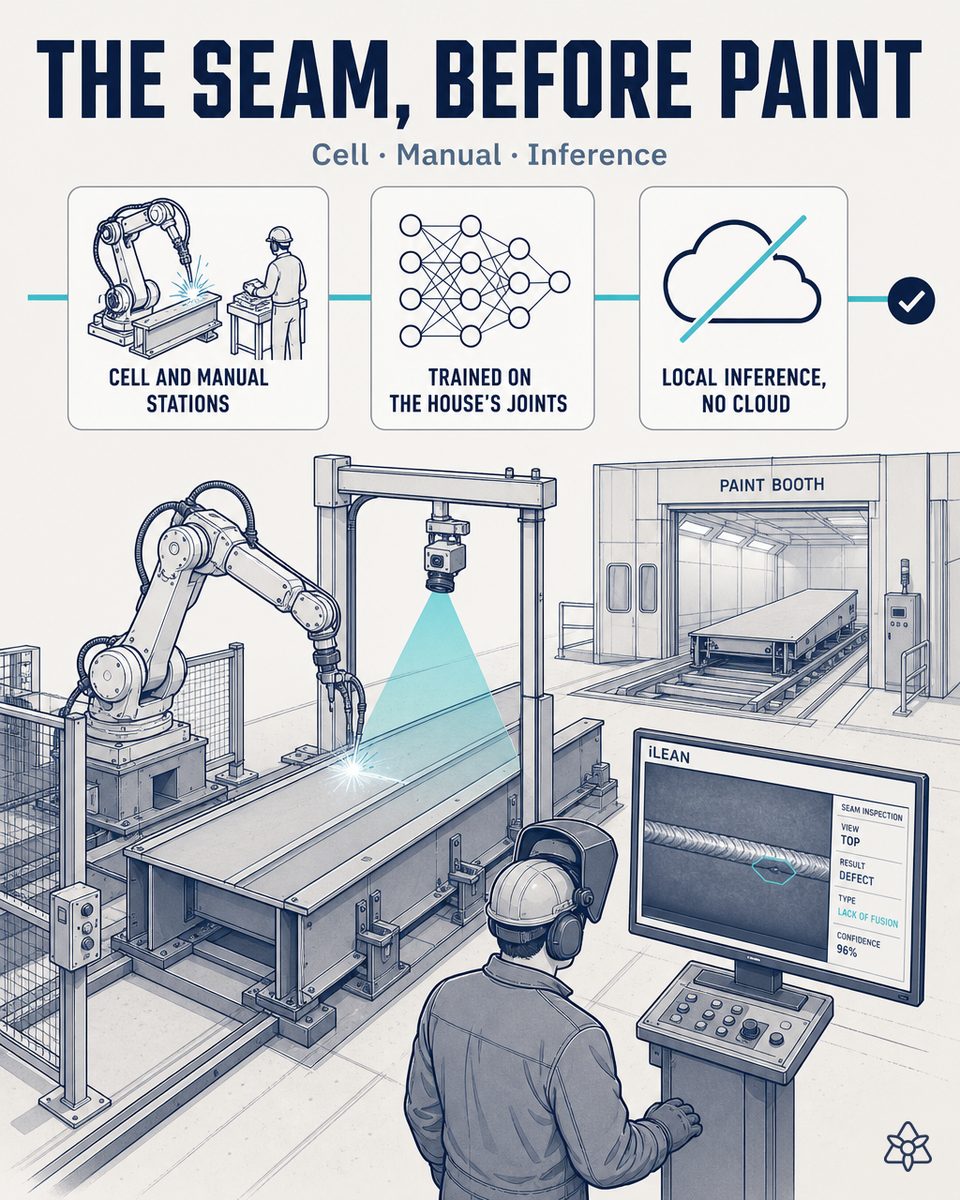
A defect that passes into paint becomes literally invisible.
One-hundred-percent inspection by the human eye is not sustainable eight hours straight, and sampling leaves gaps exactly where a configure-to-order manufacturer's variability lives: every model has different joints:
- Porosity, undercut, short seam, lack of fusion at the start — they enter paint, get covered by the powder coating and stop being visible. They no longer appear until they appear on site.
- The defect's cost is staircase-shaped — and that determines where the camera makes sense: detected in the cell it is minutes of touch-up; detected after paint, stripping and repainting; detected on site, a new unit, a crane and a claim.
- And sampling does not cover the variability — at a configure-to-order manufacturer, every model has its joint geometry, so sampling one model says nothing about the next.
In other words: the point where the defect still costs minutes is exactly the point where today there is no systematic control.
Edge — the AI does not replace the inspector, it tells them where to look.
The problem is not one of judgment: an experienced inspector recognizes an undercut perfectly. It is one of coverage and fatigue, and of the defect disappearing three stages later under the coating.
An industrial camera at the exit of the robotic welding cell and at the manual reinforcement and hinge stations. A network trained on good and bad seams of this manufacturer's real joints, not a generic catalog. Inference in milliseconds on a local Edge device, with no image sent to the cloud.
How Edge operates on the weld seam:
- At the robotic cell and the manual stations — reinforcements and hinges included, because the defect does not choose where it enters.
- Trained on the house's real joints — at a configure-to-order manufacturer every model has its geometry. A generic weld defect catalog cannot decide on these joints.
- Local inference, no image to the cloud — for latency, cost and bandwidth. And if the plant loses network, the cell keeps inspecting.
- The AI does not replace the inspector, it tells them where to look — the unit gets flagged and the inspector receives the exact point to review, instead of walking the whole perimeter with a tired eye.
- The image is archived against the serial number — and feeds that unit's conformity file, with no extra work.
Sampling and visual inspection vs. 100% Edge control
| Aspect | Inspection by eye plus sampling | With iLEAN Edge |
|---|---|---|
| Coverage of critical seams | Sampling, with gaps by model | 100%, with an archived image per unit |
| Where the defect is detected | On site, under the coating | In the cell, before paint |
| Cost of the correction | A new unit, a crane and a claim | Minutes of touch-up |
| Constancy along the shift | Degrades with fatigue | Always the same |
| What the inspector receives | A perimeter to review | The exact point to review |
| Evidence for the file | None | The seam's image per serial number |
Impact estimate for your plant — to be validated with your own numbers.
The block below is an estimate to be validated against your plant's actual data. We put it forward so the committee has an order of magnitude; we refine it during the assessment.
- Dock equipment plant with a robotic welding cell, manual reinforcement and hinge stations and a powder coating line downstream.
- Edge pilot at the cell's exit: industrial camera, local inference and training on real seams of the house's joints. First value expected within a few weeks.
- Indicative payback between 5 and 12 months depending on the current weld rework rate and the weight of site claims. Estimate to be validated.
- The case's logic lives in the cost staircase: minutes in the cell, stripping and repainting after paint, a new unit plus a crane on site. Putting the control on the first step is where the return multiplies.
- And a return that appears later: the seam image archived per serial number feeds the conformity file, which is increasingly an entry condition at large accounts.
And the fair question from the quality manager
"What if the camera flags good seams and we stop units for no reason?" — it does not stop them: it flags them and tells the inspector where to look. The decision stays human, and the cost of one extra review is seconds. On reliability, classifying an image against a pattern trained on the house's real joints is an anchored task, where the best models brought the error below 1.5% [1]. And since every flag keeps its image, calibrating the threshold is a matter of looking at the history.
[1] OpenAI paper "Why Language Models Hallucinate", 2025 — on the reliability of AI in anchored tasks.
What people ask about Edge seam inspection
Why inspect before paint and not after?
Because the powder coating makes the defect literally invisible. A porosity, an undercut or a lack of fusion at the start that enters paint gets covered and does not reappear until it appears on site. And the cost is staircase-shaped: detected in the cell it is minutes of touch-up; detected after paint it forces stripping and repainting; detected on site it is a new unit, a crane and a claim. The camera goes where the defect still costs minutes — which is exactly where there is no systematic control today.
Does it replace the inspector?
No: it tells them where to look. An experienced inspector recognizes an undercut perfectly; what they cannot do is review one hundred percent of the seams of every unit for eight hours with the same sharpness. Edge flags the unit and points them to the exact point to review, so their judgment is applied where it adds value instead of being spread across the whole perimeter. The decision on whether the seam is acceptable remains theirs, and the cost of one extra review is seconds.
Why train on this plant's joints?
Because at a configure-to-order manufacturer every model has different joints: different geometries, thicknesses and access. A generic weld defect catalog does not know what is acceptable on this joint of this model, and produces two problems at once — it flags the good and lets the bad through. Training on good and bad seams of the house's real joints, the criterion the camera applies is the one the plant already has, only applied constantly.
Do the images leave the plant?
No. Inference happens on a local Edge device, and the decision is taken there in milliseconds. It is a decision with three motives: latency — at a robotic cell's exit you cannot wait for a remote response —, the cost and bandwidth of continuously uploading images, and robustness: if the plant loses connectivity, the cell keeps inspecting. What syncs afterwards is the record with its image, not the decision.
What does it contribute to the conformity file?
The seam's image is archived against that unit's serial number, so it becomes part of its file without anyone having to prepare it. That is an important difference when the corporate customer or the auditor asks for evidence that the critical seams were verified: today the answer is a procedure and a sample; with Edge it is the image of that specific unit. And since the seam is a safety element in a structure bearing rated load, that evidence carries a different weight than a finish check.
More cases from this series
- The conformity file assembles itself, unit by unitEach unit generates its dossier as it is built: seam, curing curve, thickness, load test, heat and…
- The curing oven starts to talk: the real curve, unit by unitAn external camera reads the curing oven’s proprietary panel and digitizes the real curve per unit,…
- The nameplate, engraved from the ERP and with no typingConnect stitches the nameplate marker to the ERP via API: serial, model, rated capacity and markings…
- The manufacturing folder enters on its own: one photo and the unit exists in the systemEach leveler’s manufacturing folder enters the system with a photo: configuration, signatures and…
- The finish and load tests enter the ERP on their owniLEAN reads the thickness, adhesion and load test Excel on save, ties it to the serial number and feeds…
- The change arriving from the site, in time for it to cost nothingiLEAN reads email and messaging silently copied, cross-references the installer’s notice with the…
See a seam inspection in real time.
We work on your plant's real data, not ours. With seams from your own joints we show you what it detects. Assessment with no commitment.
See how we would apply it in your plant ‹ See all 12 loading dock equipment cases See metal fabrication