Validated startup: the right tooling and a purged booth, with evidence
In a factory where almost no unit is like the previous one, the model change happens several times a day, and two of those changes are critical: the cell's tooling must correspond to the order's model, and the color change demands purging the booth, guns and recovery unit. Today both depend on a signature with no objective evidence. With iLEAN Edge, fixed cameras compare the current state with the reference and JIDOKA AI does not release the startup until all give conformity.
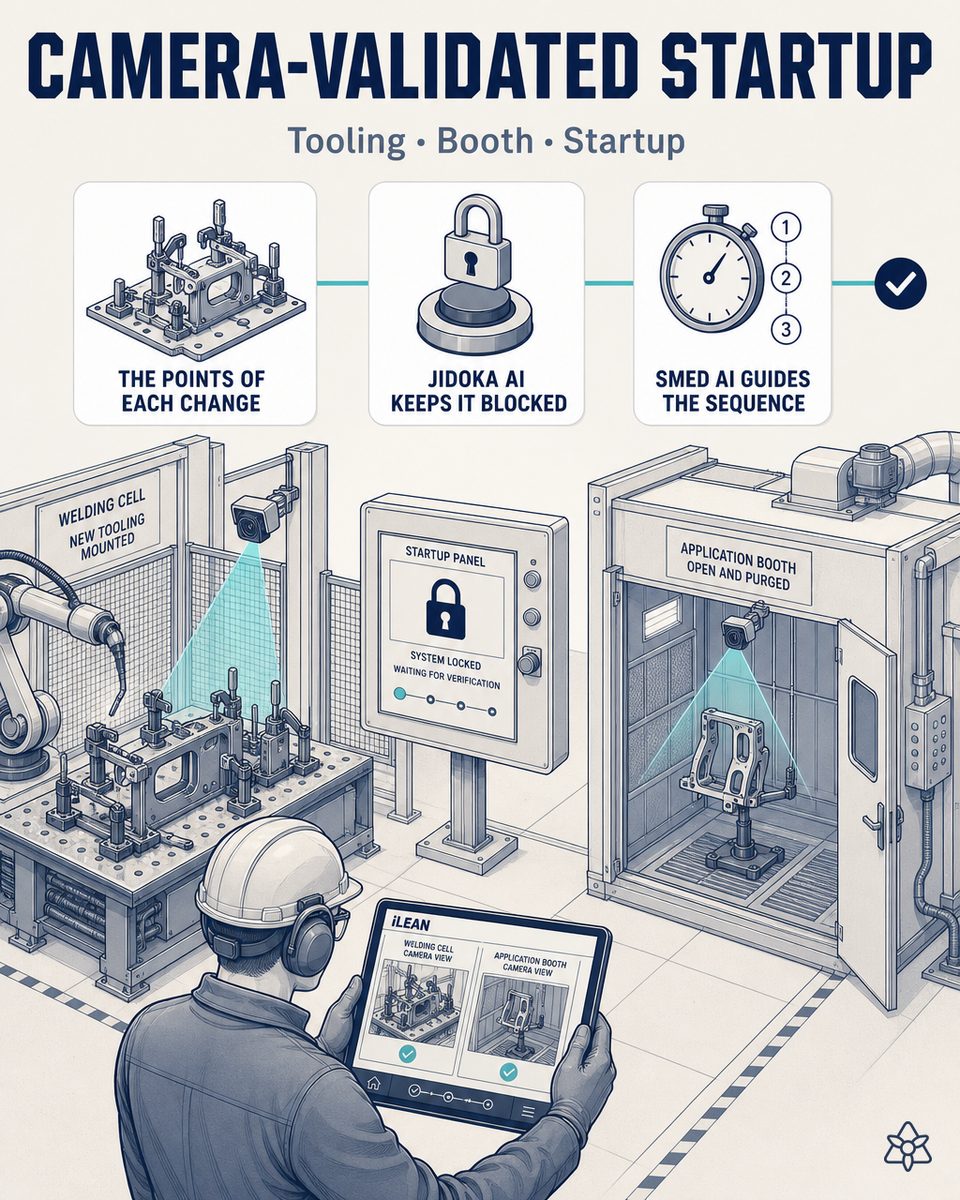
The two critical changes happen at the shift's moment of maximum hurry and minimum attention.
And it is not a discipline problem: the immediate goal after a change is recovering the time lost in the change. It is a process design problem:
- The wrong tooling means welding parts that will not fit at assembly — and it is not discovered until three stages later, with all their work already paid for.
- An incomplete purge means a residue of the previous color's powder contaminates the first unit of the new series and forces stripping and repainting the entire platform.
- And that first unit is usually the one with the tightest date — because series are ordered by urgency, so the failure lands exactly where there is least margin.
Both depend today on a signature with no objective evidence, given by someone who is also trying to recover the changeover's lost time.
Edge + JIDOKA AI + SMED AI — the verification does not lengthen the change, it orders it.
The solution is not a longer checklist: it is visual evidence per point before the signature, and a block that prevents starting while that evidence is incomplete.
Fixed cameras at the critical points — the tooling mounted in the cell, the press brake's stops and die, the application booth, the guns and the recovery unit. Networks trained to recognize "ready for this model" and "purged for this color" against the reference state. JIDOKA AI keeps the startup blocked until all give conformity.
How Edge operates on the model and color change:
- The points where each change is decided — the tooling mounted in the cell and the press brake's stops and die for the model; the application booth, guns and recovery unit for the color.
- "Ready for this model" and "purged for this color" — not a generic cleanliness check: the comparison is against the reference state of that specific model and that specific color.
- JIDOKA AI keeps the startup blocked — until all the cameras give conformity. It is not an alert that schedule pressure can skip.
- The responsible person signs with the evidence in front of them — not blind. What changes is not who authorizes, but on what.
- SMED AI guides the change's sequence — so the verification does not lengthen the change but orders it: you know what is missing and in what order to do it.
Signing blind vs. a startup validated with evidence
| Aspect | Classic model and color change | With iLEAN Edge + JIDOKA AI |
|---|---|---|
| Basis of the release | A signature with no objective evidence | Visual evidence point by point |
| Wrong tooling | Discovered three stages later | Blocked before welding |
| Color contamination | Discovered at assembly | Prevented before applying |
| Stripping and repainting the platform | A recurring cost | Eliminated at its cause |
| Model change | A lottery | Verified and timed |
| Changeover duration | The current one | Ordered by SMED AI, not lengthened |
Impact estimate for your plant — to be validated with your own numbers.
The block below is an estimate to be validated against your plant's actual data. We put it forward so the committee has an order of magnitude; we refine it during the assessment.
- Configure-to-order dock equipment plant, with several model and color changes a day.
- Edge + JIDOKA AI pilot on the change's critical points, with startup blocking and a signature on evidence. Without changing the procedure or who signs.
- The return comes from two specific line items: the elimination of stripping and repainting from color contamination and of the rework from incorrect tooling.
- Estimated payback between 5 and 10 months depending on the number of model and color changes per day. Estimate to be validated.
- And a management benefit that does not exist today: the change becomes timed point by point, which is the raw material of any real SMED project on the bottleneck.
And the fair question from the production manager
"Doesn't this lengthen every change, which is already what hurts most?" — no: the verification does not lengthen the change, it orders it. SMED AI guides the sequence, so the operator knows what is missing and in what order to do it instead of walking the line checking. And what does disappear are the post-startup readjustments, which today are not counted as part of the change but are. On reliability, comparing an image against its validated reference state is an anchored task, where the best models' error stayed below 1.5% [1].
[1] OpenAI paper "Why Language Models Hallucinate", 2025 — on the reliability of AI in anchored tasks.
What people ask about validating the model and color change
Why are these two the critical changes?
Because both produce a failure that is not seen in the moment and is paid in full. The wrong tooling in the cell means welding parts that will not fit at assembly, and that is not discovered until three stages later — with all their work already paid for. An incomplete purge of the booth, guns and recovery unit means a residue of the previous color's powder contaminates the first unit of the new series and forces stripping and repainting the entire platform. And that first unit is usually the one with the tightest shipping date, because series are ordered by urgency.
Isn't this a people-discipline problem?
No, and it is worth saying clearly: it is a process design problem. Both changes happen at the shift's moment of maximum hurry and minimum attention, because the immediate goal after a change is recovering the time lost in the change. Asking for more attention at that specific point is asking for the opposite of what the process is incentivizing. What solves the problem is not insisting, it is installing a check that does not depend on the attention available at that moment — and that also tells the operator exactly what is missing.
What exactly does the camera compare?
The point's current image against its reference state: "ready for this model" for the tooling mounted in the cell and the press brake's stops and die, and "purged for this color" for the application booth, the guns and the recovery unit. It is not a generic cleanliness check: the reference is specific to the model and the color about to enter, which is what makes the verification mean something. Each point has its own separate verdict, so you know which one to redo if something fails.
Does the camera replace the responsible person's signature?
No: it backs it. JIDOKA AI keeps the startup blocked until all the cameras give conformity, but the one who releases is the responsible person, with the visual evidence in front of them instead of blind. What changes is not who authorizes but on what. And there is a human effect that matters: today that signature forces shouldering alone a risk — a complete repaint or three stages of rework — that had no cheap way of being verified. With the evidence in front, the signature stops being an act of faith.
How can it be faster if it adds a check?
Because it replaces something else. Today, when something is not ready, the operator walks the line checking points one by one, and after startup the readjustments appear when something was off — time not counted as part of the change but which is. With the cameras, they see on screen exactly which point is missing and SMED AI guides the sequence. The verification is not added to the change: it orders it. And since it gets timed point by point, for the first time there is data to attack the changeover time itself.
More cases from this series
- The conformity file assembles itself, unit by unitEach unit generates its dossier as it is built: seam, curing curve, thickness, load test, heat and…
- The curing oven starts to talk: the real curve, unit by unitAn external camera reads the curing oven’s proprietary panel and digitizes the real curve per unit,…
- The nameplate, engraved from the ERP and with no typingConnect stitches the nameplate marker to the ERP via API: serial, model, rated capacity and markings…
- The manufacturing folder enters on its own: one photo and the unit exists in the systemEach leveler’s manufacturing folder enters the system with a photo: configuration, signatures and…
- The finish and load tests enter the ERP on their owniLEAN reads the thickness, adhesion and load test Excel on save, ties it to the serial number and feeds…
- The change arriving from the site, in time for it to cost nothingiLEAN reads email and messaging silently copied, cross-references the installer’s notice with the…
See a line startup released with evidence.
We work on your plant's real data, not ours. With your number of changes per day we calculate the case. Assessment with no commitment.
See how we would apply it in your plant ‹ See all 12 loading dock equipment cases See metal fabrication