Two taps before the data enters the ERP: industrial AI’s human gate
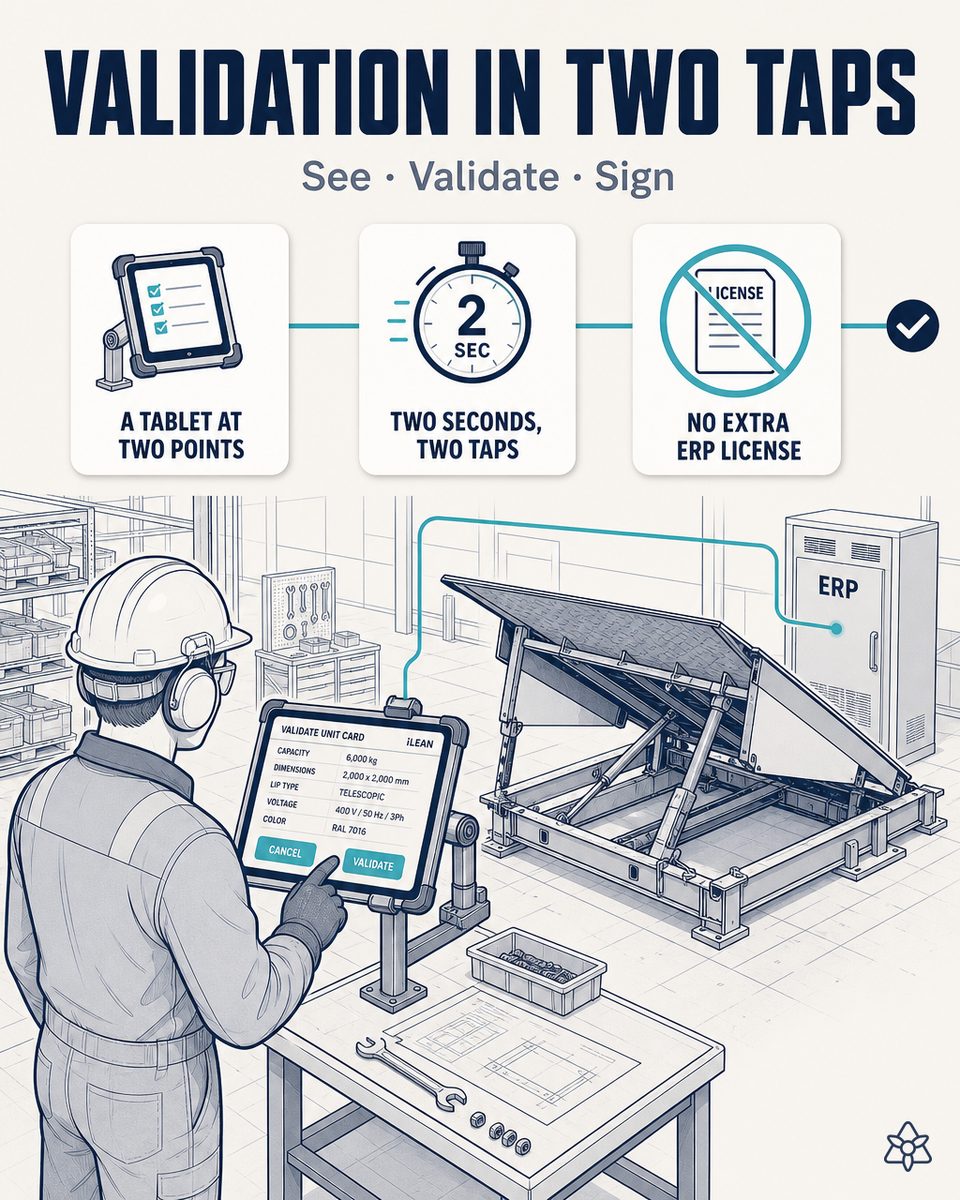
What separates an IRIS system from an autonomous AI agent is that nothing captured enters the central system without a human having seen it first. In a dock leveler factory that materializes as an industrial tablet at final assembly and shipping: everything captured about that unit appears as a two-second visual card, and the fitter confirms or corrects with two taps. Latency: seconds. No training. No habit change.
Here the fear of the AI writing on its own also has a regulatory basis.
The main cultural brake on shop-floor digitization is not technical: it is the very reasonable fear that the AI inserts data on its own and the ERP master has to be cleaned up afterwards. And in this sub-sector there is an aggravating factor:
- The data defines a safety product — with a rated capacity declared on the nameplate. A badly captured data point is not an inventory error: it is equipment declaring what it is not.
- But the alternative does not work either — asking the fitter to type the validation into the ERP means one more license, one more training and a task that competes with assembling.
- And without a human gate only two bad exits remain — either nothing is captured out of distrust, or it is captured without guarantees.
The contradiction is only apparent: what is needed is not choosing between automating and controlling, but separating the capture — which can be automatic — from the validation, which must be human but can take two seconds and demand no ERP license.
Early human verification — an interface for validating, not for entering data.
The key is aggregation. Instead of validating each capture separately, everything iLEAN knows about that unit comes together in a card per serial number — which is exactly the fitter's unit of decision.
Everything captured — the folder photo, the oven curve, the change arrived from the site, the supervisor's dictation, the finish measurements — is aggregated into a visual card per serial number. The fitter reads it in two seconds: capacity, dimensions, lip type, tension, color, deviations. They confirm with one tap or correct with another. Only then does the data cross into the ERP master.
How early human verification operates at final assembly and shipping:
- An industrial tablet on a mount, at two points — final assembly and shipping. Where the decision happens, not in an office: a validation that demands walking somewhere piles up and ends up done in bulk.
- One card per serial number, not one per capture — the fitter sees the complete unit, which is how they think. Capacity, dimensions, lip type, tension, color and deviations.
- Two seconds of reading, two taps of decision — confirm or correct. The interface is designed for validating, not for entering data.
- No additional ERP license — the fitter does not enter the ERP: they validate on the tablet and the system does the writing. That eliminates at a stroke the license, the training and the task that competed with assembling.
- Only then does it cross into the master — the boundary is explicit: what is not signed does not enter.
No human gate vs. two-tap validation
| Aspect | Autonomous capture, or nothing | With iLEAN + validation tablet |
|---|---|---|
| The ERP master | Contaminated, or empty out of distrust | Only what a person signed enters |
| Rated capacity declared on the nameplate | Risk of declaring what it is not | Confirmed by a person before shipping |
| An ERP license for the fitter | One more, with its training | None: they validate on the tablet |
| The fitter's time | A task competing with assembling | Two seconds of reading |
| Unit of validation | Each capture separately | One card per serial number |
| Traceability of the signature | Does not exist | Who validated and when, per unit |
Value of this piece — enabler of the whole matrix.
This case is deliberately presented without a payback: its value is structural, and it is what lets the rest get approved.
- Configure-to-order dock equipment manufacturer, with a safety product and a rated capacity declared on the nameplate.
- Pilot of the tablets at final assembly and shipping, together with the first capture case. It is not deployed on its own: it is the piece that makes the others signable.
- Enabling piece of the whole matrix. Without early human verification, the other eleven pieces do not pass the committee. Strategic value, not directly monetizable.
- And an advantage that usually decides the conversation with the CFO: the fitter needs no ERP license, because they do not enter the ERP — they validate on the tablet and the system does the writing.
- Regulatory benefit: every unit ships with a record of who validated its configuration and its declared capacity, which is exactly what goes unrecorded today.
And the fair question from the quality director
"If every unit must be validated, don't we lose the time we gained?" — no, because validating and typing do not cost the same. The card is read in two seconds and the decision is two taps, versus a manual ERP entry demanding a license, training and menu navigation. And it is that validation which lets the AI work on anchored tasks safely: even with an error below 1.5% [1], that remainder never reaches the master — which in a product with the capacity declared on the nameplate is not a nuance.
[1] OpenAI paper "Why Language Models Hallucinate", 2025 — on the reliability of AI in anchored tasks.
What people ask about two-tap validation
Why is the AI writing on its own more serious here?
Because the data defines a safety product with a rated capacity declared on the nameplate. A badly captured data point does not produce an inventory mismatch: it produces equipment installed at a dock declaring a capacity that does not correspond to what was actually built. That has different consequences — of liability, not of management. That is why the fear of an automatic system writing into the master is not only reasonable: here it has a regulatory basis, and the right answer is not convincing anyone to trust, but installing a gate that controls.
Does the fitter need an ERP license?
No, and it is one of the reasons this approach works where others fail. The fitter does not enter the ERP: they read the card on the tablet and confirm or correct. It is the system that writes into the master after the validation. That eliminates at a stroke three obstacles that usually kill these projects — the cost of one more license per station, the associated training and an administrative task that competes directly with assembling. The validation stops being office work done in the shop and becomes a two-second gesture.
What exactly does the card contain?
Everything iLEAN has captured about that unit, aggregated by serial number: the manufacturing folder photo, the curing oven curve, any change arrived from the site, the supervisor's dictation if there was one, and the finish measurements. And it is presented with what the fitter needs to check in large type: capacity, dimensions, lip type, tension, color and deviations. The key is that the unit is validated, not each capture separately — because the unit is how the person at final assembly thinks.
Why at final assembly and at shipping?
Because they are the last two points where someone has the unit in front of them and can check what the system says against what they see. At final assembly, before closing; at shipping, before it leaves. Putting the validation there and not in an office is what makes it happen in the moment: a validation that required walking somewhere would pile up and end up signed in bulk at the end of the shift, which is exactly the same as not doing it — signing without looking.
Why is it the enabler of the whole matrix?
Because without it the other eleven pieces do not pass the committee. Every capture case — the folder, the oven, the site notices, the weld seam — generates data that has to end up somewhere, and nobody authorizes it ending up in the ERP master without a human signature in between. With this piece on the table, the conversation changes: nobody is asked to trust the AI, they are shown the screen where a person decides. Its value is strategic and that is how it should be presented, without inventing a payback it does not have.
More cases from this series
- The conformity file assembles itself, unit by unitEach unit generates its dossier as it is built: seam, curing curve, thickness, load test, heat and…
- The curing oven starts to talk: the real curve, unit by unitAn external camera reads the curing oven’s proprietary panel and digitizes the real curve per unit,…
- The nameplate, engraved from the ERP and with no typingConnect stitches the nameplate marker to the ERP via API: serial, model, rated capacity and markings…
- The manufacturing folder enters on its own: one photo and the unit exists in the systemEach leveler’s manufacturing folder enters the system with a photo: configuration, signatures and…
- The finish and load tests enter the ERP on their owniLEAN reads the thickness, adhesion and load test Excel on save, ties it to the serial number and feeds…
- The change arriving from the site, in time for it to cost nothingiLEAN reads email and messaging silently copied, cross-references the installer’s notice with the…
See the two-tap validation screen.
We work on your plant's real data, not ours. We show you the validation working on your own captures. Assessment with no commitment.
See how we would apply it in your plant ‹ See all 12 loading dock equipment cases See metal fabrication