The supervisor dictates while walking and knowledge stops dying at the end of the shift
The supervisor of a dock equipment plant spends the shift walking between the welding cell, the manual stations, the paint entrance, hydraulic assembly, control cabinet wiring and the load test bench. With gloves on and hands busy, they cannot type, and everything they know dies at the end of the shift. With iLEAN Connect in voice mode they dictate while walking and the system structures it tied to the cell, the serial number and the shift.
It is not a lack of will: it is physics.
A capital equipment plant's most valuable operational knowledge lives in the heads of three or four supervisors — that the robot leaves a short seam on the crossbeam since the wire coil change, that a unit is waiting for a cylinder, that the new fitter needs support with the control cabinet:
- You do not type with gloves on in front of a hot part — and a tablet in the hand is one hand fewer to work with. Any system demanding writing in the moment loses before it starts.
- None of that enters any system — it is shared verbally at handover, if at all, and of the whole shift a few lines survive.
- And it multiplies with a ramping plant or a team in training — because it is exactly the knowledge that should be transferred, and the only kind written down nowhere.
The result is a plant where the information that would explain the variability between cells and between shifts is produced every day and evaporates every evening.
Connect in voice mode — the AI records and prepares, the supervisor decides.
The difference between recording and capturing is structure and control. The earpiece does not listen to the shop: it listens to what the supervisor decides to dictate to it, and turns it into an incident tied to the active context.
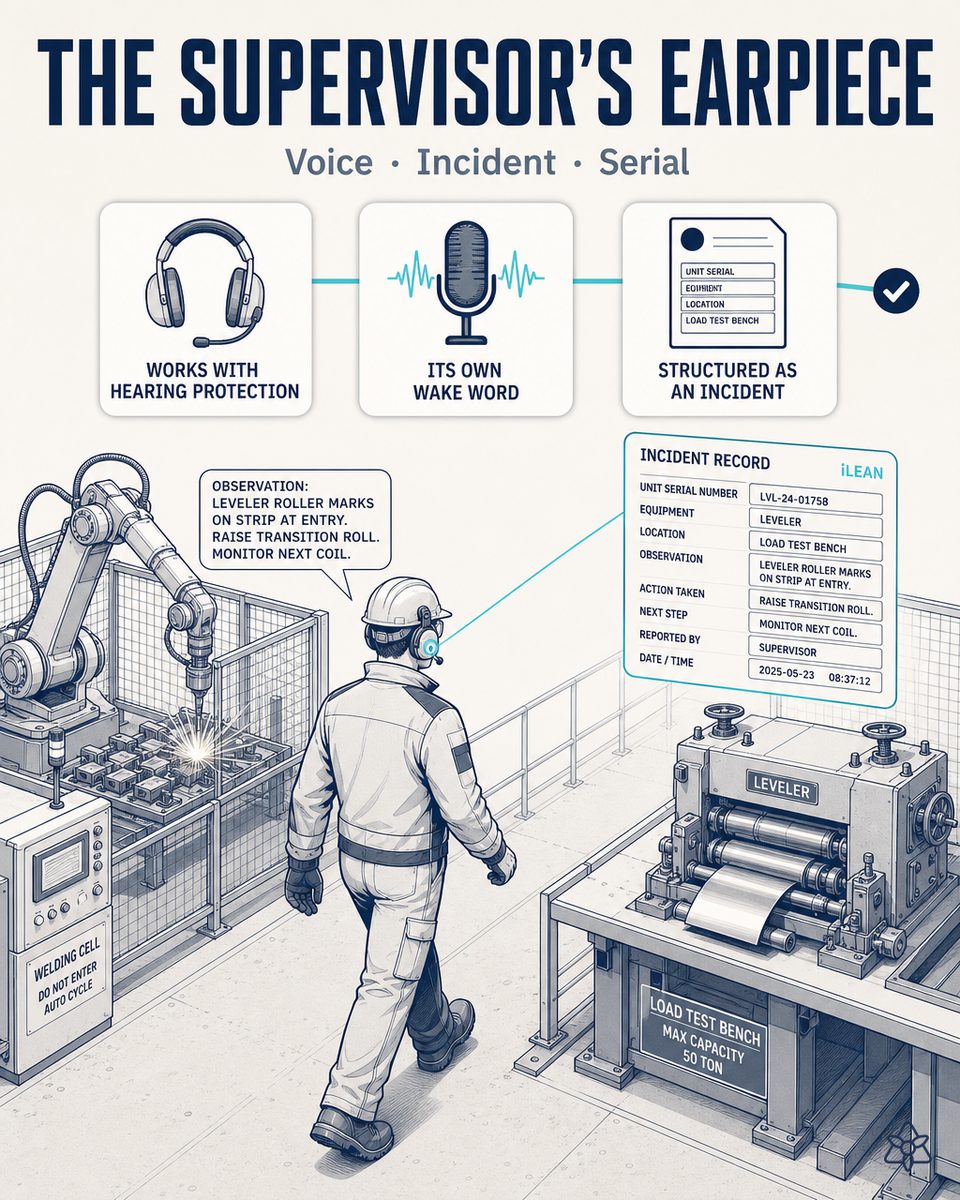
A Bluetooth earpiece compatible with the shop's hearing protection, with its own wake word and nothing to press. The supervisor speaks naturally while walking; an anchored model structures the dictation as an incident tied to the active cell, serial number and shift, and iLEAN returns support by voice or by notification.
How Connect operates in voice mode in the shop:
- Compatible with hearing protection — a starting requirement in a metal fabrication shop, not an add-on: if it forces removing the ear defenders, it does not get used.
- Its own wake word, nothing to press — with gloves there are no buttons that work. Outside that word, the earpiece transcribes and sends nothing.
- Structured as an incident, not as audio — automatically tied to the active cell, serial number and shift, without reciting references.
- A return within seconds — it checks availability, notifies the relevant role, proposes a time. A system that only stores gets abandoned; one that returns something useful sustains itself.
- Humans in command — the AI records and prepares; the one who decides what is done with the incident is the supervisor.
Knowledge that dies in the shift vs. knowledge in the system
| Aspect | Without voice capture | With iLEAN Connect voice |
|---|---|---|
| What survives the shift | What gets told verbally at handover | The structured incident with its context |
| Link to cell, serial and shift | Depends on someone remembering it | Automatic |
| Cost of recording something | Stop, remove the gloves, type | Talking while walking |
| Traceable incidents | Told verbally | With context and searchable |
| Transfer to a new team | By shadowing, with no written base | On a real per-cell history |
| Notice to the relevant role | "When I see them" | Seconds |
Impact estimate for your plant — to be validated with your own numbers.
The block below is an estimate to be validated against your plant's actual data. We put it forward so the committee has an order of magnitude; we refine it during the assessment.
- Dock equipment plant with three or four supervisors walking the shop between welding, painting, hydraulic assembly, wiring and the test bench.
- Connect voice pilot with an earpiece for one supervisor, anchored to the active cell and serial number. First value expected within a few weeks.
- A hard piece to monetize upfront, and it is worth saying so. Its value is enabling: every continuous improvement plan and every knowledge transfer to a new team depend on this information existing.
- And it is where it weighs most in this sub-sector: with a new plant ramping up or a team in training, the knowledge to transfer is precisely the kind not written down today.
- Estimate to be validated with the continuous improvement manager against their own plan.
And the fair question from the works council
"Is this a microphone over the shop?" — no. The earpiece activates with its own wake word and captures what the supervisor decides to dictate, just as if they noted it in a notebook; it does not listen continuously and does not pick up conversations with the fitters. What is stored are process incidents tied to cell, serial number and shift. And reliability plays on anchored ground: structuring a short dictation against a known context is where the best models brought the error below 1.5% [1].
[1] OpenAI paper "Why Language Models Hallucinate", 2025 — on the reliability of AI in anchored tasks.
What people ask about voice capture in a metal fabrication shop
Does it work with hearing protection and gloves?
It is designed for that. The earpiece is compatible with the shop's hearing protection — if it forced removing the ear defenders, it would not get used — and activates with its own word, with nothing to press, because with gloves no buttons work. The supervisor speaks naturally while walking, without pulling anything out of a pocket or stopping. That combination is what makes capture viable in an environment where any interface demanding glove-free hands or a screen in the hand fails in the first week.
Does the system listen to the fitters?
No. iLEAN listens to what the supervisor decides to dictate to it, when they decide to dictate it. Outside the wake word nothing is transcribed or sent: there is no continuous listening, no conversations with the team are picked up and nobody's activity is logged. What stays in the system are process incidents tied to the cell, the serial number and the shift. It is a distinction worth making clear before the pilot, and it holds up technically.
What can be dictated and how is it recorded?
Any operational observation: that the robot leaves a short seam on the crossbeam since the wire coil change, that a unit is waiting for a cylinder, that the new fitter needs support with the control cabinet. The model structures it as an incident tied to the active cell, serial number and shift, without the supervisor reciting any reference — the system already knows where they are and which unit is in progress. That is what later allows searching, grouping and seeing whether something repeats in a specific cell.
What does it return besides storing?
Immediate support, which is what makes it get used. Depending on what was dictated, iLEAN checks availability, notifies the relevant role or proposes a time, and returns it by voice or by notification. The practical difference is big: today, for maintenance to learn about something, the supervisor has to hunt them down or wait to cross paths. A system that only recorded would be abandoned in two weeks; one that solves something in the moment sustains itself. And the decision stays theirs: the AI records and prepares, the supervisor decides.
Why do you say it is hard to monetize?
Because it is, and we prefer to frame it that way. This case does not produce an isolated saving: it produces the data on which the plans that do have one are built. Every continuous improvement plan and every knowledge transfer to a new team depend on this information existing, and today it does not. In a ramping plant or with a team in training that value is especially high, because what has to be transferred is exactly what lives in three or four people's heads. It is sized with the continuous improvement manager against their own plan, not with a generic figure.
More cases from this series
- The conformity file assembles itself, unit by unitEach unit generates its dossier as it is built: seam, curing curve, thickness, load test, heat and…
- The curing oven starts to talk: the real curve, unit by unitAn external camera reads the curing oven’s proprietary panel and digitizes the real curve per unit,…
- The nameplate, engraved from the ERP and with no typingConnect stitches the nameplate marker to the ERP via API: serial, model, rated capacity and markings…
- The manufacturing folder enters on its own: one photo and the unit exists in the systemEach leveler’s manufacturing folder enters the system with a photo: configuration, signatures and…
- The finish and load tests enter the ERP on their owniLEAN reads the thickness, adhesion and load test Excel on save, ties it to the serial number and feeds…
- The change arriving from the site, in time for it to cost nothingiLEAN reads email and messaging silently copied, cross-references the installer’s notice with the…
Hear how an incident is captured without stopping walking.
We work on your plant's real data, not ours. A short pilot with one supervisor is enough to see the volume of what is lost today. Assessment with no commitment.
See how we would apply it in your plant ‹ See all 12 loading dock equipment cases See metal fabrication