GPS stitched to the ERP: the ETA that updates itself
The operator can see where every tractor unit and trailer in the fleet is at any given moment. It's a relatively modern system, with an available API, but "integrating it properly takes time" — so nobody has done it yet. The dispatcher opens the GPS platform, finds the truck, eyeballs the ETA, and re-types it by hand into the management system or an email.
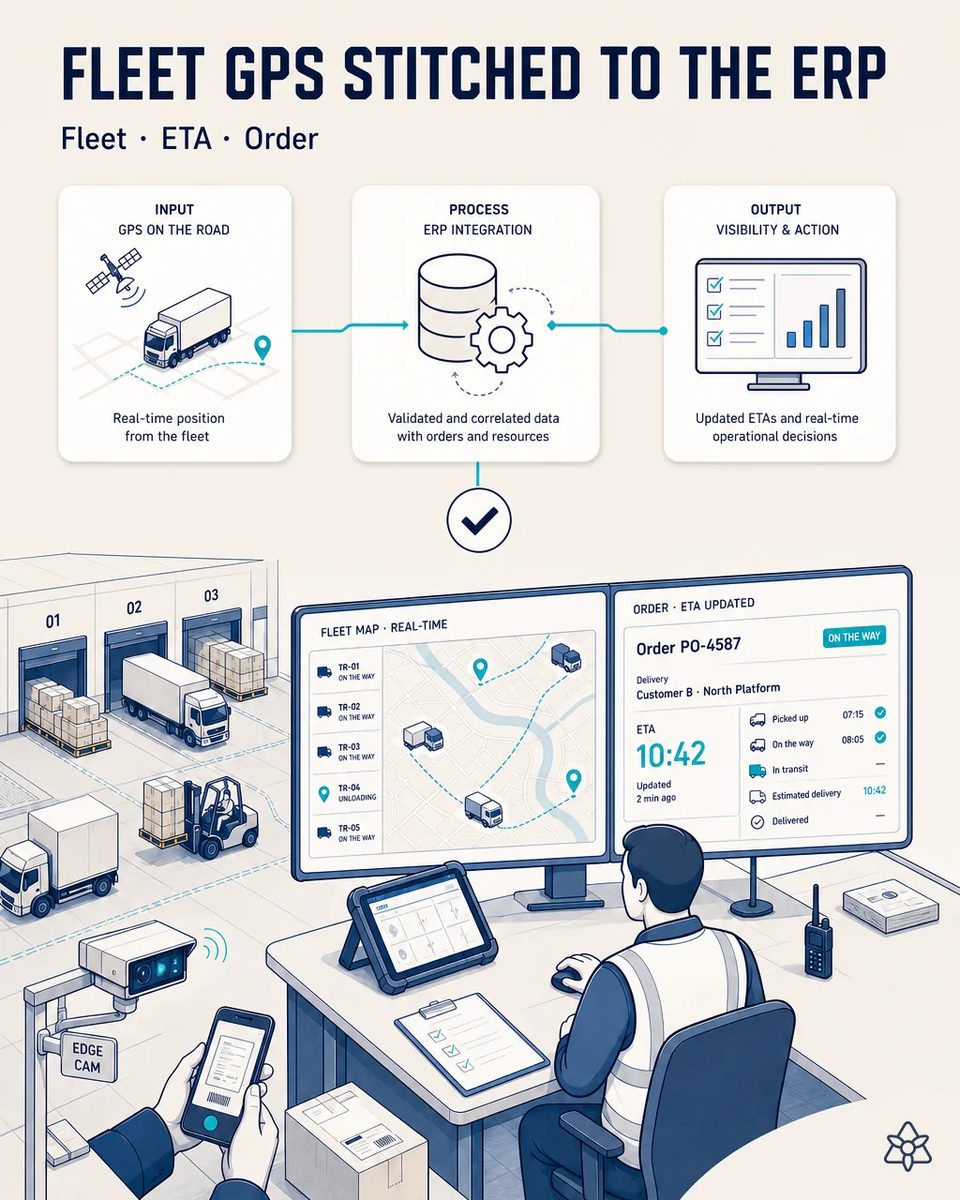
Two modern systems, connected by a dispatcher with two windows open.
It's a relatively modern system, with an available API, but "integrating it properly takes time" — so nobody has done it yet. The dispatcher opens the GPS platform, finds the truck, eyeballs the ETA, and re-types it by hand into the management system or an email.
- The operator can see where each of its dozens of tractor units and trailers is at any moment on the fleet GPS platform. The data exists, live, for every truck.
- The platform has an API, but “integrating it properly takes time”, so nobody has done it yet. It is always next quarter's project.
- The dispatcher opens the GPS, finds the truck, eyeballs the ETA and retypes it by hand into the management system or an email, several times a day and for every delayed delivery.
- Meanwhile clients call or write to ask where their delivery is, and customer service asks the dispatcher again, who opens the GPS one more time.
Connect stitches the GPS and the ERP through their APIs — no double entry.
Connect links the two modern systems via API: the position and ETA of every shipment flow automatically into the matching order. If the customer has a portal, the updated ETA arrives there directly, with nobody at the operator having to type it in.
This case is not about reading paper or screens; both systems are modern. It is about the gap between them, which today is filled by a person copying an ETA. That gap is exactly what Connect closes, and the dispatcher goes back to the work only a dispatcher can do: handling the exceptions, the breakdowns and the slots that are about to be missed. With 30 tractor units on the road, the minutes saved per ETA add up to a large part of a dispatcher's day.
Today's ETA versus the stitched ETA
| Aspect | Today | With iLEAN Connect |
|---|---|---|
| How the ETA reaches the order | Retyped by the dispatcher | Flows from the GPS automatically |
| Updates per shipment | When someone has time | Continuous |
| Customer portal | Shows the last typed ETA | Shows the live ETA |
| Where-is-my-truck calls | Answered by hand | Fewer, the portal answers |
| Dispatcher's time | Copying between two windows | Spent on exceptions |
| The GPS platform | — | Kept as it is |
Before: the dispatcher checks the GPS and re-types the ETA by hand into another system, several times a day. After: the ETA flows automatically from the GPS to the order and the customer portal.
Impact estimate — to be validated with your numbers.
The block below is an estimate to be validated against your plant's actual data. We put it forward so the committee has an order of magnitude; we refine it during the assessment.
- Estimated payback 3-6 months, the shortest of the matrix, because both systems already exist and only the stitch is missing.
- An always-updated ETA on every order, with no double entry by the dispatcher.
- Fewer tracking calls and emails to customer service, which today interrupt both customer service and dispatch.
- And better perceived service with no added headcount, because the dispatcher stops being the integration between two systems.
Payback 3-6 months · always-updated ETA with no double entry. Fewer tracking calls and emails to customer service, and better perceived service with no added headcount.
And the fair question from the production manager
“What if the ETA it posts is wrong and the client plans around it?” — the ETA is not invented: it comes from your own GPS platform, and matching each vehicle to its order is an anchored task, where the best models drop below 1.5% error [1]. When a truck cannot be matched unambiguously to an order, it is shown to the dispatcher instead of being posted. And the dispatcher can still override any ETA manually; the system records that it was overridden and by whom.
[1] OpenAI paper "Why Language Models Hallucinate", 2025 — on the reliability of AI in anchored tasks.
What people ask about stitching the fleet GPS to the ERP
Do we have to change GPS provider?
No. Connect uses the API your current platform already exposes. Nothing changes for drivers, for the onboard units or for the trucks. If the platform has no API, a scheduled export can be used instead, with a slightly longer delay.
How is each truck matched to its order?
Through the trip assignment already in the ERP: tractor unit, trailer and orders loaded. When that assignment is missing, the dispatcher is asked once and the answer is kept for the whole trip. A trailer swap mid-trip is picked up from the GPS and reflected on the orders it carries.
Does the client see the ETA?
If you have a customer portal, the updated ETA is published there directly. If not, it can be sent by email at the moments you define, such as departure and a significant delay. The format and timing are agreed with each client, since not all of them want the same level of detail.
What happens when a truck is delayed?
The ETA on the order moves with it, and a delay beyond the threshold you set can trigger an alert to customer service before the client calls. The threshold can be set per client, because a 30-minute delay matters more on some routes than others.
Does it also record the arrival at the delivery point?
Yes, the arrival time is stored on the order, which is useful when a client disputes a delivery slot or a waiting-time charge. Combined with the dossier, it closes the trail from the dock to the delivery point.
More cases from this series
- The customer alert that arrives before it's too lateiLEAN silently reads customer alerts and cross-checks them against the live order, with a concrete…
- The delivery note that doesn't waitOne photo of the delivery note and lot labels digitizes receiving in seconds. Up to -70% on…
- The scale that finally talks to the central systemAn external camera digitizes the dock scale reading. Every shipment's weight gets traced without…
- Hands-free between aisles, knowledge that doesn't get lostThe supervisor dictates issues while walking between warehouses and docks. iLEAN listens, structures and…
- The spreadsheet that stops being copied by handiLEAN reads the stock and location spreadsheet in real time and, after validation, pushes it into the…
- Paper picking sheet, digital data at zero-second latencyThe paper picking sheet gets photographed and enters the central system at zero-second latency. No…
Tell us how many times a day your dispatchers copy an ETA from one screen to another.
We work on your plant's real data, not ours. Assessment with no commitment.
Request estimated ROI within 48h ‹ See all cases of warehousing and transport See logistics