Hands-free between aisles, knowledge that doesn't get lost
The warehouse supervisor spends the shift covering aisles and docks, on and off the forklift, coordinating pickers from three different clients at once. They can't type or reach for their phone while driving the forklift or adjusting a pallet — so the information in their head stays there. That location B-14 is overloaded, that a new picker needs support, that a pallet arrived with broken wrapping — none of that reaches the system.
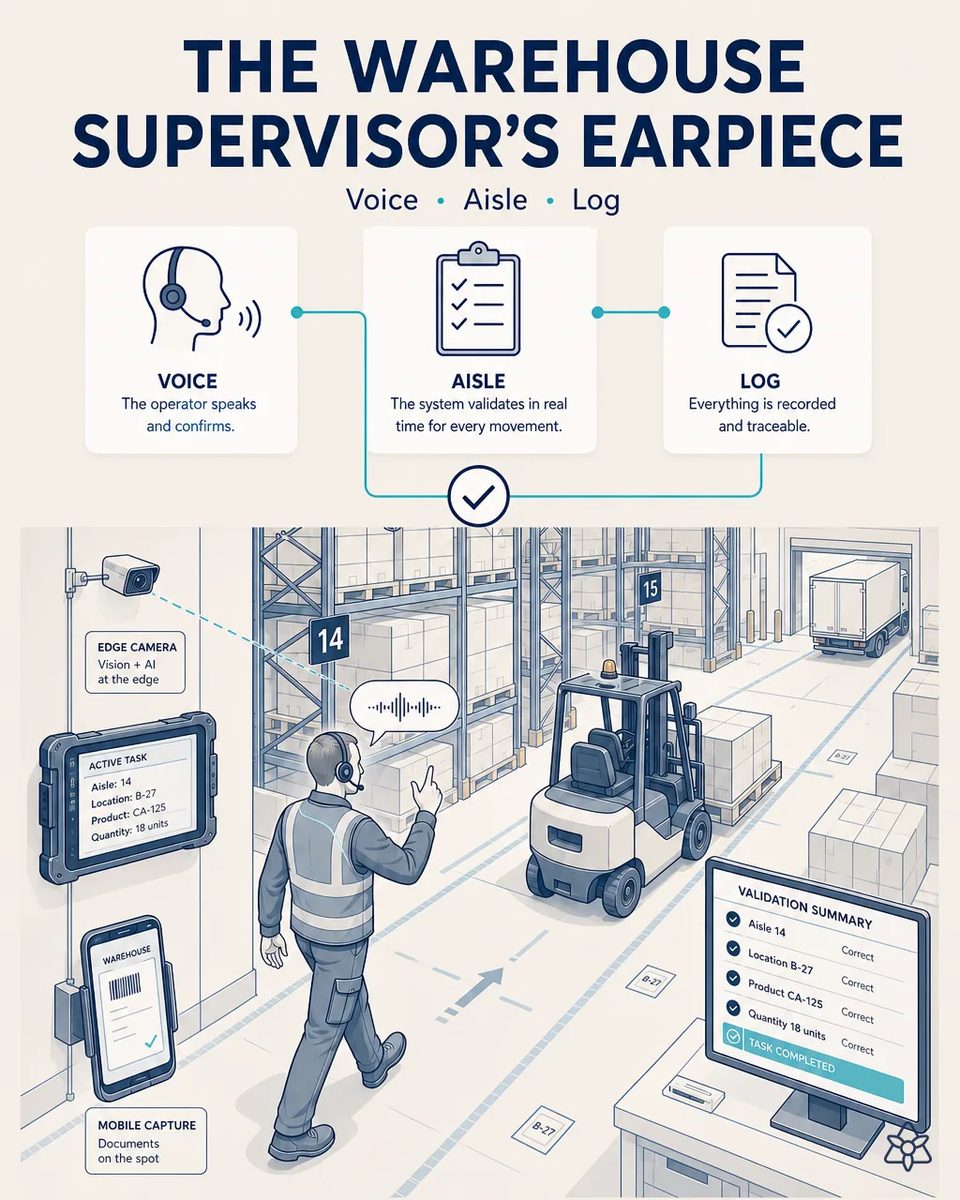
The supervisor knows where the warehouse hurts. The WMS does not.
The supervisor can't type or reach for their phone while driving the forklift or adjusting a pallet — so the information in their head stays there. That location B-14 is overloaded, that a new picker needs support, that a pallet arrived with broken wrapping — none of that reaches the system.
- The warehouse supervisor covers aisles and docks, on and off the forklift, coordinating pickers from three different clients at once and answering the phone for the fourth.
- He cannot type or reach for his phone while driving a forklift or squaring a pallet, so what he sees stays in his head until the end of the shift, and often beyond it.
- That location B-14 is overloaded, that a new picker needs support, that a pallet came in with broken wrap: none of it reaches the system, and the next shift finds out the hard way.
- The result is that occupancy across the warehouses cannot even be improved, because the data to measure it does not exist. Decisions about relocations are made from memory.
Connect in voice mode — iLEAN listens to the supervisor, not to the pickers.
"Note that B-14 is overloaded, needs relocating before the next receiving" — with a custom wake-word, no device to touch. The issue gets linked to the active warehouse, location and client, and the response comes back by voice or as a push to the supervisor's tablet.
Hands-free is not a convenience here, it is the condition: the supervisor spends the shift on a forklift or between racks. The case only works if recording an issue costs one sentence and no detour to the office. Once it does, what used to be shift-end memory becomes a running list of locations, clients and issues that the whole operation can see.
Today's round versus the dictated round
| Aspect | Today | With iLEAN Connect |
|---|---|---|
| An overloaded location | Remembered, maybe | Logged with warehouse and client |
| Broken wrap at receiving | Mentioned at the coffee machine | Recorded at the location |
| Picker who needs support | Depends on who notices | Noted and followed up |
| Effort to record an issue | Get off the forklift, find a terminal | One sentence, hands-free |
| Occupancy across warehouses | Cannot be measured | Built from real issues |
| Ordinary aisle conversation | — | Not recorded |
Before: what the supervisor knows dies at the end of the shift. After: it enters the system in real time, dictated on the move, no device to touch.
Impact estimate — to be validated with your numbers.
The block below is an estimate to be validated against your plant's actual data. We put it forward so the committee has an order of magnitude; we refine it during the assessment.
- No standalone payback: this is an enabling piece, and we do not put a number on it by itself because its value shows up in the other cases.
- Its value is strategic: it is what makes continuous improvement of occupancy across the warehouses possible.
- Today that improvement cannot even be measured, because the issues that explain it — overloaded locations, blocked aisles, slow relocations — are never written down.
- It also feeds the rest of the matrix: relocations, damaged receivings and picker support become data that the dock, the WMS and the audit dossier can use.
Strategic value, not directly monetizable · enables continuous improvement across warehouses. It's the piece that makes continuous improvement of occupancy across all the warehouses possible — something that today can't even be measured because the data doesn't exist.
And the fair question from the production manager
“Is this for listening in on my pickers?” — no: iLEAN only records what the supervisor dictates after the wake-word, with no continuous listening and no tracking of anyone's position. Turning a spoken sentence into warehouse, location, client and issue is an anchored task, where the best models drop below 1.5% error [1], and the structured note is shown back on the tablet so he can correct it. What he gains is not having to remember, at the end of the shift, what he saw eight hours earlier in a different warehouse.
[1] OpenAI paper "Why Language Models Hallucinate", 2025 — on the reliability of AI in anchored tasks.
What people ask about the warehouse supervisor's earpiece
Does it work with forklift and dock noise?
That is the design condition. Recognition is prepared for warehouse noise, reversing alarms and dock doors, and for logistics vocabulary such as location codes, client names and dock numbers. It works with headsets compatible with the hearing protection your docks already use.
How does it know which location he is talking about?
He says it, the way he would tell a colleague: B-14, dock 3, client X. iLEAN ties the note to the active warehouse and to that location in the WMS, so it can be found later by location or by client. If he names a location that does not exist, the note is returned to him for correction instead of being filed.
Does he get anything back?
Yes. The answer comes by voice or as a push to his tablet, for example the stock currently at that location or the next receiving scheduled for it, so he can decide the relocation on the spot. The answer is short by design: he is driving a forklift, not reading a report.
Do the pickers have to wear an earpiece?
No. This case is for the supervisor only. Pickers keep working as they do today, and nothing they say on the floor is recorded. That separation is deliberate and is what keeps the case accepted by the team in month six.
What does he dictate most in practice?
Relocations, overloaded or blocked locations, damaged pallets at receiving and pickers who need support. Those four already explain most of the occupancy problems a multi-client warehouse carries. After a few weeks the pattern of recurring locations is usually the first surprise for the operations manager.
More cases from this series
- The customer alert that arrives before it's too lateiLEAN silently reads customer alerts and cross-checks them against the live order, with a concrete…
- The delivery note that doesn't waitOne photo of the delivery note and lot labels digitizes receiving in seconds. Up to -70% on…
- The scale that finally talks to the central systemAn external camera digitizes the dock scale reading. Every shipment's weight gets traced without…
- The spreadsheet that stops being copied by handiLEAN reads the stock and location spreadsheet in real time and, after validation, pushes it into the…
- GPS stitched to the ERP: the ETA that updates itselfEvery truck's position and ETA flow automatically from the GPS into the ERP and the customer portal,…
- Paper picking sheet, digital data at zero-second latencyThe paper picking sheet gets photographed and enters the central system at zero-second latency. No…
Tell us how many warehouses one supervisor covers and where his notes end up today.
We work on your plant's real data, not ours. Assessment with no commitment.
Request estimated ROI within 48h ‹ See all cases of warehousing and transport See logistics