The delivery note that doesn't wait
Every supplier truck that reaches the dock brings a paper delivery note and lot/expiry labels on every pallet — data critical for traceability. While the driver waits, racking up demurrage, someone would have to manually enter every line of the delivery note into the ERP/WMS. In a multi-client warehouse that can end up being shipped to the wrong client weeks later, with nobody catching it in time.
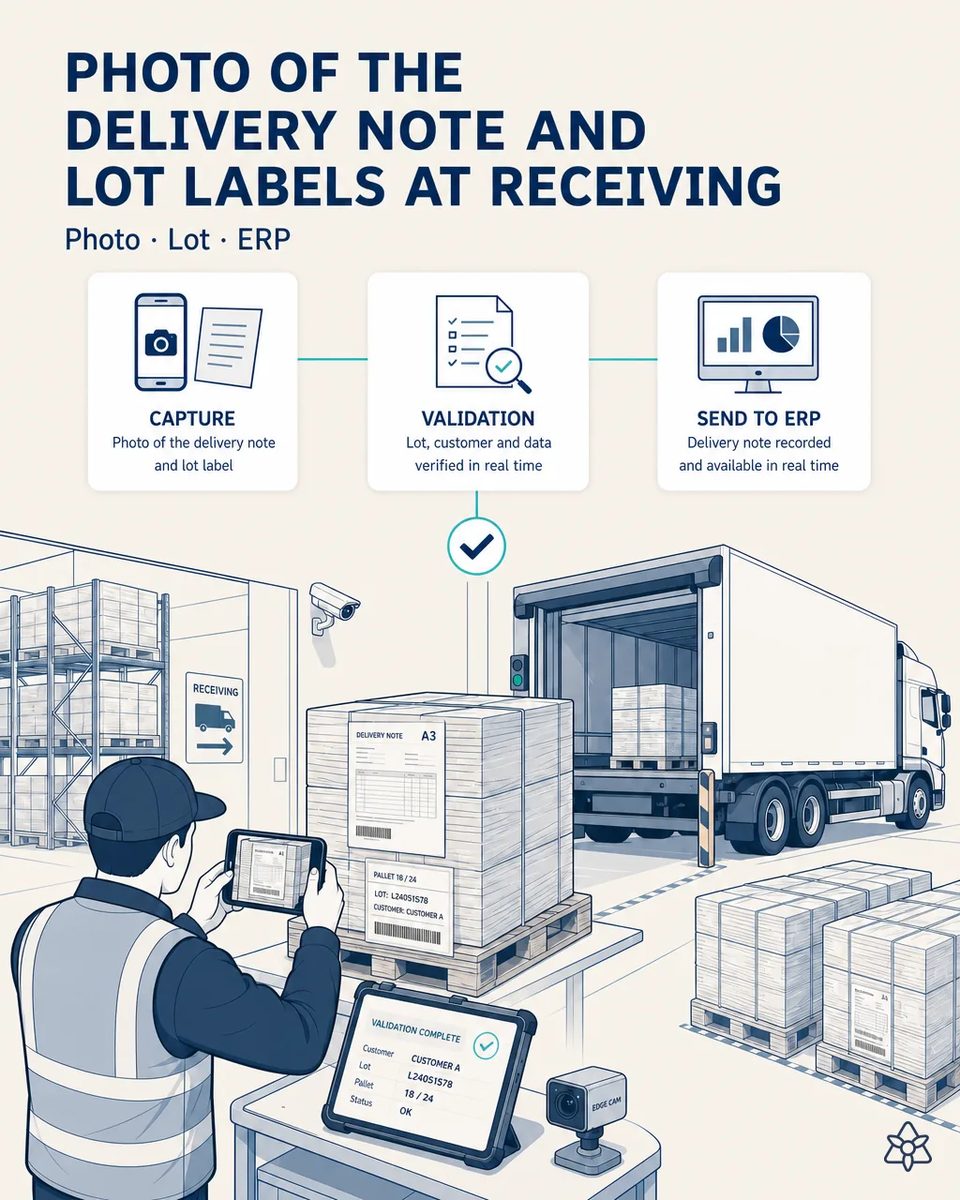
Traceability starts with someone typing while a truck waits.
While the driver waits, racking up demurrage, someone would have to manually enter every line of the delivery note into the ERP/WMS. In a multi-client warehouse that can end up being shipped to the wrong client weeks later, with nobody catching it in time.
- Every inbound truck brings a paper delivery note and lot and expiry labels on every pallet: the data that makes traceability possible for food and medical clients.
- While the driver waits, racking up demurrage, someone has to enter every line of the delivery note into the ERP/WMS by hand, with the next truck already queuing at the gate.
- A lot or expiry typed wrong at receiving does not fail at receiving. In a multi-client warehouse it can ship to the wrong client weeks later, or break first-expired-first-out picking.
- And the receiving module needs 2-3 active ERP licenses just so those lines can be typed, whether the warehouse is busy or not.
Connect in photo mode at receiving — delivery note and labels, no supplier changes.
The vision AI recognizes the delivery note's layout without asking the supplier to change theirs, and reads GS1-128, QR, barcode or plain OCR on the labels. The receiving manager confirms on the industrial tablet; the data crosses over automatically via API.
Suppliers will not change their delivery note for you, and they do not have to. The vision model recognizes each supplier's layout as it comes and reads the labels with whichever code they carry. The receiving lead stops typing and starts checking, and the truck leaves the dock with its data already in the ERP.
Today's receiving versus photographed receiving
| Aspect | Today | With iLEAN Connect |
|---|---|---|
| Delivery note entry | Typed line by line | One photo |
| Lot and expiry | Typed from the label | Read from GS1-128, QR, barcode or text |
| Driver waiting at the dock | Demurrage running | Data in the ERP within minutes |
| Supplier's document format | Whatever they send | Recognized as it is |
| Wrong lot at receiving | Discovered weeks later, at shipping | Stopped at the validation tap |
| Receiving module licenses in the warehouse | 2-3 active | Only whoever validates |
Before: the truck waits racking up demurrage while data is typed line by line, risking lot errors. After: photo, one-tap validation, data in the ERP within minutes.
Impact estimate — to be validated with your numbers.
The block below is an estimate to be validated against your plant's actual data. We put it forward so the committee has an order of magnitude; we refine it during the assessment.
- Estimated payback 3-8 months, depending on inbound volume and the number of receiving licenses today.
- -50 to -70% on receiving/warehouse module licenses: only the receiving lead validates with a tap.
- Less demurrage, because the truck no longer waits for line-by-line data entry before it can leave the dock.
- And lot and expiry enter correct from the start, which is what protects the shipment weeks later and keeps expiry-based picking honest.
Payback 3-8 months · -50 to -70% on receiving/warehouse module licenses. The receiving module today requires 2-3 active licenses; with Connect, only the manager validates with a tap — the rest no longer need direct ERP access.
And the fair question from the production manager
“What if it misreads a lot number on a creased label?” — reading a delivery note and a coded label is an anchored task, where the best models drop below 1.5% error [1], and a barcode or GS1-128 read is checked by its own structure. When a label is only legible as text and confidence drops, the field is highlighted on the tablet for the receiving lead to confirm against the pallet in front of him. Every confirmed line keeps the photo it was read from, so a lot question weeks later is answered by looking at the label itself.
[1] OpenAI paper "Why Language Models Hallucinate", 2025 — on the reliability of AI in anchored tasks.
What people ask about photographing the delivery note
Will our suppliers need to send a different delivery note?
No. The model recognizes each supplier's layout as it is, which matters when dozens of suppliers deliver for different clients and none of them will change their paperwork for one warehouse. A new supplier's layout is learned from its first few delivery notes, not from a template you have to build.
Which label codes does it read?
GS1-128, QR and standard barcodes, and plain OCR when the label only carries printed text. Lot and expiry are taken from whichever is present. When both a code and printed text are present, they are cross-checked against each other.
Does it compare the delivery note with the expected receipt?
Yes. The lines read are checked against the purchase order or advance notice in the ERP/WMS, and any difference in quantity, lot or reference is flagged before posting. Differences are shown to the receiving lead with the photo next to the expected line.
How do the license savings work?
Today 2-3 people need receiving module licenses to type. With Connect only the person who validates needs access, and the rest no longer need direct ERP access. Receiving keeps the same pace with fewer people logged into the ERP.
What about pallets for different clients on the same truck?
Each pallet's label ties it to its client, so mixed loads are split into the right client stock at the moment of receiving instead of being sorted out later. That split is what prevents goods from being stocked under the wrong client from day one.
More cases from this series
- The customer alert that arrives before it's too lateiLEAN silently reads customer alerts and cross-checks them against the live order, with a concrete…
- The scale that finally talks to the central systemAn external camera digitizes the dock scale reading. Every shipment's weight gets traced without…
- Hands-free between aisles, knowledge that doesn't get lostThe supervisor dictates issues while walking between warehouses and docks. iLEAN listens, structures and…
- The spreadsheet that stops being copied by handiLEAN reads the stock and location spreadsheet in real time and, after validation, pushes it into the…
- GPS stitched to the ERP: the ETA that updates itselfEvery truck's position and ETA flow automatically from the GPS into the ERP and the customer portal,…
- Paper picking sheet, digital data at zero-second latencyThe paper picking sheet gets photographed and enters the central system at zero-second latency. No…
Tell us how long an inbound truck waits at your dock while the delivery note is typed.
We work on your plant's real data, not ours. Assessment with no commitment.
Request estimated ROI within 48h ‹ See all cases of warehousing and transport See logistics