The scale that finally talks to the central system
Before loading, every pallet or truck passes over the dock scale — a critical figure for weight/volume billing and for catching shortages. It's a 10-20 year old unit with a proprietary panel that isn't networked; the manufacturer no longer supports integration, and replacing it means stopping the dock. Today that vital figure appears on the display, someone jots it down if there's time, and then it's gone — never tied to the specific shipment.
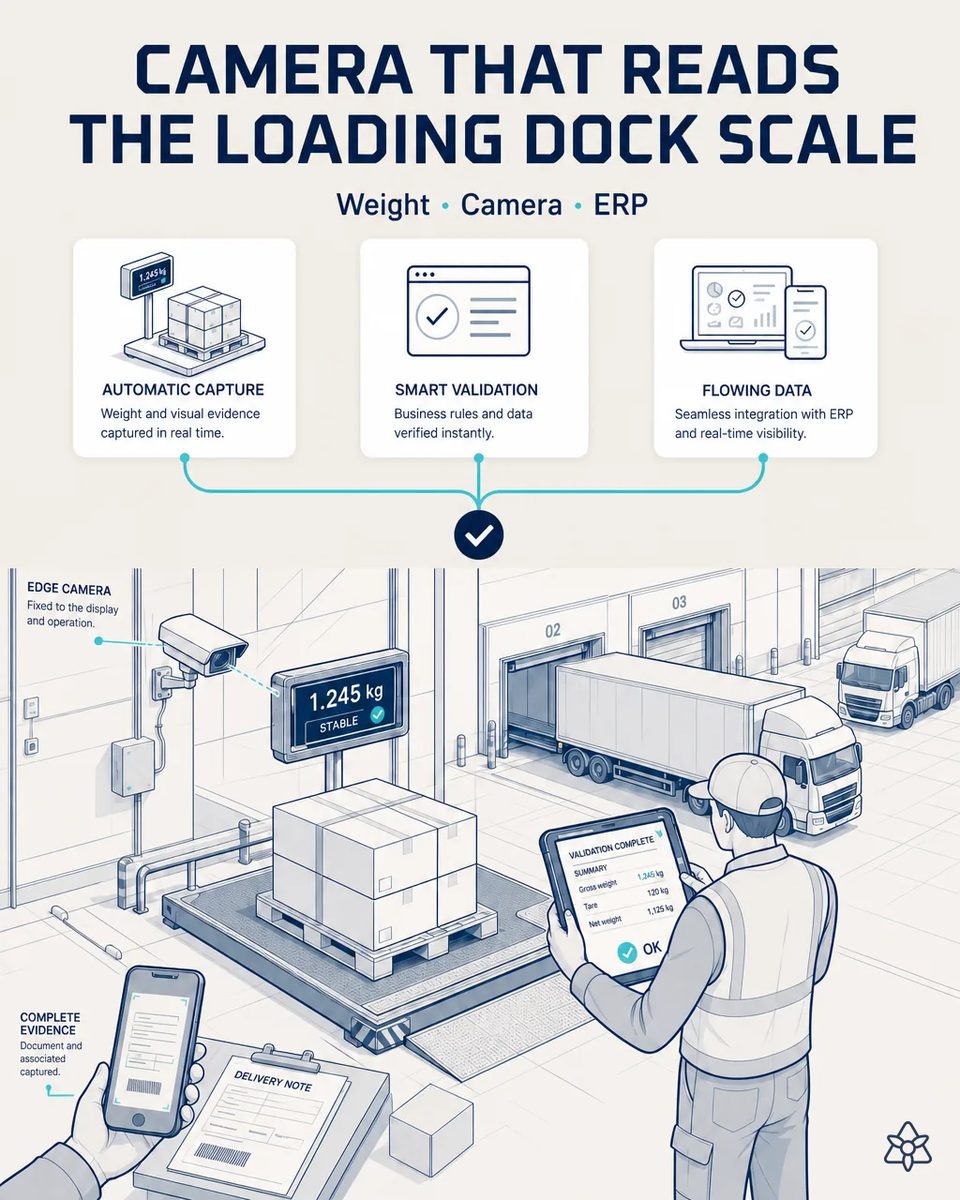
The weight that decides the invoice lives for a few seconds on a display.
It's a 10-20 year old unit with a proprietary panel that isn't networked; the manufacturer no longer supports integration, and replacing it means stopping the dock. Today that vital figure appears on the display, someone jots it down if there's time, and then it's gone — never tied to the specific shipment.
- Every pallet or truck crosses the dock scale before loading. That figure drives weight/volume billing and is the first signal of a short shipment, a missing layer or a pallet built for the wrong order.
- The scale is 10-20 years old, with a proprietary panel that is not networked; the manufacturer no longer supports integration, and nobody wants to open a calibrated indicator to add a cable.
- Replacing it means taking the dock out of service, so it stays. Today the weight appears on the display, someone jots it down if there is time between two forklifts, and then it is gone.
- When a client disputes an invoice or reports a short delivery, there is no weight tied to that specific shipment to answer with, and the discussion ends in a credit note to keep the account calm.
Connect in photo mode on the scale display — read from outside, not wired in.
A camera pointed at the display, with OCR and an anchored LLM, reads every reading and cross-references it with whichever order is at that dock at that moment. The scale isn't touched or replaced: it stays exactly as it is, but the weight is now traced, pallet by pallet, in central memory.
The scale keeps working exactly as it does today; nothing is opened, rewired or recalibrated. What changes is that every reading is now attached to the order that was on that dock at that moment, pallet by pallet. A figure that used to live for a few seconds becomes the weight behind every invoice line and the first warning of a shipment that does not add up.
Today's dock scale versus the scale being read
| Aspect | Today | With iLEAN Connect |
|---|---|---|
| Life of the weight reading | A few seconds on the display | Stored per shipment |
| Link to the order | None, or a handwritten note | The order at that dock, automatically |
| Weight/volume billing dispute | Your word against the client's | The weight of that pallet |
| Short shipment | Discovered at delivery | Visible before loading |
| The scale itself | — | Untouched, not replaced |
| Replacement capex | On the wish list | Not needed |
Before: the weight only exists on the scale's display for a few seconds. After: the weight is traced per shipment in central memory, without touching the equipment.
Impact estimate — to be validated with your numbers.
The block below is an estimate to be validated against your plant's actual data. We put it forward so the committee has an order of magnitude; we refine it during the assessment.
- Estimated payback 5-10 months, depending on the share of your revenue billed by weight or volume.
- Fewer weight/volume billing disputes, because every invoice line has a traced weight behind it with time, dock and order.
- No capex spent replacing a scale that still works perfectly well mechanically, and no dock taken out of service to install a new one.
- And a weight mismatch against the order shows up at the dock, not in the client's receiving report two days later.
Payback 5-10 months · every shipment's weight traced, zero billing disputes. Fewer weight/volume billing disputes, and no CAPEX spent replacing a scale that still works perfectly well mechanically.
And the fair question from the production manager
“Can a camera reading a display stand up in a billing dispute?” — the task is anchored: a fixed display, digits in a known position and a physically possible weight range, where the best models drop below 1.5% error [1]. The system only takes the reading once the scale shows stable, and discards any value outside the plausible range for that pallet instead of storing it. Each stored weight keeps the frame it was read from, so anyone can check the digit against the image.
[1] OpenAI paper "Why Language Models Hallucinate", 2025 — on the reliability of AI in anchored tasks.
What people ask about reading the dock scale
Do we have to open or modify the scale?
No. The camera points at the display from outside. There is no wiring into the indicator and no change to its calibration or legal metrology seal, so the scale stays valid for trade use. It is also why it can be installed without the scale supplier's involvement.
How does it know which shipment the weight belongs to?
It crosses the reading with the order assigned to that dock in the WMS at that moment, so each weight lands on the right shipment and client even when two clients load from neighboring docks. If no order is assigned to the dock, the reading waits for a person to assign it instead of being guessed.
What if the reading is taken before the scale settles?
It waits for the stable indication on the display. A fluctuating value while the forklift is still lowering the pallet is not stored as a weight. The frame read is the one where the indicator shows stable, which is the same rule your dock team applies by eye.
Does it work with truck scales as well as platform scales?
Yes, the pattern is the same: a display read from outside and tied to whatever is on the scale at that moment, whether a single pallet or a loaded trailer. The camera position and the expected range are set per scale during commissioning.
Can the stored weight be shown to a client?
Yes. Each weight keeps its timestamp, dock and order, and the camera frame it was read from, which is exactly what is needed to settle a weight/volume invoice discussion. A dispute that today ends in a credit note can be answered with the actual reading.
More cases from this series
- The customer alert that arrives before it's too lateiLEAN silently reads customer alerts and cross-checks them against the live order, with a concrete…
- The delivery note that doesn't waitOne photo of the delivery note and lot labels digitizes receiving in seconds. Up to -70% on…
- Hands-free between aisles, knowledge that doesn't get lostThe supervisor dictates issues while walking between warehouses and docks. iLEAN listens, structures and…
- The spreadsheet that stops being copied by handiLEAN reads the stock and location spreadsheet in real time and, after validation, pushes it into the…
- GPS stitched to the ERP: the ETA that updates itselfEvery truck's position and ETA flow automatically from the GPS into the ERP and the customer portal,…
- Paper picking sheet, digital data at zero-second latencyThe paper picking sheet gets photographed and enters the central system at zero-second latency. No…
Tell us how many weight disputes you closed last quarter without a recorded weight.
We work on your plant's real data, not ours. Assessment with no commitment.
Request estimated ROI within 48h ‹ See all cases of warehousing and transport See logistics