The spreadsheet that stops being copied by hand
Many operators bill storage per client, and that pricing model requires a per-client stock and location spreadsheet, updated every time goods come in or go out. It's the real source of occupancy data, but the official billing system depends on someone manually transcribing it periodically. The administration manager spends hours a week copying and pasting, with all the error risk that carries.
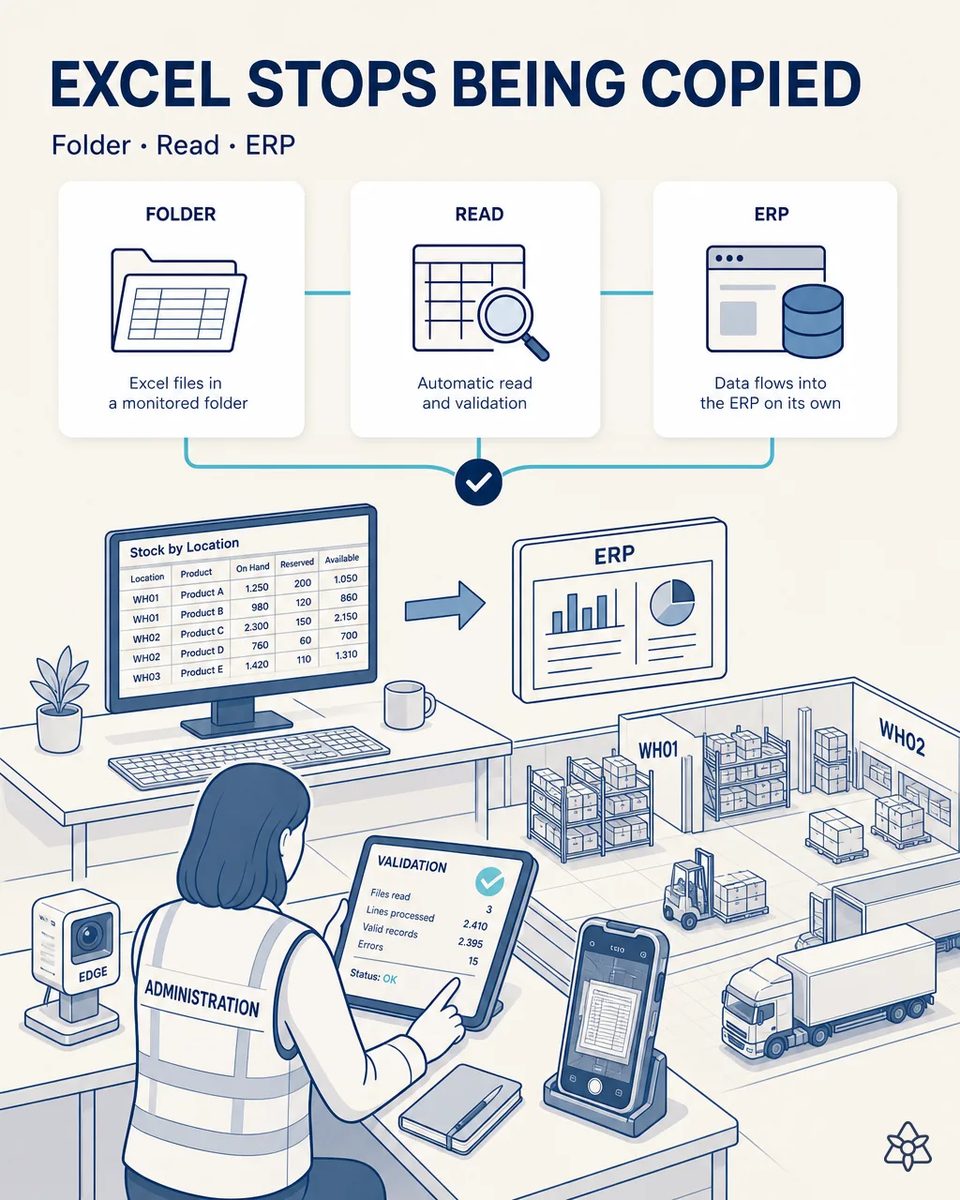
Storage is billed from a spreadsheet the ERP only sees days later.
That spreadsheet is the real source of occupancy data, but the official billing system depends on someone manually transcribing it periodically. The administration manager spends hours a week copying and pasting, with all the error risk that carries.
- Billing storage by pallet position or occupancy requires a per-client stock and location spreadsheet, updated every time goods come in or go out of any of the warehouses. With several warehouses and dozens of clients, that spreadsheet changes many times a day.
- That spreadsheet is the real source of occupancy data, the one the warehouse team trusts. The official billing system depends on someone transcribing it periodically.
- The administration manager spends hours a week copying and pasting, with the error risk that carries straight into an invoice and, from there, into a client's complaint. A row pasted one line off is enough to bill a pallet position to the wrong client for a whole month.
- And several people keep an ERP inventory license only to maintain that copy, which is a recurring cost nobody associates with a spreadsheet.
Connect watching the shared folder — the file, not the person.
The system watches the shared folder — not the person —, reads the delta when the file is saved, and parses it with an anchored LLM. The manager validates on screen and the data crosses over automatically, with no manual transcription.
Nobody is asked to stop using the spreadsheet; it works and the team knows it. Connect reads the change when the file is saved, the manager validates it on screen, and the ERP stops lagging days behind the warehouse. Storage is invoiced on today's occupancy, and the licenses that only existed to keep a copy alive can be dropped. It is the same pattern a multi-client operator repeats with every client that pays for storage by position: one spreadsheet, one person copying it, one ERP that finds out late.
The copied spreadsheet versus the connected spreadsheet
| Aspect | Today | With iLEAN Connect |
|---|---|---|
| Lag between spreadsheet and ERP | Days | Zero-second latency after validation |
| Admin time | Hours a week copying and pasting | Minutes validating |
| Occupancy billed to each client | What was last transcribed | What the spreadsheet says today |
| What gets read | The whole file, by eye | Only the delta since the last save |
| ERP inventory licenses | Several, to maintain the copy | Only whoever validates |
| The spreadsheet itself in the warehouse | — | Unchanged |
Before: days of lag between the real spreadsheet and the official ERP, with hours a week spent transcribing. After: the data crosses over automatically after validation, at zero-second latency.
Impact estimate — to be validated with your numbers.
The block below is an estimate to be validated against your plant's actual data. We put it forward so the committee has an order of magnitude; we refine it during the assessment.
- Estimated payback 4-9 months, depending on how many people log into the ERP today only to maintain the copy.
- -50 to -80% on inventory/billing module licenses: only the person who validates needs one.
- Hours a week of manual transcription recovered by administration, every week of the year.
- And storage invoices built on today's occupancy, not on the last time someone had time to copy it, which removes a frequent source of billing disputes.
Payback 4-9 months · -50 to -80% on inventory/billing module licenses. If several administration staff log into the ERP just to maintain this spreadsheet, with Connect only the person who validates needs a license — the rest no longer do.
And the fair question from the production manager
“What if it reads the wrong column and bills a client for another client's pallets?” — parsing a spreadsheet whose structure is known is an anchored task, where the best models drop below 1.5% error [1]. Only the rows that changed are proposed, each tagged with its client and location, and nothing crosses into the ERP until the administration manager has validated it on screen. Every validated delta is stored with its author and time, so the invoice for any client can be traced back to the exact spreadsheet change behind it.
[1] OpenAI paper "Why Language Models Hallucinate", 2025 — on the reliability of AI in anchored tasks.
What people ask about connecting the stock spreadsheet
Do we have to change the spreadsheet's layout?
No. The model learns the structure you already use, including one tab per client or per warehouse if that is how it is organized, and the merged headers people add over time. If the layout changes, the change is detected and confirmed once instead of breaking the import.
Does it re-read the whole file every time?
No. It reads the delta when the file is saved, so the validation screen shows only what moved since the last time, not hundreds of unchanged locations. That keeps validation to a few minutes even when the file covers several warehouses.
How are the license savings achieved?
Today several people log into the ERP just to keep the copy up to date. With Connect only the person who validates needs access, and the rest drop their inventory license at the next renewal. The saving is usually visible on the first renewal after deployment.
What if two people save the file at once?
Each save produces its own delta with its author, and conflicting changes on the same location are flagged for validation instead of being merged silently. Nothing is overwritten without someone seeing both versions first.
Can we check the result against past storage invoices?
Yes, and it is a good way to start: compare a month of transcribed occupancy with what the spreadsheet actually held, client by client, before connecting the push. That comparison often finds billing gaps that pay for the first months on their own.
More cases from this series
- The customer alert that arrives before it's too lateiLEAN silently reads customer alerts and cross-checks them against the live order, with a concrete…
- The delivery note that doesn't waitOne photo of the delivery note and lot labels digitizes receiving in seconds. Up to -70% on…
- The scale that finally talks to the central systemAn external camera digitizes the dock scale reading. Every shipment's weight gets traced without…
- Hands-free between aisles, knowledge that doesn't get lostThe supervisor dictates issues while walking between warehouses and docks. iLEAN listens, structures and…
- GPS stitched to the ERP: the ETA that updates itselfEvery truck's position and ETA flow automatically from the GPS into the ERP and the customer portal,…
- Paper picking sheet, digital data at zero-second latencyThe paper picking sheet gets photographed and enters the central system at zero-second latency. No…
Tell us how many people keep an ERP license only to maintain the stock spreadsheet.
We work on your plant's real data, not ours. Assessment with no commitment.
Request estimated ROI within 48h ‹ See all cases of warehousing and transport See logistics