The customer alert that arrives before it's too late
A client writes to reduce an order from eight pallets to five and change the delivery destination — a legitimate, frequent change. It lands in the account manager's inbox, who forwards it to the warehouse in the early afternoon, when the order is already wrapped with the original eight pallets. With no reaction time, the order ships wrong — back to the warehouse, reload, delay, and an unhappy client.
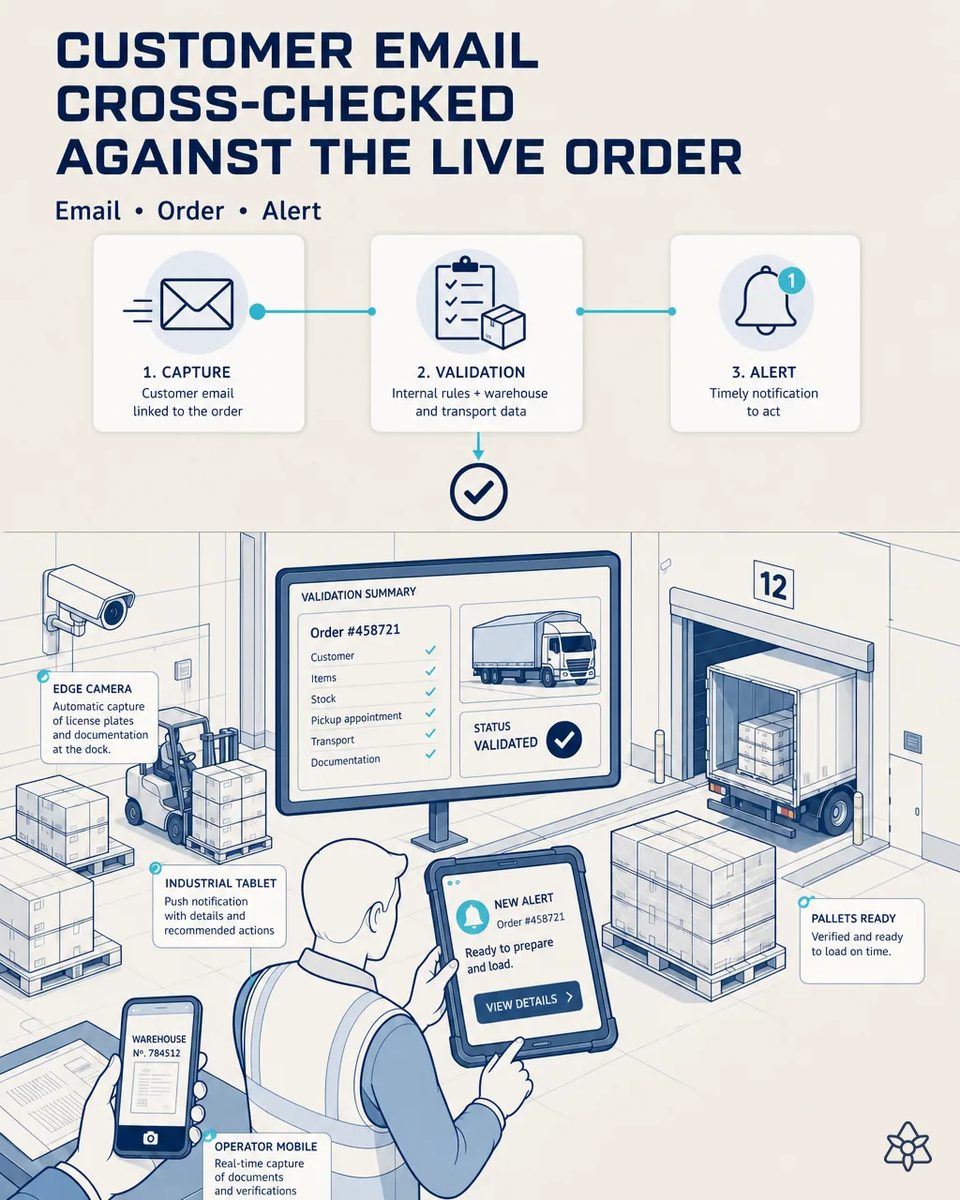
The client warned in time. The warehouse found out too late.
It lands in the account manager's inbox, who forwards it to the warehouse in the early afternoon, when the order is already wrapped with the original eight pallets. With no reaction time, the order ships wrong — back to the warehouse, reload, delay, and an unhappy client.
- A client writes to cut an order from eight pallets to five and change the delivery address. It is a legitimate, frequent request, and it usually arrives in the morning with plenty of time to act.
- It lands in the account manager's inbox, among a hundred other messages, and reaches the warehouse 2-4 hours later, forwarded with a one-line note or mentioned in a phone call.
- By then the order is picked and wrapped with the original eight pallets, the truck slot at the dock is booked and the driver is already on the way.
- With no reaction time, the order ships wrong: back to the warehouse, reload, delay and an unhappy client who did everything right and still received the wrong load.
Connect in silent-copy mode — it reads the mailbox, not the people.
The system sits silently in copy on the mailbox, detects the alert, extracts intent and entities, and cross-references it with the live order in the ERP/WMS. "Adjust order PED-4471 to 5 pallets and change destination; there's still time before load cutoff" — not just "you got an email".
The value is not in noticing that an email arrived; everyone already gets notifications. It is in saying what to do with it: which order, what changes, and whether there is still time before the load cutoff for that dock. “Adjust order PED-4471 to 5 pallets and change destination” is an instruction a shipping lead can act on in a minute; a forwarded email is not.
Today's client alert versus the cross-checked alert
| Aspect | Today | With iLEAN Connect |
|---|---|---|
| Time to reach the warehouse | 2-4 hours | Seconds |
| What the warehouse receives | A forwarded email | The concrete action on the order |
| Link to the live order | Someone looks it up | Crossed with the ERP/WMS automatically |
| Load cutoff | Unknown to whoever reads it | Stated in the alert |
| Change after wrapping | Unwrap, reload, delay | Caught before picking ends |
| Account manager away | The alert waits | The alert does not depend on them |
Before: the customer's alert takes 2-4 hours to reach someone who can act. After: the system reads it at zero-second latency and returns the concrete action.
Impact estimate — to be validated with your numbers.
The block below is an estimate to be validated against your plant's actual data. We put it forward so the committee has an order of magnitude; we refine it during the assessment.
- Estimated payback 3-7 months, depending on how many order changes arrive by email each week.
- From 2-4 hours of human latency to seconds between the client's email and the person at the dock who can act on it.
- Fewer partial reloads and avoidable returns caused by changes that arrived in time but were read late.
- And no truck leaving with the wrong load or destination, which is the most expensive version of the same email: freight, redelivery and a client relationship to repair.
Payback 3-7 months · from 2-4h of human latency to seconds. It avoids partial reloads, avoidable returns, and the cost of a truck leaving with the wrong load or destination.
And the fair question from the production manager
“What if it misreads the client's request and changes the wrong order?” — extracting intent, order number and quantities from an email and checking them against an existing order is an anchored task, where the best models drop below 1.5% error [1]. And it changes nothing on its own: it proposes the action and the shipping supervisor confirms it on the tablet before the order is touched. When the proposal is rejected or edited, that correction is kept and used to improve the next extraction for that client.
[1] OpenAI paper "Why Language Models Hallucinate", 2025 — on the reliability of AI in anchored tasks.
What people ask about reading client emails
Does it read every email in the company?
No. It sits in copy only on the mailboxes and addresses you choose, typically order desks and account managers, and ignores what is not about an active order. The scope is agreed with you before deployment and can be narrowed at any time.
What if the client does not quote the order number?
It matches by client, destination, date and reference against the open orders. If more than one order fits, it asks a person instead of guessing, because a wrong match is worse than a slow one. Over time it learns how each client refers to their own orders, which reduces those questions.
Does it modify the order in the WMS by itself?
No. It proposes the change and a person confirms it. The order only changes after that confirmation, and the confirmation is recorded with its author. That record is what you show the client when they ask what was done with their request.
What happens if the change arrives after load cutoff?
The alert says so explicitly, so the supervisor can decide whether to hold the truck, split the load or call the client, instead of discovering the change after departure. Knowing it at once is what turns a wrong shipment into a managed one.
Does it handle attachments such as revised order spreadsheets?
Yes, the attachment is read like the body of the email and its lines are compared with the live order, so a revised quantity buried in a file is not missed. The same applies to PDFs of revised orders that some clients send instead of writing the change.
More cases from this series
- The delivery note that doesn't waitOne photo of the delivery note and lot labels digitizes receiving in seconds. Up to -70% on…
- The scale that finally talks to the central systemAn external camera digitizes the dock scale reading. Every shipment's weight gets traced without…
- Hands-free between aisles, knowledge that doesn't get lostThe supervisor dictates issues while walking between warehouses and docks. iLEAN listens, structures and…
- The spreadsheet that stops being copied by handiLEAN reads the stock and location spreadsheet in real time and, after validation, pushes it into the…
- GPS stitched to the ERP: the ETA that updates itselfEvery truck's position and ETA flow automatically from the GPS into the ERP and the customer portal,…
- Paper picking sheet, digital data at zero-second latencyThe paper picking sheet gets photographed and enters the central system at zero-second latency. No…
Tell us how many orders last month shipped wrong after the client had already warned you.
We work on your plant's real data, not ours. Assessment with no commitment.
Request estimated ROI within 48h ‹ See all cases of warehousing and transport See logistics