Paper picking sheet, digital data at zero-second latency
In any multi-client warehouse, every order is prepared following a printed picking sheet: which reference, which quantity, which location, for which client. It's the document that says, for real, what actually shipped. The picker marks it by hand while walking the aisles with the forklift, then leaves it in a tray until someone transcribes it at shift close — if there's time that same day. If there's a mismatch between what was picked and what the order called for, it usually surfaces when the client calls to complain, not before the truck leaves.
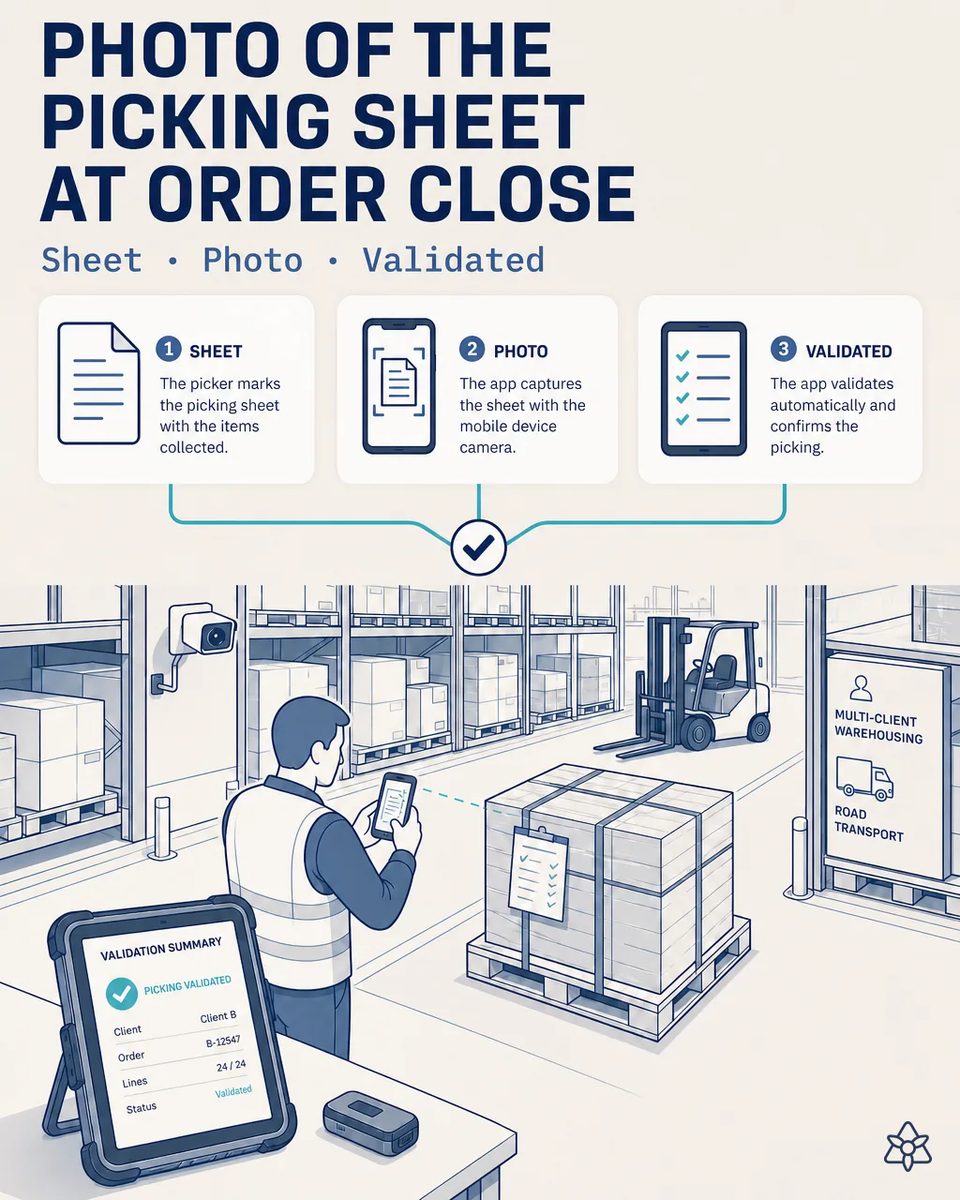
What actually shipped is written on a sheet sitting in a tray.
The picker marks it by hand while walking the aisles with the forklift, then leaves it in a tray until someone transcribes it at shift close — if there's time that same day. If there's a mismatch between what was picked and what the order called for, it usually surfaces when the client calls to complain, not before the truck leaves.
- The WMS prints the picking sheet with reference, quantity, location and client, but the picker corrects it by hand on the move: a short location, a substituted reference, a quantity split across two pallets because the first one was full.
- Those handwritten marks are the real record of what left the warehouse, and they sit in a dock tray until someone transcribes them at shift close, if there is time that same day. On a busy Friday, the tray waits until Monday.
- In a multi-client warehouse the same aisle holds goods for three or four clients with similar packaging, so a reference picked from the neighboring location is easy to make and hard to spot by eye once the pallet is wrapped.
- Between the pick and the transcription the error travels unseen: it usually surfaces when the client calls to complain, not before the truck leaves the dock, and by then the only fix is a return and a second delivery.
Connect in photo mode — the picker keeps marking the sheet exactly as before.
The picker takes a photo of the completed sheet before wrapping the pallet. An anchored LLM extracts reference, quantity, location and client from every line, and stores it centrally at zero-second latency. No new screen to learn, no process to change: they keep marking the sheet exactly as before. The only difference is that, alongside the paper, the digital record now exists instantly.
It asks the picker for one photo before wrapping the pallet, nothing else. No new screen, no scanner workflow to learn, no change to how the WMS prints the sheet. The handwritten corrections stop dying in a tray and become lines the system can check against the order while the pallet is still at the dock. That is why it is usually the first case a warehouse approves: it changes the data, not the habit.
The paper picking sheet versus the photographed picking sheet
| Aspect | Today | With iLEAN Connect |
|---|---|---|
| When the pick exists in the system | Hours later, at shift close | Zero-second latency |
| Handwritten corrections | Lost unless someone types them | Extracted line by line |
| Wrong location or reference | Found in the client's complaint | Visible before the truck leaves |
| Admin transcription time | Every order, every shift | Recovered |
| Picks per client and per warehouse | Rebuilt from the tray | Queryable by order |
| The picker's routine | — | Unchanged: one photo |
Before: the picking sheet sits in a dock tray for hours until manual transcription. After: the picking data exists in the central system at zero-second latency, the moment the photo is taken.
Impact estimate — to be validated with your numbers.
The block below is an estimate to be validated against your plant's actual data. We put it forward so the committee has an order of magnitude; we refine it during the assessment.
- Estimated payback 4-9 months, depending on the number of orders picked per day and on how many people transcribe sheets today.
- Administrative transcription time recovered at every shift close, which in a warehouse running several hundred order lines a day is a large part of one person's afternoon.
- From hours of latency to zero-second capture per order: the pick exists in central memory the moment the photo is taken.
- And the hours-long window in which a picking error travels unseen is closed before loading, which is where a mistake still costs minutes instead of a return.
Payback 4-9 months · from hours of latency to zero-second capture per order. It recovers administrative transcription time and closes the hours-long window in which a picking error travels unseen.
And the fair question from the production manager
“What if it misreads a handwritten quantity?” — reading fields from a sheet with a known layout is an anchored task, where the best models drop below 1.5% error [1]. And there is a second net: every line is checked against the order in the WMS, and any mismatch or low-confidence value goes to the dock tablet for a person to confirm before it counts. Every correction made there is stored, so the model learns the handwriting habits of your own pickers.
[1] OpenAI paper "Why Language Models Hallucinate", 2025 — on the reliability of AI in anchored tasks.
What people ask about photographing the picking sheet
Do we have to change the picking sheet format?
No. The model reads the sheet your WMS already prints, including the handwritten marks, ticks and crossed-out quantities the picker adds on the move. Changing the format is the fastest way to make pickers stop marking it.
When should the photo be taken?
When the order is complete and before the pallet is wrapped. At that moment the sheet reflects what is actually on the pallet, and there is still time to open it and correct a line without touching the truck.
Does it work when one order spans several pallets?
Yes. Each sheet is tied to its order and client, so a pick split across pallets is consolidated into one record instead of several loose pages that someone has to match later.
What happens if the pick does not match the order?
The discrepancy is flagged with the line, location and client involved, while the goods are still at the dock rather than at the client's door. The shipping lead decides whether to correct the pallet or the record.
Do pickers need a company phone?
A shared rugged phone or tablet per dock is usually enough. What matters is that the photo is a two-second gesture at the wrapping station, not a new procedure on the warehouse floor.
More cases from this series
- The customer alert that arrives before it's too lateiLEAN silently reads customer alerts and cross-checks them against the live order, with a concrete…
- The delivery note that doesn't waitOne photo of the delivery note and lot labels digitizes receiving in seconds. Up to -70% on…
- The scale that finally talks to the central systemAn external camera digitizes the dock scale reading. Every shipment's weight gets traced without…
- Hands-free between aisles, knowledge that doesn't get lostThe supervisor dictates issues while walking between warehouses and docks. iLEAN listens, structures and…
- The spreadsheet that stops being copied by handiLEAN reads the stock and location spreadsheet in real time and, after validation, pushes it into the…
- GPS stitched to the ERP: the ETA that updates itselfEvery truck's position and ETA flow automatically from the GPS into the ERP and the customer portal,…
Tell us how many hours your picking sheets wait in the tray before they exist in the WMS.
We work on your plant's real data, not ours. Assessment with no commitment.
Request estimated ROI within 48h ‹ See all cases of warehousing and transport See logistics