The finish defect that no longer reaches the customer
At real line speed, the human eye lets scratched or poorly painted cabinets through. iLEAN Edge inspects 100% of units and pulls the defective one before packing.
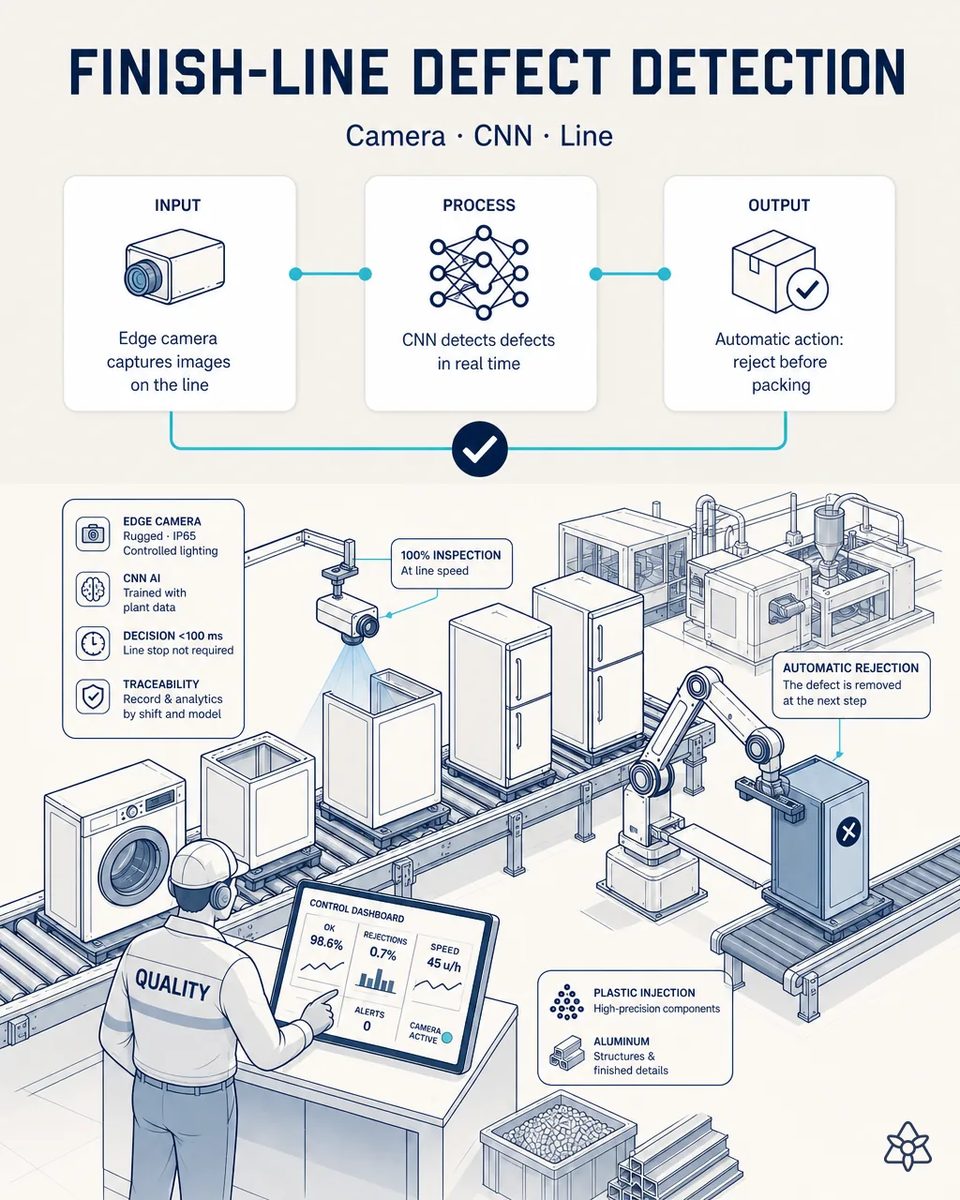
At line speed, a scratched cabinet looks like a good one.
100% human visual control is impossible at real line speed. Sample-based inspection leaves gaps that end up as warranty claims or distributor returns.
- Checking 100% of cabinets by eye is impossible at real line speed. Inspection is done by sampling, and the sample is only as good as the inspector's last hour. At the end of a ten-hour shift, that hour is not the best one.
- Scratches, dents, orange peel, runs and thin paint pass in the gaps between samples, especially at the end of a long shift or after a color change. A cabinet missed there will reach a customer's kitchen with the defect in plain sight.
- Those units come back as finish-defect claims from distributors or as warranty returns, with freight both ways and a replacement unit on top. A dented cabinet that reaches the customer's kitchen also costs a service visit and a bad review.
- And every returned cabinet costs far more than the scrap or rework it would have been on the line, before packing.
Edge — a local CNN over the line, inference in milliseconds.
Edge camera over the line + local CNN trained on good/bad examples of the specific cabinet. Millisecond inference, no cloud dependency.
The model is trained on good and bad examples of your own cabinets, under your line's lighting. It does not depend on the cloud or the plant network, so it keeps up with the conveyor and never holds it. The inspector stops sampling and starts deciding the borderline cases. That is where their experience is worth most. Their decisions on those cases are what keep improving the model.
Sampled finish checks versus 100% Edge inspection
| Aspect | Today | With iLEAN Edge |
|---|---|---|
| Cabinets inspected | A sample | Every unit |
| Where the defect is caught | At the distributor | Before packing |
| Inspector fatigue in white goods | Grows over the shift | Irrelevant to the camera |
| Decision time per cabinet | — | Milliseconds, local |
| Defect history | Anecdotes | Images by shift and model |
| Borderline finish | Passed or failed by feel | Escalated to quality |
Partial sampling → 100% unit control. Finish-defect claims → sharp reduction.
Impact estimate — to be validated with your numbers.
The block below is an estimate to be validated against your plant's actual data. We put it forward so the committee has an order of magnitude; we refine it during the assessment.
- Estimated payback 5-12 months, depending on your current rejection rate.
- From partial sampling to 100% unit control at real line speed. Every cabinet, every shift, every color. The inspector's role moves from sampling to judging the hard cases.
- A sharp reduction in finish-defect claims and returns from distributors, with the freight and replacement units they bring.
- And a defect history by shift and model that points back at the paint line or the handling step causing it. Fixing the cause upstream is worth more than catching the defect downstream.
Estimated payback 5-12 months depending on current rejection rate. *Estimate to validate*.
And the fair question from the production manager
"What if it rejects good cabinets?" — false positives are the real risk of any vision system, so the model is trained on your own cabinets and lighting, not a generic one. Classifying a known defect on a known surface is an anchored task, where the best models drop below 1.5% error [1], and borderline units go to a quality inspector rather than straight to scrap. Each decision the inspector makes feeds back into training. The camera does not replace the inspector's judgment; it replaces the sampling that today decides which cabinets nobody looks at.
[1] OpenAI paper "Why Language Models Hallucinate", 2025 — on the reliability of AI in anchored tasks.
What people ask about inspecting cabinet finish
Which finish defects can it detect?
Those you train it on with real examples: scratches, dents, orange peel, runs, thin coverage, contamination. The defect catalog is defined together with your quality team. The list starts with the defects that generate most claims today, and grows from there.
Does it slow the conveyor?
No. Inference runs locally in milliseconds per cabinet, and the reject is handled downstream without stopping the line or the packing station. A robot or a diverter pulls the cabinet; the conveyor keeps its pace.
How many defect photos do we need?
Fewer than people expect, because finish defects repeat. What matters is that they are real photos of your own cabinets, colors and surfaces. A few hundred good and bad examples per cabinet family are usually enough to start, and the model improves as the line runs.
Does it work on stainless steel and on white enamel?
Yes, with a model per surface. Reflective stainless needs its own lighting setup, which is fixed at commissioning so reflections are not read as scratches. Black glass doors and textured finishes get the same treatment. Each surface family has its own model and its own reference images.
Do the cabinet images leave the plant?
No. Inference is local at the edge, and images are stored on site for training and traceability by shift and model. Nothing goes to an external cloud, which also keeps inference independent from the plant network.
More cases from this series
- A photo of the Work Order at line startupThe line lead photographs the Work Order and the startup checklist; the assembly batch exists in the…
- The delivery note that reaches the ERP with a photo and a tapPhoto the delivery note and the resin or component batch labels; iLEAN digitizes them and pushes them to…
- The line lead's knowledge that no longer gets lostThe line lead dictates while walking between molders and assembly; iLEAN listens, structures the issue…
- The lab test spreadsheet that no longer lives on its owniLEAN absorbs the leak-tightness and vibration test spreadsheet in real time and pushes it to the ERP…
- Verify in two taps, before the data crosses into the ERPNothing iLEAN captures enters the ERP without a human confirming it with two taps. Seconds of latency,…
- The supplier alert that no longer gets lost in the inboxiLEAN reads the resin supplier's email in seconds, cross-checks it against active orders, and suggests…
Bring your real defect photos and validate the model on your own product.
We work on your plant's real data, not ours. Assessment with no commitment.
Request estimated ROI within 48h ‹ See all cases of white goods See home appliances