The line lead's knowledge that no longer gets lost
The molding line lead walks the whole shift with both hands busy. With a Bluetooth headset and Connect voice mode, they dictate an issue on the move and iLEAN structures it and replies in seconds.
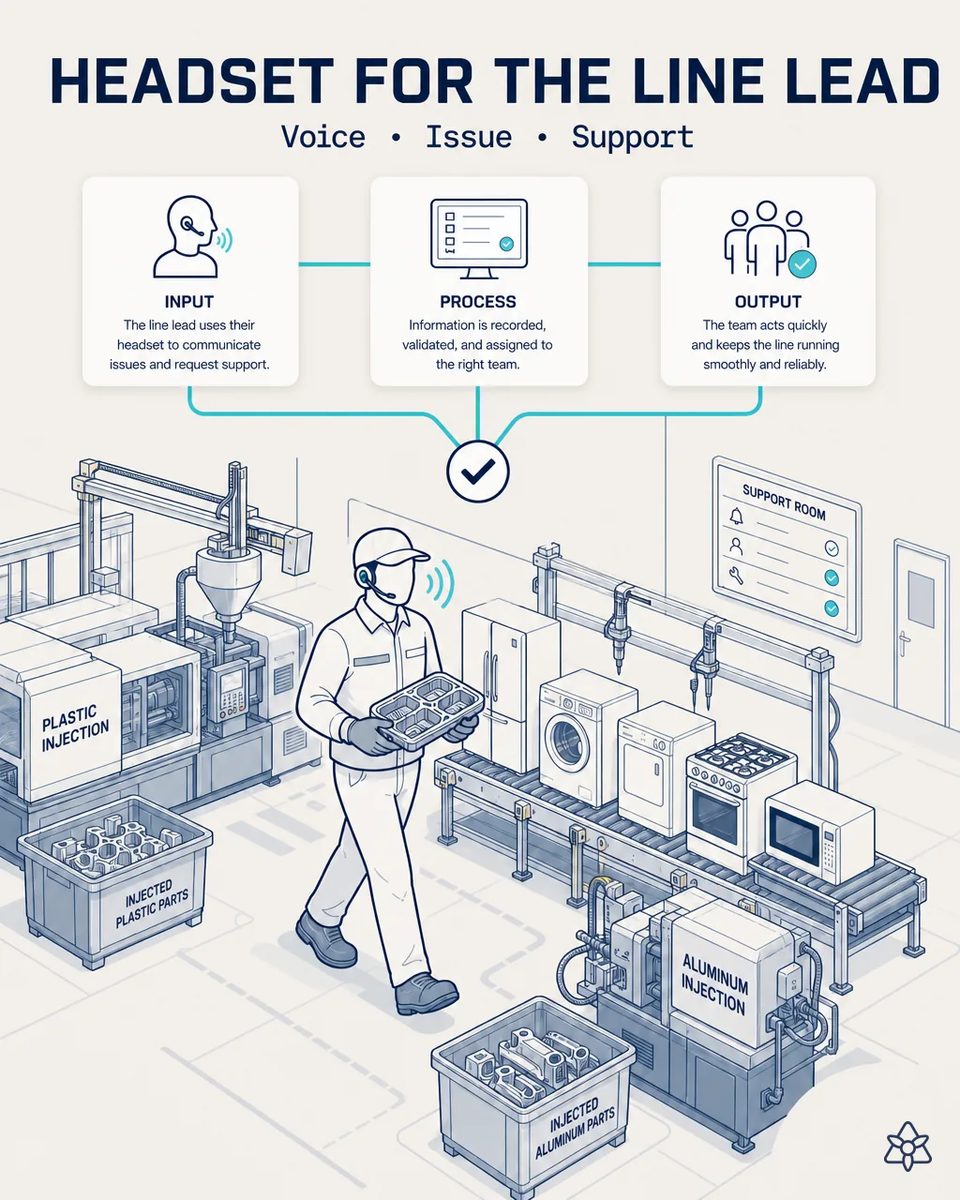
What the line lead knows is gone by the next shift.
Critical knowledge the line lead carries in their head — more rejects on a molder after a batch change, a new operator who needs backup — dies at shift end because they can't type.
- The molding line lead walks between molders and the assembly line the whole shift, carrying parts, adjusting, solving. Both hands are always busy, and there is no terminal on the way.
- They notice what no system records: a molder throwing more rejects since the last resin batch, a door-liner mold that needs a touch every two hours, a new operator who needs backup on the dryer drum cell.
- None of it is written down, because writing means stopping and walking to a terminal in the middle of a problem.
- At shift end that knowledge dies in a two-minute handover, and the next lead rediscovers the same problem from scratch, sometimes the same night. New operators pay the price, because nobody tells them what the last shift learned.
Connect in voice mode — a wake word, then the line lead just talks.
Custom wake-word, an LLM that structures the dictation as an issue linked to the active machine, order and shift. Feedback by voice or as a push to the supervisor's tablet.
It only records what the line lead decides to say, when they decide to say it. That boundary is what keeps the headset in use after the first month: it is a tool for them, not a tool on them. And what they say stops depending on their memory at 6 a.m.
The line lead's shift today versus the shift on record
| Aspect | Today | With iLEAN Connect |
|---|---|---|
| An issue spotted at a molder | Remembered, maybe | Dictated in seconds on the move |
| Link to machine and order | None | Automatic: active machine, order, shift |
| Reply to the line lead | — | By voice, or a push to the supervisor's tablet |
| Shift handover | Two minutes by word of mouth | A structured list of open issues |
| Rejects after a resin batch change | A hunch | A pattern with dates |
| Ordinary talk on the floor | — | Never recorded |
Knowledge that dies at shift end → enters the system in real time and gets cross-referenced with live data.
Impact estimate — to be validated with your numbers.
The block below is an estimate to be validated against your plant's actual data. We put it forward so the committee has an order of magnitude; we refine it during the assessment.
- No standalone payback: we do not put a number on it, because its value shows up in the cases it feeds, not on its own invoice.
- Strategic value for continuous improvement: shift knowledge enters the system in real time and is crossed with live molder and order data.
- Scrap reduction when a recurring molder problem is caught as a pattern with dates instead of being solved again every shift.
- To be sized together with your continuous-improvement lead, against the issues that get lost today at handover. A month of dictated issues is usually enough to see where the value lies.
Strategic value for continuous improvement and scrap reduction. *Estimate to validate* with the continuous-improvement lead.
And the fair question from the production manager
"Will it understand dictation next to a molder at full noise?" — recognition is prepared for industrial noise and trade vocabulary, and turning a short dictation into machine, symptom and order is an anchored task where the best models drop below 1.5% error [1]. Every structured issue is played back or shown on the tablet, so the line lead corrects it in one sentence if something was misheard. Nothing goes into the record that they have not heard back.
[1] OpenAI paper "Why Language Models Hallucinate", 2025 — on the reliability of AI in anchored tasks.
What people ask about dictating issues on the molding floor
Is the headset listening all shift?
No. It only records after the wake word, which is chosen for your plant. Everything else said on the floor is never captured or stored. That limit is what makes the line team accept it in the first place.
Does the line lead have to say the molder number every time?
Not necessarily. If the active order or the machine is clear from context, it is filled in, and the summary shows it so the line lead can confirm. Saying the machine name is still the fastest way when they are between two molders.
Does it work with hearing protection?
Yes. The headset is chosen to be compatible with ear protection, which is standard in a molding area, and the microphone is designed for that noise.
Who receives what the line lead dictates?
The supervisor on their tablet, and whoever owns that kind of issue: maintenance for a molder fault, quality for a reject pattern, planning for a material problem. Each issue lands with the person who can actually close it, not in a general inbox.
Why deploy a headset that does not pay for itself?
Because it fills the other cases with what only a person on the floor sees. Without it, the rest of the matrix only knows what machines and documents say. The line lead is the only sensor that understands why a molder is acting up.
More cases from this series
- A photo of the Work Order at line startupThe line lead photographs the Work Order and the startup checklist; the assembly batch exists in the…
- The delivery note that reaches the ERP with a photo and a tapPhoto the delivery note and the resin or component batch labels; iLEAN digitizes them and pushes them to…
- The lab test spreadsheet that no longer lives on its owniLEAN absorbs the leak-tightness and vibration test spreadsheet in real time and pushes it to the ERP…
- Verify in two taps, before the data crosses into the ERPNothing iLEAN captures enters the ERP without a human confirming it with two taps. Seconds of latency,…
- The supplier alert that no longer gets lost in the inboxiLEAN reads the resin supplier's email in seconds, cross-checks it against active orders, and suggests…
- The serial-number labeler that no longer depends on typingSerial number and warranty print automatically from the ERP, with no manual typing on the labeler when…
Try the headset with your line team for one shift.
We work on your plant's real data, not ours. Assessment with no commitment.
Request estimated ROI within 48h ‹ See all cases of white goods See home appliances