The lab test spreadsheet that no longer lives on its own
The final-test lab fills in a spreadsheet every shift with leak-tightness, vibration, noise and electrical safety results. iLEAN Connect absorbs it in real time and pushes it to the ERP after human validation.
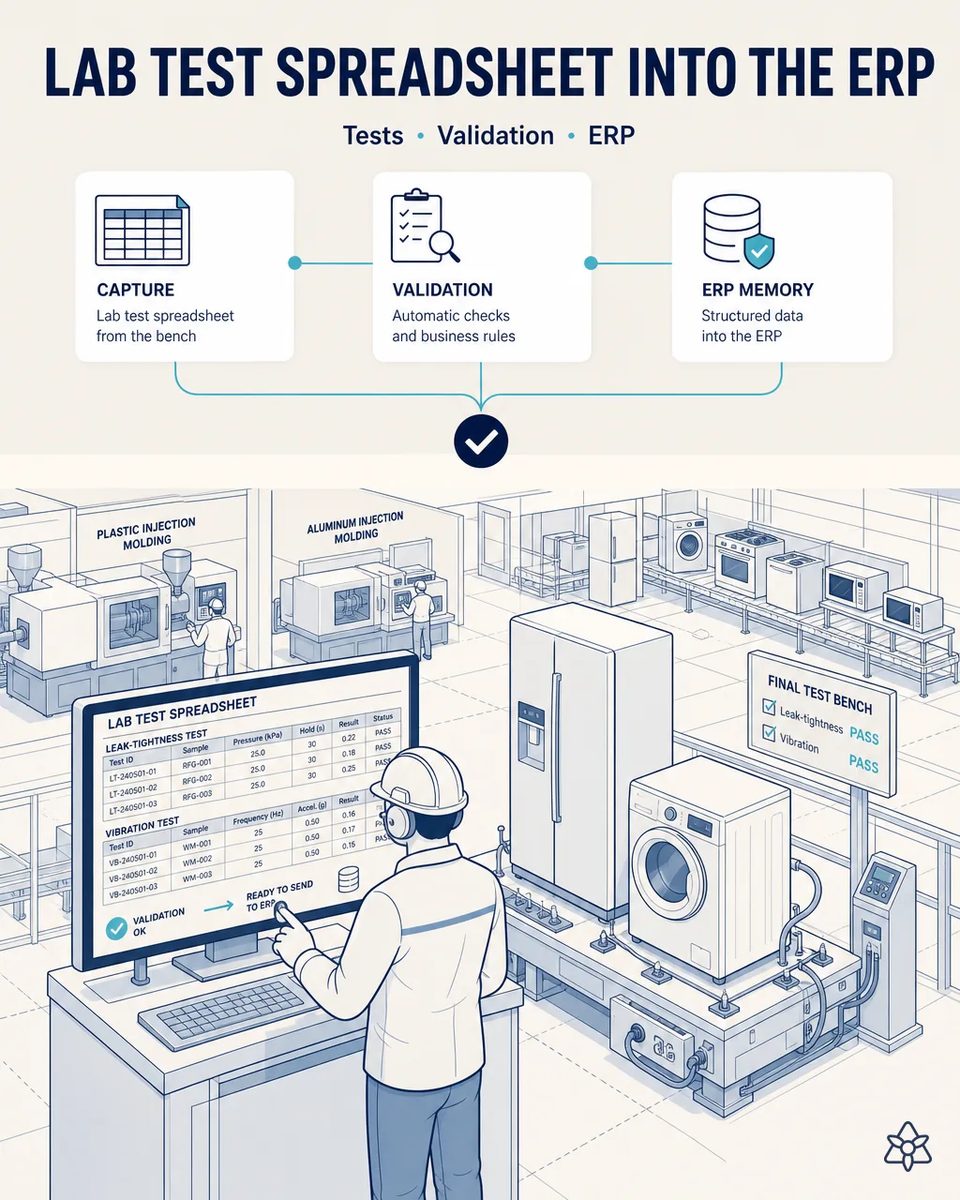
The test lab and the ERP live weeks apart.
The lab's real spreadsheet and the official ERP are two parallel worlds, with weeks of lag from manual transcription and copy-paste errors.
- Every shift, the final-test lab fills in a spreadsheet: refrigerant circuit leak-tightness, washer vibration and spin noise, dielectric strength and ground continuity.
- That spreadsheet is the real record. The ERP gets a transcribed copy weeks later, with the copy-and-paste errors that come with it and the gaps nobody notices.
- When a distributor reports a noisy washer batch, the quality engineer opens the spreadsheet, not the ERP — because the ERP is not up to date.
- And several people keep an ERP quality-module license only to type in those results, month after month. Their time goes into typing, not into analyzing why a batch of washers is louder than the last one.
Connect listening inward — it reads the file, not the person.
Connect "listens inward", reads the file's delta when it's saved, parses it with an anchored LLM, and after the quality supervisor validates it, pushes it into the ERP via API.
The lab keeps its spreadsheet exactly as it is. What changes is that the official system stops lagging behind it, and the licenses paid only to copy results into the ERP stop being necessary. The test result is in the ERP the same shift it was measured. A distributor complaint can then be answered with data from the ERP, by batch and by test.
The test spreadsheet today versus the connected spreadsheet
| Aspect | Today | With iLEAN Connect |
|---|---|---|
| Lag between lab and ERP | Weeks | Second zero after validation |
| Hours per month transcribing | Several, every month | Zero |
| Noisy washer batch complaint | Answered from the spreadsheet | Answered from the ERP |
| Spreadsheet format | Must be respected | Read as it is, even as it changes |
| Who validates before the push | Nobody, it is just copied | The quality supervisor |
| Quality-module licenses | One per person typing | Only the one who validates |
Weeks of lag → zero seconds. Hours per month transcribing → zero.
Impact estimate — to be validated with your numbers.
The block below is an estimate to be validated against your plant's actual data. We put it forward so the committee has an order of magnitude; we refine it during the assessment.
- Estimated payback 4-9 months, to be checked against your current ERP license invoice.
- CFO angle: a typical 50-80% reduction in quality and lab-module licenses, because whoever logs in only to type results stops needing to.
- From weeks of lag to zero seconds between the test bench and the ERP, once the supervisor validates.
- Hours of transcription per month brought to zero, along with the copy errors that came with them. The test technician spends that time on the bench, not at the keyboard.
Typical 50-80% reduction in quality/lab-module licenses, estimated payback 4-9 months. *Estimate to validate*.
And the fair question from the production manager
"That spreadsheet has been edited by five people over the years — does it hold up?" — that is the expected case. Parsing does not rely on fixed cells: it interprets columns, units, merged cells and notes as they are, which is an anchored task where the best models drop below 1.5% error [1]. And nothing reaches the ERP until the quality supervisor validates it. A value outside its physical range, such as a negative leak rate, is flagged instead of pushed.
[1] OpenAI paper "Why Language Models Hallucinate", 2025 — on the reliability of AI in anchored tasks.
What people ask about the final-test lab spreadsheet
Does the final-test lab have to redesign its leak and vibration sheet?
No. Asking the lab to change format is the quickest way to make it stop using the system. iLEAN reads the one it already has, in the format it has today. The lab's habits are the reason the spreadsheet works, so they are left alone. The technicians keep working exactly as they did yesterday.
Which tests does it cover?
Whatever goes into the spreadsheet: leak-tightness of the sealed system, vibration, noise, dielectric strength, ground continuity. The structure is learned at commissioning. If a new test is added as a column, the next save already carries it. No one has to reconfigure anything when the lab changes its sheet.
When exactly is the file read?
When it is saved. Only the change since the last save is processed, so a sheet with years of history is not reread every time someone adds a row. A result saved at the end of a test run is in the validation queue seconds later.
Which ERP licenses stop being needed?
Those of people who log into the quality module only to enter results. That is why it is framed as an estimate to check against your actual ERP invoice. The supervisor who validates keeps a license; the people who only typed results no longer need one.
Does it track who opens the file?
No. It reads the file on save; there is no tracking of who edits it, when they open it or how long they spend on it. What matters is the result, not the person behind it. Access to the file stays exactly as your IT team set it.
More cases from this series
- A photo of the Work Order at line startupThe line lead photographs the Work Order and the startup checklist; the assembly batch exists in the…
- The delivery note that reaches the ERP with a photo and a tapPhoto the delivery note and the resin or component batch labels; iLEAN digitizes them and pushes them to…
- The line lead's knowledge that no longer gets lostThe line lead dictates while walking between molders and assembly; iLEAN listens, structures the issue…
- Verify in two taps, before the data crosses into the ERPNothing iLEAN captures enters the ERP without a human confirming it with two taps. Seconds of latency,…
- The supplier alert that no longer gets lost in the inboxiLEAN reads the resin supplier's email in seconds, cross-checks it against active orders, and suggests…
- The serial-number labeler that no longer depends on typingSerial number and warranty print automatically from the ERP, with no manual typing on the labeler when…
Calculate how much you would save on quality-module ERP licenses.
We work on your plant's real data, not ours. Assessment with no commitment.
Request estimated ROI within 48h ‹ See all cases of white goods See home appliances