The delivery note that reaches the ERP with a photo and a tap
The truck arrives with resin, sheet metal or compressors. With a photo of the delivery note and the batch labels, iLEAN Connect digitizes everything and inserts it into the ERP after one validation tap.
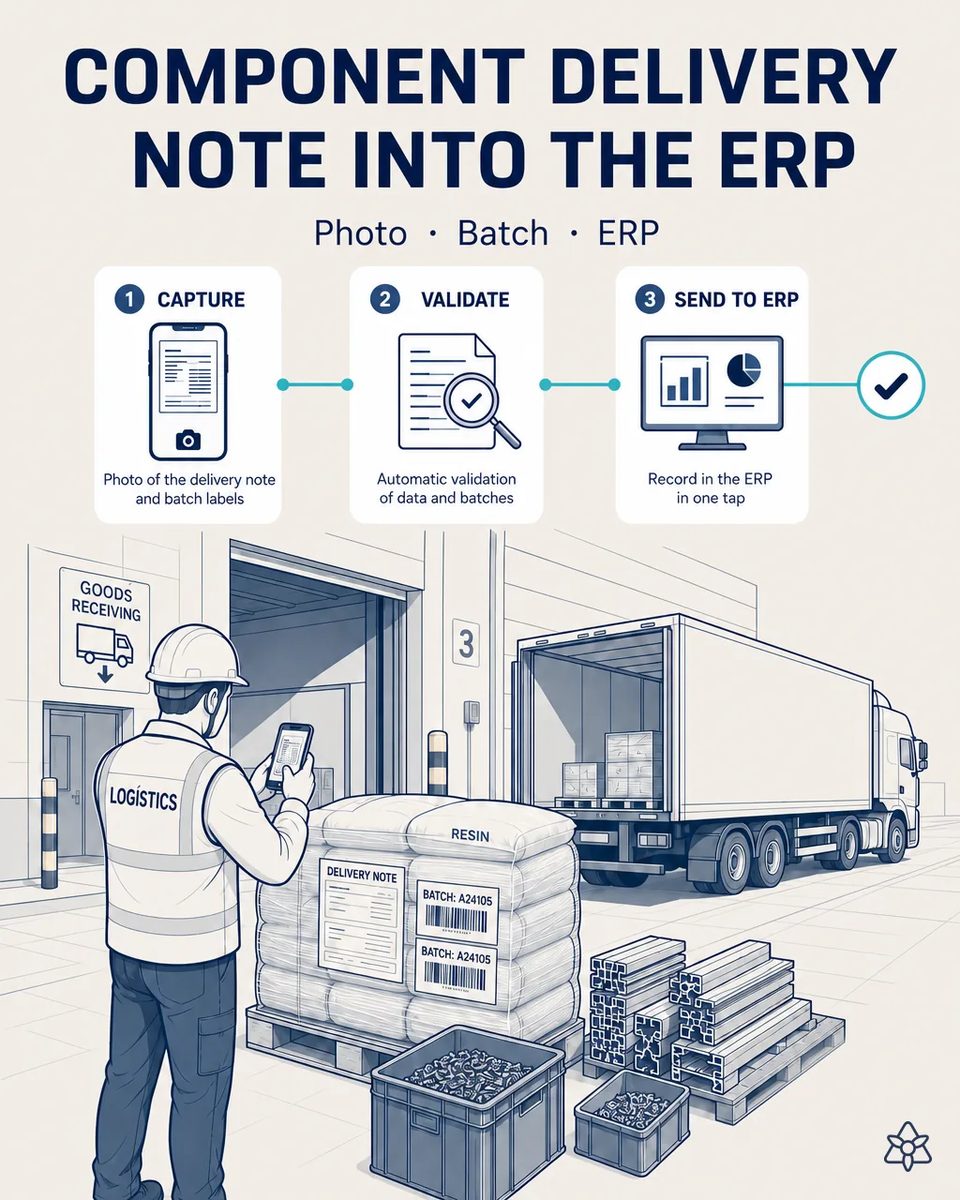
Traceability for a warranty return starts at the receiving dock.
The receiving supervisor types dozens of ERP lines while the truck racks up demurrage. If they rush, batches get mis-entered and surface weeks later in a warranty return with no clear traceability.
- The truck arrives with resin bags, pre-painted sheet metal coils, compressors or control boards. Each delivery note has dozens of lines and each pallet its own batch label.
- The receiving supervisor types it all into the ERP while the truck racks up demurrage at the dock and the next one waits outside. On a busy morning, the receiving office becomes the plant's bottleneck.
- If they rush, a compressor batch gets entered against the wrong line, or two batches get merged into one, and nobody notices. The ERP accepts it, because the number is valid; it is just the wrong one.
- It surfaces weeks or months later in a warranty return with no clear traceability: the field failure exists, the batch it came from does not.
Connect in photo mode — delivery note and pallet labels, no supplier changes.
Vision AI recognizes the delivery-note format without asking the supplier to change it, plus the GS1-128/QR/barcode labels on each pallet. One-tap validation on an industrial tablet.
The supplier keeps its delivery note and the plant keeps its labels. What changes is that the batch of every compressor and every resin bag enters the ERP correctly the first time, which is the first link of any warranty investigation. The truck leaves in minutes.
Receiving today versus receiving with a photo
| Aspect | Today | With iLEAN Connect |
|---|---|---|
| Truck time at the dock | Long, with demurrage | Minutes |
| Batch entry errors | Hidden until a warranty return | Zero, caught at the tablet |
| Pallet labels | Read and retyped | GS1-128, QR or barcode read from the photo |
| Supplier's delivery note format | Has to be learned by each typist | Recognized as it is |
| Compressor batch to appliance | Broken link | Complete via photo and GS1 |
| Receiving-module licenses in white goods | Several | Only the one who validates |
Long carrier demurrage → minutes. Hidden batch errors → zero. Broken traceability → complete via photo and GS1.
Impact estimate — to be validated with your numbers.
The block below is an estimate to be validated against your plant's actual data. We put it forward so the committee has an order of magnitude; we refine it during the assessment.
- Estimated payback 3-8 months, depending on the number of trucks per day.
- CFO angle: a typical 50-70% reduction in receiving and warehouse-module licenses, recurring every year. The license logic is the same as in the lab: whoever only typed stops needing access.
- Carrier demurrage cut from long waits to minutes per truck.
- Hidden batch errors at zero, and traceability complete from the dock to the finished appliance. A warranty claim on a compressor can be traced back to the truck it arrived on.
Typical 50-70% reduction in receiving/warehouse-module licenses, estimated payback 3-8 months. *Estimate to validate*.
And the fair question from the production manager
"We have thirty suppliers, each with its own delivery note — will it read them all?" — yes, without templates per supplier: reading lines, quantities and batches from a delivery note is an anchored task where the best models drop below 1.5% error [1]. Pallet labels are read by their GS1-128, QR or barcode symbology where present, and the supervisor validates with one tap before anything enters the ERP. Low-confidence fields are highlighted so the supervisor looks exactly where it matters.
[1] OpenAI paper "Why Language Models Hallucinate", 2025 — on the reliability of AI in anchored tasks.
What people ask about receiving components with a photo
Do suppliers have to change their delivery notes?
No. The model recognizes each format as it comes. Asking thirty resin, sheet metal and component suppliers to change is exactly what makes these projects stall. Each new supplier format is recognized from its first delivery note, with no setup on their side.
What if the delivery note and the compressor pallet labels disagree?
The mismatch is highlighted on the tablet before validation. Today nobody makes that check with a truck waiting at the dock and the driver in a hurry. A compressor pallet labeled with one batch and declared with another is exactly the error that breaks traceability.
Does it check the delivery against the purchase order?
Yes, when connected to the ERP: quantities and materials are compared with the open order and differences are shown before the receipt is booked. Short or over deliveries are flagged before anyone signs for them. The supplier's claim process starts with evidence, not with a phone call.
Do we need handheld barcode guns at the dock?
No. A photo from a phone or an industrial tablet is enough. If you already have scanners that work well, they can still be used alongside. The photo also keeps the delivery note image linked to the receipt for later questions. That image answers most supplier disputes on its own.
Can receiving be the first case we deploy?
Yes. It shows results from the first truck and does not depend on any other case being in place, which makes it a common starting point. It also feeds ring 1 of the flagship from day one.
More cases from this series
- A photo of the Work Order at line startupThe line lead photographs the Work Order and the startup checklist; the assembly batch exists in the…
- The line lead's knowledge that no longer gets lostThe line lead dictates while walking between molders and assembly; iLEAN listens, structures the issue…
- The lab test spreadsheet that no longer lives on its owniLEAN absorbs the leak-tightness and vibration test spreadsheet in real time and pushes it to the ERP…
- Verify in two taps, before the data crosses into the ERPNothing iLEAN captures enters the ERP without a human confirming it with two taps. Seconds of latency,…
- The supplier alert that no longer gets lost in the inboxiLEAN reads the resin supplier's email in seconds, cross-checks it against active orders, and suggests…
- The serial-number labeler that no longer depends on typingSerial number and warranty print automatically from the ERP, with no manual typing on the labeler when…
Send us one of your real delivery notes and see it read in a demo.
We work on your plant's real data, not ours. Assessment with no commitment.
Request estimated ROI within 48h ‹ See all cases of white goods See home appliances