The serial-number labeler that no longer depends on typing
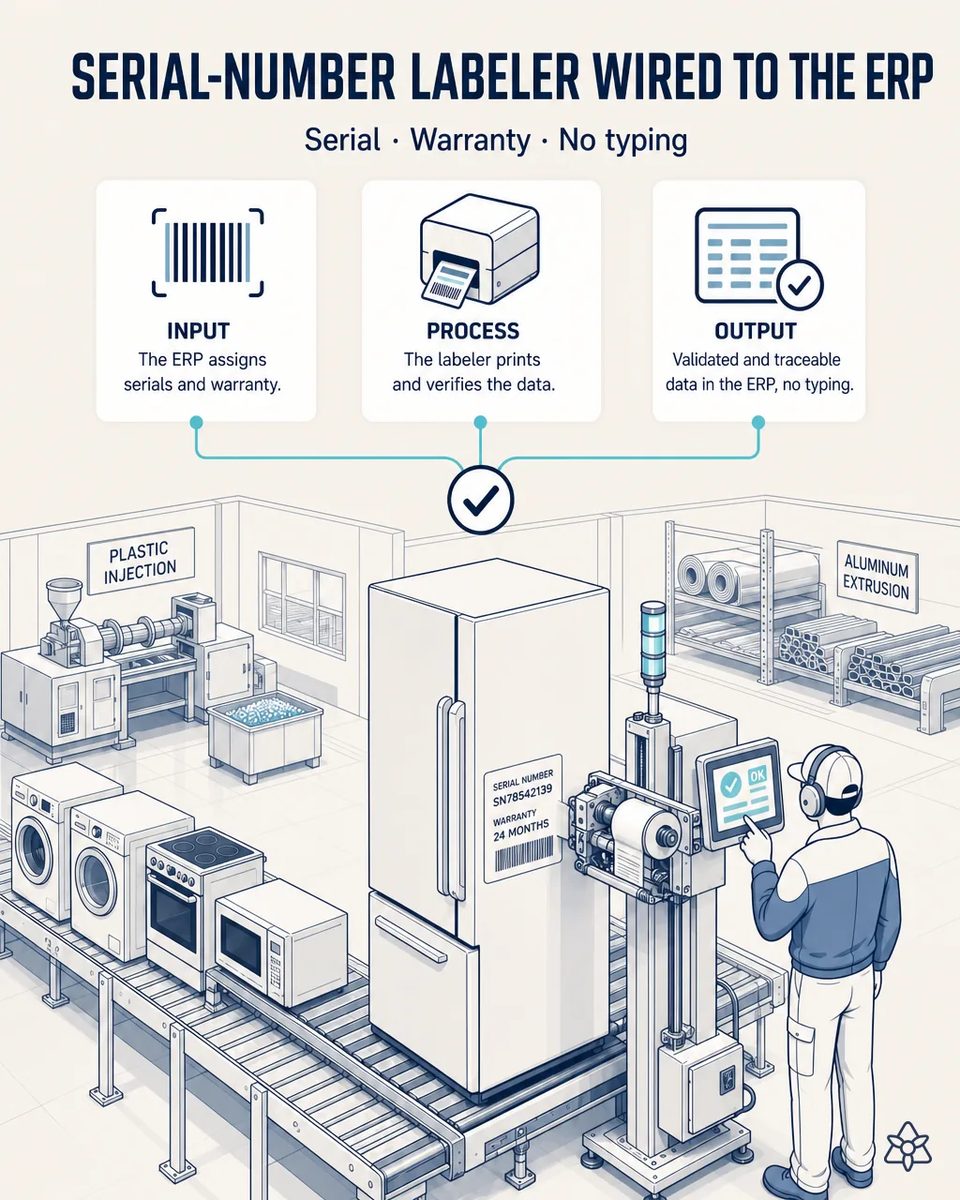
The serial-number and warranty label is the last piece before the customer. With iLEAN Connect, the labeler is wired bidirectionally to the ERP: model, critical batch and date travel automatically.
The last piece before the customer is typed by hand.
The labeler has an API but sits isolated from the ERP; every order change means someone manually types the serial-number range. A mistake there means misassigned warranty or traceability.
- The serial-number and warranty label is what the end customer, the service technician and the warranty department will read for years after the appliance leaves the plant.
- The labeler has an API, but it sits isolated from the ERP. Every order change means someone types the serial range, the model and the date on its panel.
- One wrong digit and a batch of refrigerators carries serials that belong to another model, or warranty dates that do not match the production date.
- That shows up when a warranty claim cannot be matched to its production batch, or when a recall cannot tell which units are affected and has to be widened. The label is small; the cost of an error on it is not.
Connect wires the labeler to the ERP — one tap when the order changes.
When the ERP marks a new order active, it automatically publishes model, critical-component batch and date to the labeler via API. A new order means one tap in the ERP.
The data the ERP already has stops being typed a second time. When the order changes, model, critical-component batch and date travel on their own, so the label on the cabinet is the one the order says. It is one of the cheapest cases in the matrix and one of the fastest to pay back. The operator stops being the link between two systems that already know how to talk.
The isolated labeler versus the labeler wired to the ERP
| Aspect | Today | With iLEAN Connect |
|---|---|---|
| Serial range at model change | Typed on the panel | Published from the ERP |
| Critical-component batch on label | Often missing | Printed with every unit |
| Warranty start date | Set by hand | Taken from the order |
| Serial-number typing errors | Some every month | Zero of human origin |
| Order change | Minutes at the panel | One tap in the ERP |
| Labeler or ERP replaced | — | Neither |
Monthly serial-number typing errors → zero human-origin labeling error.
Impact estimate — to be validated with your numbers.
The block below is an estimate to be validated against your plant's actual data. We put it forward so the committee has an order of magnitude; we refine it during the assessment.
- Estimated payback 3-6 months, one of the fastest in the matrix.
- Monthly serial-number typing errors go to zero errors of human origin.
- Every unit carries its critical-component batch, so a warranty claim can be traced back to production without guesswork.
- And if a recall ever happens, the affected serial range is a query, not an estimate widened as a precaution. The warranty department also stops chasing serials that do not match any production record.
Fast payback, 3-6 months. *Estimate to validate*.
And the fair question from the production manager
"Isn't a full ERP-labeler integration project the clean way?" — it is, on the day it reaches the top of the IT list, which is why the labeler is still isolated. This uses the API both already have and replaces neither. Where data is read rather than published — confirming what was actually printed — it is an anchored task where the best models drop below 1.5% error [1]. The operator still sees the new range on the labeler screen before the first label of the order prints.
[1] OpenAI paper "Why Language Models Hallucinate", 2025 — on the reliability of AI in anchored tasks.
What people ask about wiring the serial-number labeler
How do we know if our labeler has the API we need?
Most industrial labelers sold in the last ten years have one. We check the model and firmware with you before committing to anything, usually in one call. If it does not have one, we tell you before anything else is discussed.
Does it print the compressor or motor batch on the label?
Yes, if the order carries it. That field is what links a warranty claim to the production batch years later, when the service technician reads the plate. It is the field that turns a vague recall into a bounded serial range.
What happens to labels already printed when the order changes?
Pending labels from the previous order are flagged before the new range starts, so two serial ranges never get mixed on the same pallet. The operator sees the change on the labeler screen before the first new label prints.
Does it confirm what was actually printed?
Yes. What comes back to the ERP is what the labeler reports having printed, not just what was requested, so a failed print is visible. That confirmation is what turns the label into evidence for the warranty file.
Can it handle different label layouts per export market?
Yes. The layout lives in the labeler as it does today; what travels from the ERP is only the data that fills it. Export markets with their own warranty terms simply receive different values from the ERP order.
More cases from this series
- A photo of the Work Order at line startupThe line lead photographs the Work Order and the startup checklist; the assembly batch exists in the…
- The delivery note that reaches the ERP with a photo and a tapPhoto the delivery note and the resin or component batch labels; iLEAN digitizes them and pushes them to…
- The line lead's knowledge that no longer gets lostThe line lead dictates while walking between molders and assembly; iLEAN listens, structures the issue…
- The lab test spreadsheet that no longer lives on its owniLEAN absorbs the leak-tightness and vibration test spreadsheet in real time and pushes it to the ERP…
- Verify in two taps, before the data crosses into the ERPNothing iLEAN captures enters the ERP without a human confirming it with two taps. Seconds of latency,…
- The supplier alert that no longer gets lost in the inboxiLEAN reads the resin supplier's email in seconds, cross-checks it against active orders, and suggests…
Check with us whether your labeler already has the API you need.
We work on your plant's real data, not ours. Assessment with no commitment.
Request estimated ROI within 48h ‹ See all cases of white goods See home appliances