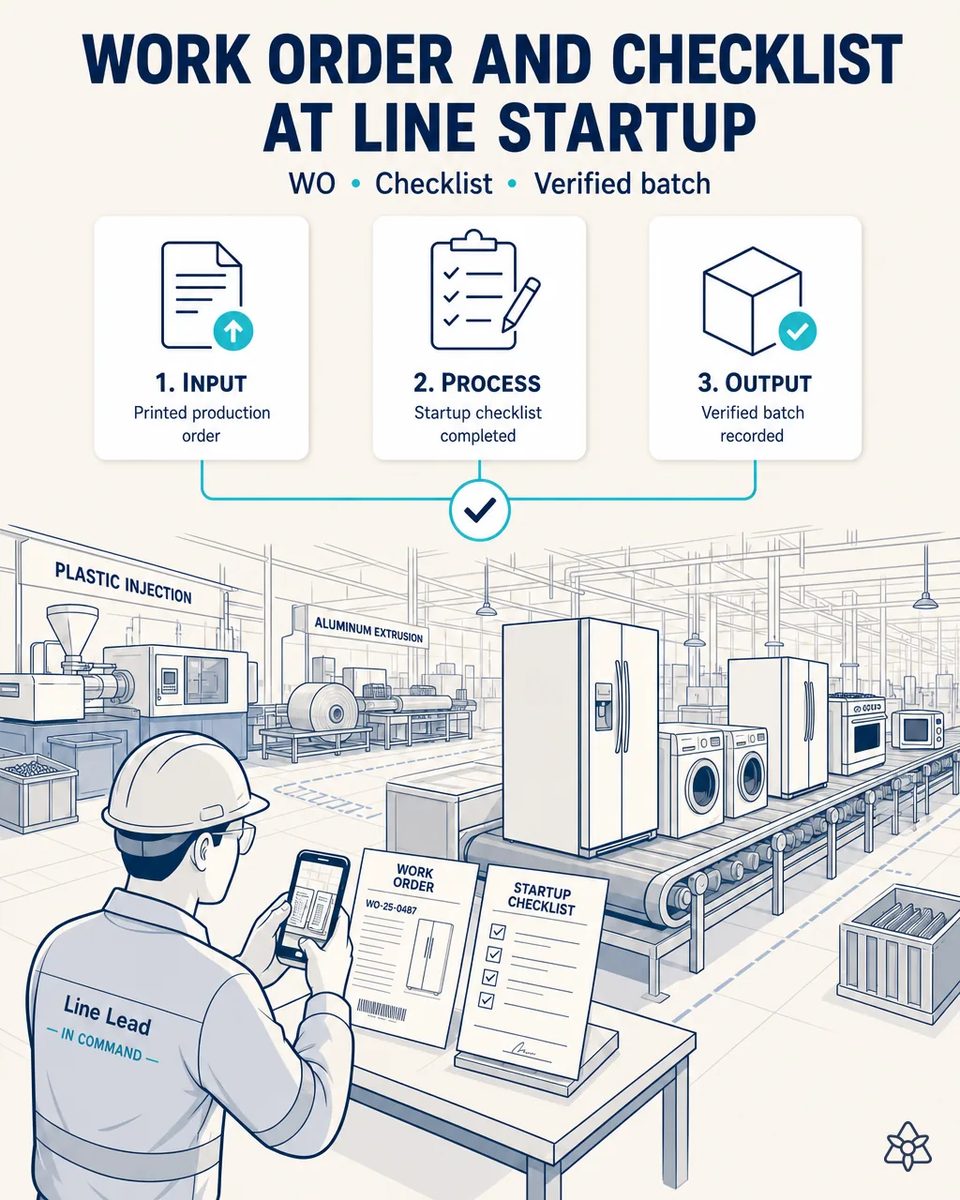
A photo of the Work Order at line startup
In a white-goods factory, every line starts its shift with a printed Work Order and a startup checklist filled in by hand. With iLEAN Connect, two phone photos are enough for that batch to exist in the central system in zero seconds, without changing anyone's routine.
The batch that went into each line is rebuilt at the end of the day.
The Work Order and startup checklist — model, compressor or motor batch, reference torque — are printed from the ERP, but any shift-change note is handwritten and can take hours to get digitized, if it ever does before the shift ends. By day's end, someone has to reconstruct which batch went into which line.
- The Work Order prints from the ERP with the model, the compressor or motor batch and the reference torque for the door hinges and the drum bearing. That part is clean, because the ERP generated it.
- The trouble starts at shift change: a compressor pallet swapped mid-run, a torque adjusted on a screwdriver, a door-gasket reel replaced, a control board batch that arrived late. All of it is written by hand on the startup checklist.
- Those notes take four to eight hours to be typed in, if they are typed before the shift ends at all. Over a weekend, the gap grows to two days.
- By the end of the day someone has to reconstruct which compressor batch went into which washer or refrigerator line — exactly the record a warranty return will ask for months later, when nobody remembers the shift.
Connect in photo mode — the line lead keeps the printed Work Order.
Connect photo mode recognizes the document with an anchored LLM, extracts model, critical-component batch and torque, and stores it in central memory. Before it crosses into the system, the supervisor confirms it with two taps on the line tablet (early human verification).
Nothing changes in the startup routine except a phone photo of two papers that already exist. That is why it is usually the first case a white-goods plant approves: it asks the line for nothing, it needs no integration on day one, and it gives the quality team the batch per line from minute one instead of at the end of the shift.
Line startup on paper versus line startup on record
| Aspect | Today, on paper | With iLEAN Connect |
|---|---|---|
| Digitization latency | 4-8 hours, or never | Second zero after the two taps |
| Compressor or motor batch per line | Rebuilt at end of day | Queryable by batch on the web |
| Shift-change note | Handwritten in the margin | Extracted and tied to the Work Order |
| Reference torque used | On the printout only | Stored with the batch |
| Warranty return months later | Search through folders | One lookup by serial range |
| Line lead's routine | — | Same papers, one photo more |
4-8 hours of digitization latency → zero seconds. Manual end-of-shift reconstruction → instant web lookup by batch.
Impact estimate — to be validated with your numbers.
The block below is an estimate to be validated against your plant's actual data. We put it forward so the committee has an order of magnitude; we refine it during the assessment.
- Estimated payback 4-9 months, depending on the number of lines and shifts you run.
- From 4-8 hours of digitization latency down to zero seconds once the supervisor confirms the summary on the line tablet.
- The manual end-of-shift reconstruction of which batch went where becomes an instant web lookup by batch, available to quality, planning and after-sales.
- Hours of supervisor and quality time recovered every week, line by line — time that today goes into copying papers instead of solving the line's problems.
Estimated payback 4-9 months depending on line/shift volume. *Estimate to validate*.
And the fair question from the production manager
"What if it reads the compressor batch wrong?" — pulling model, batch and torque from a Work Order with a known layout is an anchored task, where the best models drop below 1.5% error [1]. And there is a second net: before anything crosses into the system, the supervisor sees the summary on the line tablet and confirms or corrects it with two taps. A wrong batch never reaches the record unseen.
[1] OpenAI paper "Why Language Models Hallucinate", 2025 — on the reliability of AI in anchored tasks.
What people ask about capturing assembly line startup
Do we have to change the Work Order or the startup checklist?
No. Both stay exactly as they are printed today. The photo reads the existing layout, including whatever the line lead writes by hand in the margin, which is usually the most useful part. It is where the line lead writes what actually happened, not what was planned.
Why two photos and not one?
Because the Work Order says what should be built and the checklist says what the line actually started with. The value is in having both tied to the same batch, so any difference between plan and reality is visible. A refrigerator line that started with a different compressor pallet than the order says shows up on the first day, not in a claim.
Does it capture a compressor batch swapped mid-shift?
Yes, as long as the change is noted on paper as it is today. It is extracted and linked to the units built after that moment, which is precisely what a warranty investigation needs to bound the affected range. Without it, a field failure forces you to treat the whole day's production as suspect.
Does it need ERP integration from day one?
No. Batches are stored in iLEAN's central memory from the first startup and can be looked up on the web. The push to the ERP is connected later, once the value is proven on the floor. Starting without integration is what lets a plant see results in the first week.
Does it work with the phone the line lead already carries?
Yes. Any phone with a decent camera is enough for the photo. An industrial tablet at the line is only needed for the two-tap confirmation, and it serves the other cases too.
More cases from this series
- The delivery note that reaches the ERP with a photo and a tapPhoto the delivery note and the resin or component batch labels; iLEAN digitizes them and pushes them to…
- The line lead's knowledge that no longer gets lostThe line lead dictates while walking between molders and assembly; iLEAN listens, structures the issue…
- The lab test spreadsheet that no longer lives on its owniLEAN absorbs the leak-tightness and vibration test spreadsheet in real time and pushes it to the ERP…
- Verify in two taps, before the data crosses into the ERPNothing iLEAN captures enters the ERP without a human confirming it with two taps. Seconds of latency,…
- The supplier alert that no longer gets lost in the inboxiLEAN reads the resin supplier's email in seconds, cross-checks it against active orders, and suggests…
- The serial-number labeler that no longer depends on typingSerial number and warranty print automatically from the ERP, with no manual typing on the labeler when…
Tell us how long a line startup takes to exist in your system today.
We work on your plant's real data, not ours. Assessment with no commitment.
Request estimated ROI within 48h ‹ See all cases of white goods See home appliances