Zero manual typing between the ERP and the labeler
The labeler that prints batch, vintage and the regulator's numbered back-label already has an API, but it's isolated from the ERP. iLEAN stitches it in: the data flows automatically from the active bottling order.
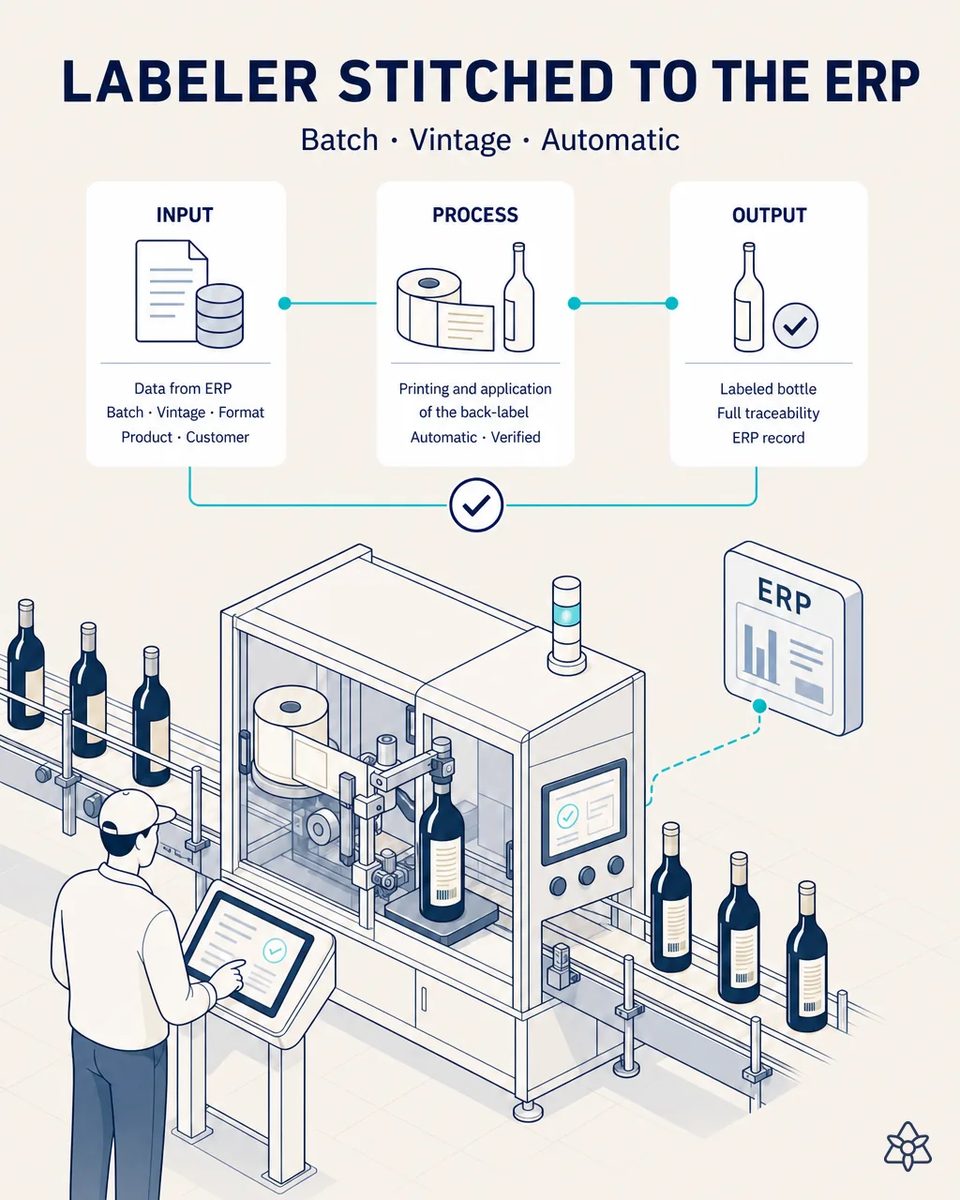
One keystroke on the labeler can compromise a whole batch.
one wrong keystroke on vintage or back-label numbering compromises an entire batch in front of the regulatory council — and it only surfaces weeks later.
- The labeler prints batch, vintage and the numbered back-label assigned by the regulatory council. On a busy day it runs several orders, each with its own data. It is a modern machine with an API — and it is isolated from the ERP.
- So at every bottling order someone types on its panel what the ERP already knows: batch, vintage, variety, the back-label range for that order.
- One wrong digit on the vintage or on the back-label numbering is enough to compromise the whole batch in front of the regulatory council. Back-label numbers are controlled one by one; a skipped or repeated range has to be explained.
- And the error does not show on the line: it surfaces weeks later, when the cases are already with the distributor and the only fix is a withdrawal. The cost of that withdrawal is far above the cost of the bottling run itself.
Connect stitches two modern systems through their APIs, replacing neither.
Connect stitches two modern systems together via API. When the ERP flags the start of a bottling order, it automatically publishes batch, vintage, variety and numbering to the labeler.
Nothing on the line changes for the operator except that the fields arrive already filled in. The error that used to depend on a tired finger at the end of a long bottling run simply stops being possible, because nobody types the vintage any more. And the operator gains the minutes that used to go into copying fields at every order and format change.
The isolated labeler versus the labeler fed by the ERP
| Aspect | Today | With iLEAN Connect |
|---|---|---|
| Vintage and batch on the label | Typed at every order | Published by the ERP |
| Back-label numbering | Entered by hand | Assigned from the active order |
| Human-origin labeling errors | Several a year | Zero |
| When an error shows up | Weeks later, at the distributor | It cannot happen at the source |
| Non-conformity risk with the council | Permanent | Drastically reduced |
| Labeler and ERP | — | Both kept, neither replaced |
several typing errors on vintage/batch per year → zero human-origin labeling error.
Impact estimate per bottling order — to be validated with your numbers.
The block below is an estimate to be validated against your plant's actual data. We put it forward so the committee has an order of magnitude; we refine it during the assessment.
- Fast payback, estimated 3-6 months.
- Several vintage and batch typing errors a year drop to zero human-origin labeling errors.
- Drastic reduction in the risk of a non-conformity before the regulatory council, and of a withdrawal from the distributor. That risk is the real reason this case pays back so fast.
- And the operator stops copying by hand what the ERP already has, at every order and every format change. With several formats bottled in the same week, that adds up quickly.
fast payback, 3-6 months; drastic reduction in the risk of non-conformity before the regulatory council. Estimate to validate.
And the fair question from the production manager
"Wouldn't a full integration project with the labeler vendor be cleaner?" — it would, the day it reaches the top of the list, and that day rarely comes. This stitching uses the API the labeler already has and needs no shutdown window. Mapping ERP fields to the labeler's is an anchored task, where the best models drop below 1.5% error [1], and the first orders are checked side by side before going live.
[1] OpenAI paper "Why Language Models Hallucinate", 2025 — on the reliability of AI in anchored tasks.
What people ask about connecting the labeler to the ERP
Which data travels to the labeler?
Batch, vintage, variety and the back-label numbering, all taken from the bottling order the ERP marks as active. Nothing is typed on the machine's panel. If the order changes mid-run, the new data is published to the labeler with the change.
What if the labeler has no API?
Most recent labelers have one. If yours does not, we look at the alternatives during the compatibility check before promising anything. The check takes a short call with your line technician and the labeler's documentation.
Does the bottling line need to stop for the integration?
No. The connection is prepared alongside and switched on between orders, without a dedicated shutdown and without touching the line's mechanics. The first orders run in parallel with the current procedure so the team can compare results.
How are the regulator's back-label ranges kept consistent?
The numbering is assigned from the order, so a range cannot be reused or skipped because of a typing slip, and every number used is traceable to its batch. That reconciliation is what the regulatory council asks for when it audits back-label usage.
Does this replace the camera check on the bottle?
No, they complement each other. This case removes the typing error at the source; the Edge camera confirms what was actually printed on each bottle. Together they are two of the four rings of the flagship case.
More cases from this series
- The capital pain of any winery, solved in 4 rings4 coordinated rings (ERP, labeler, Edge, evidence pack) stop the line the moment a batch or vintage…
- The audit dossier, ready before the auditor shows upEvery critical change automatically generates a photo, log and sign-off. Agents organizes the evidence…
- Nothing enters the ERP without your confirmationNothing iLEAN captures reaches the ERP without a human confirming it with 2 taps on an industrial tablet.
- The fermentation curve, digitized without touching the equipmentAn external camera digitizes the fermentation temperature curve from a legacy control panel, without…
- From the grower's text message to action, in secondsiLEAN reads associated growers' alerts in silent copy and reschedules harvest before the trailer even…
- The grower's delivery note, from paper to ERP in secondsPhotograph the grower's weighbridge note and it goes straight to the ERP after one confirmation tap.…
Tell us how vintage and batch reach your labeler today.
We work on your plant's real data, not ours. Assessment with no commitment.
Request estimated ROI within 48h ‹ See all cases of wineries See food industry