The audit dossier, ready before the auditor shows up
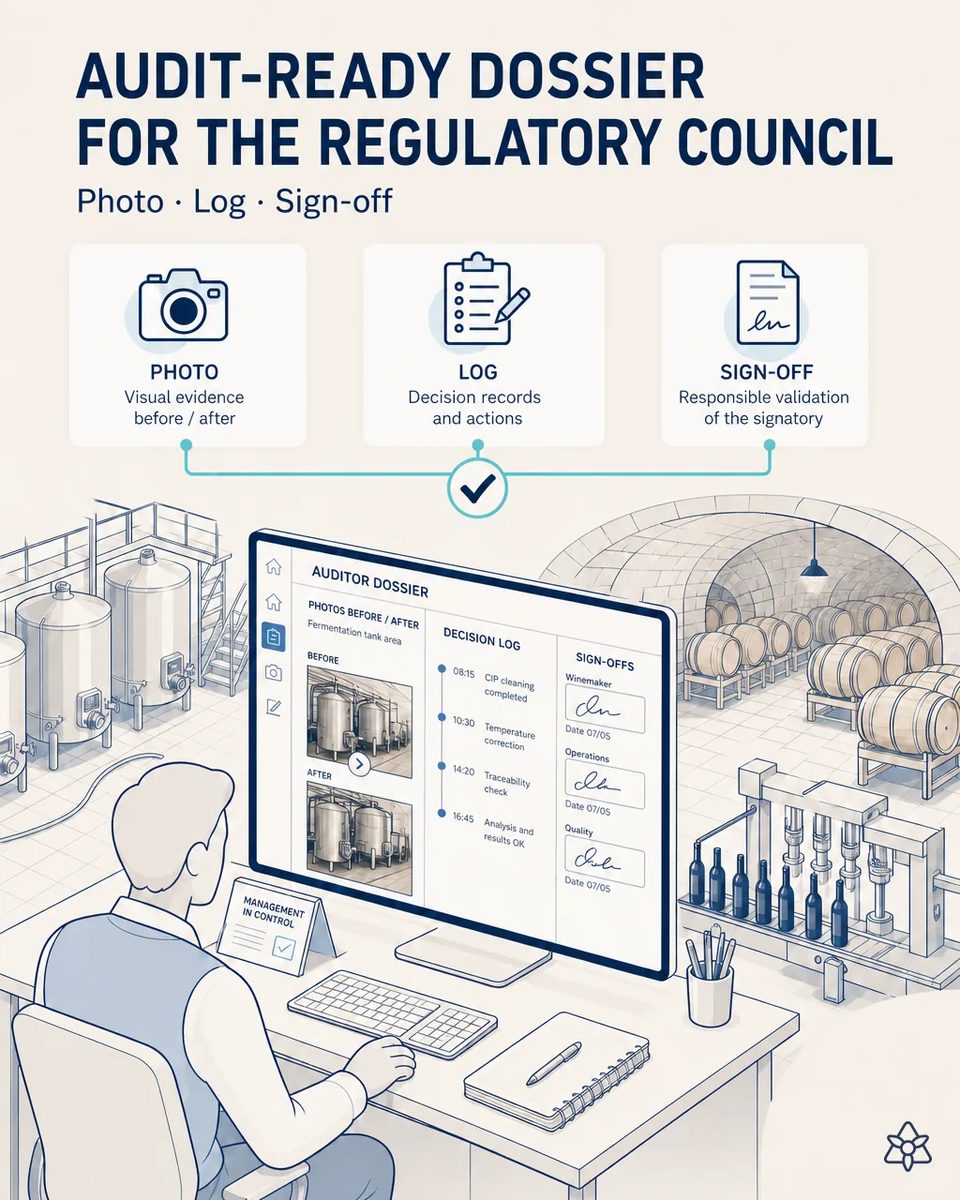
The day the auditor arrives, someone today spends days rebuilding traceability. With Edge plus Agents, every critical change automatically generates its own dossier: photo, log, sign-off.
Before every audit, someone rebuilds the campaign from scratch.
regulatory council and export-certification audits require evidence that today gets rebuilt manually, risking observations for documentation gaps.
- Regulatory council inspections and export certification audits ask for evidence: which grapes went into which tank, who cleaned it, when it was racked, which batch was bottled with which back-labels. Export certifications add their own requirements on top, often for the same batches.
- That evidence exists, but it is scattered across paper logs, spreadsheets, the ERP and people's memory, and nobody owns the whole picture. Each department keeps its own part in its own format.
- So the days before the auditor arrives are spent rebuilding it, and whatever nobody wrote down at the time stays as a gap.
- Those gaps are where observations for incomplete documentation come from, and they put origin certification and export contracts at risk.
Edge captures each critical change; Agents files it by certification standard.
Edge (captures photo plus data per change) plus Agents (organizes by certification standard, generates a structured dossier per period/campaign). Zero manual post-hoc work.
Evidence written at the moment of the change cannot have the gaps of evidence rebuilt weeks later. The audit stops being a project and becomes a download of what already exists, filtered for whoever is asking. And because every record carries its photo and its signature, the question of who did what and when is answered by the dossier itself, not by the people who happened to be there.
Rebuilt traceability versus the dossier kept live
| Aspect | Today | With iLEAN Agents |
|---|---|---|
| Preparing a council inspection | Days of rebuilding | None, the dossier exists |
| Evidence per critical change | A note, if someone wrote it | Photo, log and sign-off |
| Origin and export standards at once | Separate folders for each | Same evidence, filed per standard |
| Documentation gaps at the winery | Found by the auditor | Flagged when the change happens |
| Organized by | Whoever prepares the audit | Period and campaign, automatically |
| Risk of an observation | Present in every audit | Eliminated for incomplete documentation |
days of pre-audit rebuilding → zero; risk of observation for incomplete documentation → eliminated.
Impact estimate per audit — to be validated with your inspection calendar.
The block below is an estimate to be validated against your plant's actual data. We put it forward so the committee has an order of magnitude; we refine it during the assessment.
- Estimated payback 6-12 months, depending on how often you are audited. Wineries with several export certifications usually sit at the shorter end.
- Days of pre-audit rebuilding reduced to zero, for the council and for every export certification. That time comes back to the quality team every single year. The people who used to rebuild the campaign go back to their own work.
- The risk of an observation for incomplete documentation is eliminated. Each observation avoided is also a follow-up visit avoided.
- And continuous protection of origin certification and export contracts, which are worth far more than the audit itself. An importer that asks for traceability gets it the same day.
continuous protection of origin certification and export contracts. Estimated payback of 6-12 months depending on audit frequency. Estimate to validate.
And the fair question from the production manager
"Isn't this just a document repository with a new name?" — a repository keeps what someone decides to upload, after the fact, with the same gaps. Here each change generates its own record when it happens, and Agents only classifies it: matching a record to the clause of a standard is an anchored task, where the best models drop below 1.5% error [1], and the winemaker signs every entry.
[1] OpenAI paper "Why Language Models Hallucinate", 2025 — on the reliability of AI in anchored tasks.
What people ask about the regulatory council dossier
What counts as a critical change at the winery?
Variety or range changes in a tank or line, cleanings, rackings, blends and the start of each bottling order. The list is agreed with your quality team before anything is captured. It can be extended later if an auditor asks for something new.
Can the same evidence serve the council and an export certification?
Yes. The evidence is captured once and filed against each standard, so nothing is duplicated for different auditors and nothing contradicts itself. That matters when the council and an export certifier ask for the same campaign in the same season.
Does the auditor get access to our ERP?
No. They receive a dossier scoped to the period and campaign under review, and nothing else from the winery's systems. The dossier can be exported or shared as a read-only view.
What happens if a change has no evidence?
The gap is flagged the day it happens, while it can still be fixed by whoever was there, not the day the auditor finds it. A missing sign-off on a cleaning, for instance, is visible the same afternoon.
Do we need every other case deployed first?
No. It starts with the Edge captures available and grows as more pieces are added. Each one fills its own part of the dossier. The tank cleaning case and the labeler integration are usually the first sources.
More cases from this series
- The capital pain of any winery, solved in 4 rings4 coordinated rings (ERP, labeler, Edge, evidence pack) stop the line the moment a batch or vintage…
- Nothing enters the ERP without your confirmationNothing iLEAN captures reaches the ERP without a human confirming it with 2 taps on an industrial tablet.
- The fermentation curve, digitized without touching the equipmentAn external camera digitizes the fermentation temperature curve from a legacy control panel, without…
- From the grower's text message to action, in secondsiLEAN reads associated growers' alerts in silent copy and reschedules harvest before the trailer even…
- The grower's delivery note, from paper to ERP in secondsPhotograph the grower's weighbridge note and it goes straight to the ERP after one confirmation tap.…
- The harvest log, digitized at zero latencyPhotograph the harvest intake log with a phone and the batch is already live in the central system.…
Tell us how many days your team spends preparing each regulatory council inspection.
We work on your plant's real data, not ours. Assessment with no commitment.
Request estimated ROI within 48h ‹ See all cases of wineries See food industry