Nothing enters the ERP without your confirmation
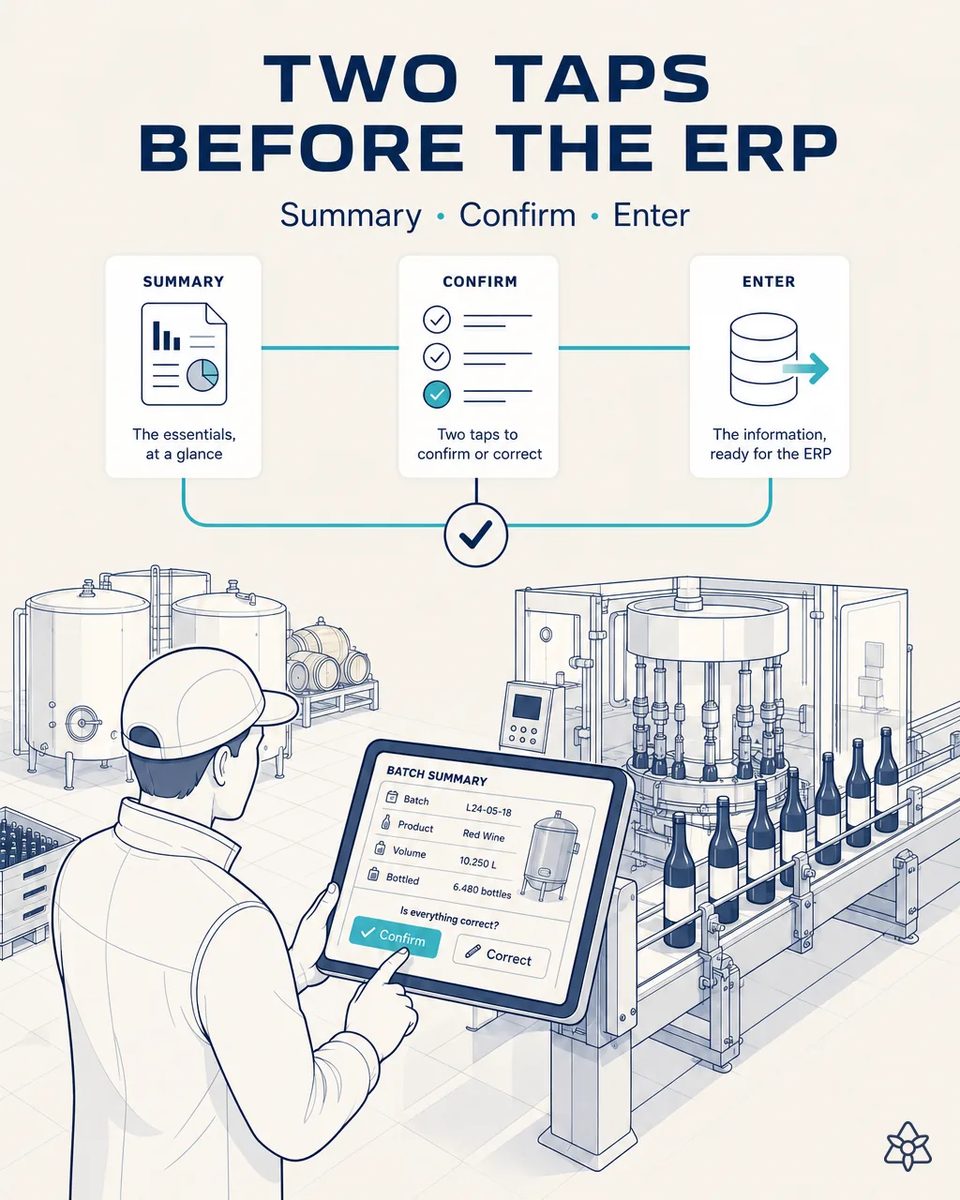
What sets iLEAN apart from an autonomous agent is that nothing it captures enters the central system without a human seeing it first. On the bottling line, that means a tablet with two-tap validation.
The fear that blocks the whole project is not technical.
The fear that AI will enter data on its own and contaminate the ERP master is the main cultural blocker, especially when the data affects batch, vintage or denomination of origin.
- The main objection in a winery is not whether AI can read a log. It is the fear that it will write into the ERP on its own and contaminate the master data everyone relies on.
- That fear is reasonable when the data is batch, vintage or denomination of origin: one wrong field can end up printed on thousands of back-labels.
- The usual outcome is the worst of both worlds: either unvalidated data enters, or nothing is captured at all out of distrust and the paper keeps winning.
- And when the regulatory council asks who entered a figure and on what basis, "the system" is not an acceptable answer. The answer has to be a name, a time and what that person saw.
Connect with early human verification — a two-second summary and two taps.
Connect early human-verification mode. Every capture (photo, voice, parsed email) reaches an industrial tablet as a two-second visual summary. The supervisor confirms with one tap, or corrects with another.
This piece earns nothing on its own, and it is the one that lets everything else be signed off. No winery with origin requirements approves a system that writes batch and vintage data without a named person behind every single entry. With it, the cellar team stops seeing AI as something that writes behind their backs and starts seeing it as something that prepares their work for a signature.
Unchecked capture versus capture confirmed on the bottling line
| Aspect | Today | With iLEAN |
|---|---|---|
| Data entering the ERP | Typed late, or entered unchecked | Confirmed by a person in seconds |
| Who answers for each figure | Unclear | The supervisor who confirmed it |
| A wrong vintage or batch | Found on the back-label | Corrected on the tablet |
| Captures from photo, voice and email | Each one handled differently | One summary format, one gesture |
| The ERP master | At risk | Clean |
| The team's trust in AI | Low, so nothing gets captured | Built on control, not on promises |
unvalidated data contaminating the ERP, or data not captured out of distrust → data captured and validated with seconds of latency, clean master data.
Why this piece has no payback of its own.
The block below is an estimate to be validated against your plant's actual data. We put it forward so the committee has an order of magnitude; we refine it during the assessment.
- No standalone payback · enabling piece: we do not put a number on it, because its value is letting the other eleven cases be approved.
- In a winery with denomination-of-origin traceability requirements, no other piece of the matrix gets signed off without it.
- It turns unvalidated data, or data never captured out of distrust, into data captured and validated with seconds of latency.
- And it keeps the ERP master clean, which is what every later audit, every blend decision and every back-label depend on.
enabling piece — without it, no other piece of the matrix gets signed off in a winery with denomination-of-origin traceability requirements. Strategic value, not directly monetizable.
And the fair question from the production manager
"If a person confirms everything anyway, what is the AI doing?" — the work it removes is assembling, not deciding. Extracting the fields is an anchored task, where the best models drop below 1.5% error [1]; the supervisor only looks at a summary that is already built and confirms or corrects it. Every correction is stored with its author, so the system learns exactly where it got it wrong.
[1] OpenAI paper "Why Language Models Hallucinate", 2025 — on the reliability of AI in anchored tasks.
What people ask about confirming captures on the tablet
How long does each confirmation take at the winery?
A couple of seconds. The summary arrives already assembled, and the supervisor confirms with one tap or corrects with another, without leaving the bottling line.
Can it be turned off so data flows straight in?
No. It is part of the architecture, not a setting. Nothing iLEAN captures crosses into the ERP without a person seeing it first, whatever the source. That is a design decision we do not offer to relax, because it is what makes the rest of the matrix acceptable to a regulatory council.
What is stored when someone confirms?
The summary shown, who confirmed it, when, and any correction made. That is the trail the regulatory council or an importer can ask for, years later if needed. It also shows how often each type of capture is corrected, which tells you where the extraction needs work.
Does the tablet survive the bottling hall?
It is an industrial tablet, chosen for humidity, splashes of wine and cleaning products, and mounted where the supervisor already works rather than in an office. If the line already has a supervisor terminal, the same screen can be used instead.
Does it only cover bottling data?
No. Photos from the scale, dictations from the barrel cellar and parsed grower messages reach the same tablet with the same two-tap gesture, so there is only one habit to learn. That uniformity is what makes the gesture stick after the first week.
More cases from this series
- The capital pain of any winery, solved in 4 rings4 coordinated rings (ERP, labeler, Edge, evidence pack) stop the line the moment a batch or vintage…
- The audit dossier, ready before the auditor shows upEvery critical change automatically generates a photo, log and sign-off. Agents organizes the evidence…
- The fermentation curve, digitized without touching the equipmentAn external camera digitizes the fermentation temperature curve from a legacy control panel, without…
- From the grower's text message to action, in secondsiLEAN reads associated growers' alerts in silent copy and reschedules harvest before the trailer even…
- The grower's delivery note, from paper to ERP in secondsPhotograph the grower's weighbridge note and it goes straight to the ERP after one confirmation tap.…
- The harvest log, digitized at zero latencyPhotograph the harvest intake log with a phone and the batch is already live in the central system.…
Tell us who answers today for the batch and vintage data in your ERP.
We work on your plant's real data, not ours. Assessment with no commitment.
Request estimated ROI within 48h ‹ See all cases of wineries See food industry